Here: Where I/We Are.

Post leaving my daughter in her college dorm, the cats and I hole up and read Here by Richard McGuire. A sample of this amazing book is:

Here: the cats and I wake, in the morning that’s yet dark, to the rain pattering through the open windows on the stones and leaves around our house. One more week of August remains, and the swimming prognosis is lousy.

Around me: backroads in places still barely passable, bridges out, the riverbanks strewn with human junk — pieces of the ripped-apart motel, wires wound around wood and twisted clothing and two cars and so much plastic. I started this summer, July 1, driving to an Independence Day celebration, cloudy with smoke from the Canadian wildfires, noting that day as my own marker: the smoke has become part of our life. We accepted it, kept on with our lives, as we had — and have — to do.

A summer of the strangest things. The world’s great problems, my own petty woes. In all this, we filled our days with working and drinking coffee, hiking and playing cards and eating tacos and talking, so much talking. Gravy.

On this rainy Friday morning, a Raymond Carver poem:

“Gravy”

No other word will do. For that’s what it was. Gravy.
Gravy, these past ten years.
Alive, sober, working, loving and
being loved by a good woman. Eleven years
ago he was told he had six months to live
at the rate he was going. And he was going
nowhere but down. So he changed his ways
somehow. He quit drinking! And the rest?
After that it was all gravy, every minute
of it, up to and including when he was told about,
well, some things that were breaking down and
building up inside his head. “Don’t weep for me,”
he said to his friends. “I’m a lucky man.
I’ve had ten years longer than I or anyone
expected. Pure gravy. And don’t forget it.”

Vermont’s Foundation: Freedom and Bread

A possum circles in the highway, no doubt startled by my headlights. It’s past midnight, and no soul’s around. I drift into the other lane and let the possum do what it wants to do.

I’m listening to the radio playing the Rolling Stones and thinking of a David Budbill poem I read that afternoon, about Vermont’s colonists and centuries of following folks, seeking freedom and bread. The possum is definitely seeking her or his own version of possum bread, but freedom…? The question looms large. I haven’t far to drive this night, but the words stick with me — bread and freedom — surely two of the main drivers in my life, likely in yours, too.

The peepers are lusty along the Lamoille. The air reeks of wet mud, of that sweet fecundity of spring.

At home again, we lie down with the windows open. I hear the teenagers talking and laughing before they slip into the thickness of young sleep. To ward off the night’s gloom and cold, I’d started a small fire in the wood stove. Through the open window now drifts smoke. In these May days — both hot and chilly — I’ve moved my wood piles, again, as I tend to do, raking the bark and broken bits to dry in the sun. Foolish, perhaps, to keep a fire smoldering while the bedroom windows are open. Or maybe simply a kind of freedom.

What Is June Anyway?

After three weeks of hot weather and drought,

           we’ve had a week of cold and rain,

just the way it ought to be here in the north,

            in June, a fire going in the woodstove

all day long, so you can go outside in the cold

            and rain anytime and smell

the wood smoke in the air.

This is the way I love it. This is why

           I came here almost

fifty years ago. What is June anyway

          without cold and rain

and a fire going in the stove all day?

— David Budbill

History, Yellow Wallpaper, Gas Station.

On my way home, I stop to fuel my Subaru. A light snow falls, icy around the edges, barely sharp enough to tease my cheeks as I stand looking up. It’s after dark, and the people are coming and going in the convenience store with cups of coffee and bottles of wine and white paper cartons of fried food. The river curves behind the store and the attached garage, silently bending through town, water running beneath the frozen surface.

The evening before, my daughter asked me about The Yellow Wallpaper, the novella she’s reading for class. I remembered the free copy I picked up in high school, dirty and water-stained — a copy I probably snagged from my high school floor. This is the season of freeze and thaw, freeze and thaw, the long slow slog towards spring. In the late afternoons, skiing, the sunlight pushes through the forest. Some days, cold. Some days, warm. So it goes.

Life is a verb, not a noun.

— Charlotte Perkins Gilman

Midwinter.

On a Wednesday washed out of color, this mid-January has the taste of February, wet, the wind wicking up wildly then dropping down again to the sodden snow. January is the season of work, of leaning in hard to a task at hand, for pleasure, for wage, for cleanliness, for the way work sweeps us out, makes something new. In its own way, winter’s short, pinwheeling along to spring, to the radiance of summer.

Here’s a perfect poem for today.

To go in the dark with a light is to know the light.

To know the dark, go dark. Go without sight,

and find that the dark, too, blooms and sings,

and is traveled by dark feet and dark wings.

— Wendell Berry

The Shape of Things.

In the early 1600s when Samuel de Champlain was bunking around the fire with people who lived on the shores of an enormous and beautiful lake, Champlain remarked in his journal how surprised he was that these strangers discussed their dreams every morning as if their dreams were as real as the waking world. I’ve been thinking about Champlain’s observance and how easily we can narrow our vision, completely discounting or ignoring pieces of our past and present.

A blog reader who sometimes mails me terrific books sent me Jane Alison’s Meander, Spiral, Explode: Design and Pattern in Narrative. As I’m finishing up a draft of my novel, the book has made me look harder at the novel’s structure. As a writer, I can’t help but look at my own tangled story — and those around me — and the way plot lines and patterns, how chance and opportunity, blend and shape our lives.

For Ray Carver fans (and who isn’t a fan, really? if not, you might want to be!), there’s a terrific essay on one of my favorite stories, “Where I’m Calling From.”

So often fictions that experiment formally do so at the expense of feeling. They toy on surfaces or are purely cerebral affairs, don’t explore human complexities. But the mostly unconventional narratives I’ve been discussing have dealt powerfully with core human matters.

— Jane Alison

Winter.

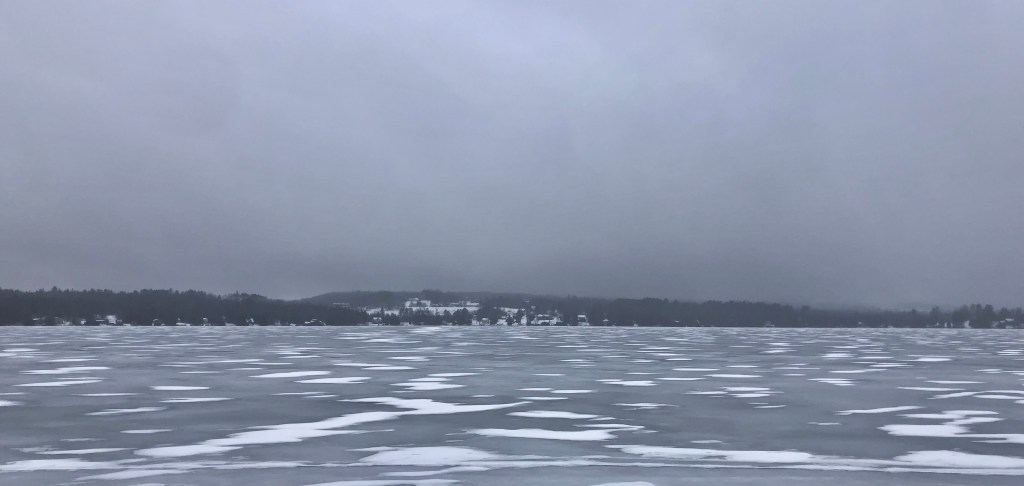
This is: winter, not-winter, definitely-winter. Scattered, my thoughts fragmented, I wander down to the lake where the ice has set in now. The world is utterly still there save for a scattering of snowfall. The birds are silenced, and even the breeze has vanished. The profoundness of deep midwinter dwarfs the human world. I lean into it, letting the cold eat up my fury. On my way back, a squirrel runs across the road, calling back to me…

Sylvia Plath writes:

Winter is for women —

The woman still at her knitting,

At the cradle of Spanish walnut,

Her body a bulb in the cold and too dull to think…