Hardwick Postcard #8: Talk, Talk

There’s not a bland way to write this: gossip is part of the human condition. Gossip in a small town? Can be funny. Or scorching.

Arriving at a library meeting, someone walks in and says, I’ve been to the post office. I’ve got gossip.

I come out from the stacks where I’ve been shelving books and say, Do tell….

I spend a lot of time at the post office, and I frequently have the odd sense the post office folks know me intimately. While my email inbox may have more details, a whole landscape of my life channels through that slender box. Like gossip, sometimes the mail’s good, sometimes bad, and sometimes rather dull.

From the post office gossip unravels laughter, but then much seriousness, too. The story is about one person, one family, but really about our community. In a multifaceted way, it’s a variation of the contemporary disfunction of our greater society, about emptiness and loneliness, and the natural lust to fill those caverns in our souls, and how badly awry human nature can go.

Then we stop talking for a moment. We just stop.

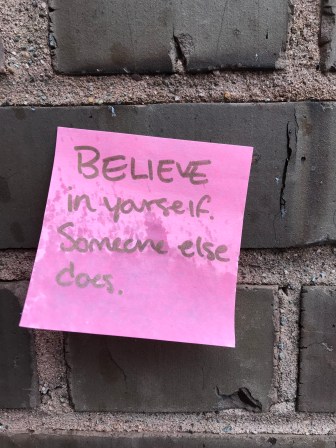
Later, my daughter sends me a photo of a post-it she found on a classroom building at Johnson State. She snapped the photo and left the note for another passerby to read.

Reading fiction not only develops our imagination and creativity, it gives us the skills to be alone. It gives us the ability to feel empathy for people we’ve never met, living lives we couldn’t possibly experience for ourselves, because the book puts us inside the character’s skin.

– Ann Patchett
IMG_1900.jpg


The Constellations in Motion

In an acceptance form letter for an essay, an editor suggests reading that slim college handbook, Strunk and White. For a mini-refresher lesson, I click on the link, since it’s been many years since I opened my copy. (Do I still even possess a copy? I’m a little worried I may have jettisoned that in my move…)

Between useful directions like Enclose parenthetic expressions between commas, I read Writers will often find themselves steering by stars that are disturbingly in motion.

Last night, my daughter and I stood outside in the cold, talking with a neighbor, looking up at the small white lights my daughters strung over our barn. The neighbor tells me about the man who last painted the barn before I bought this property, how painstakingly he prepped the clapboards and sealed each nailhole.

I lean against the cornerboard, thinking of all that hard work. Clouds have blown in, and the moon is obscured. Rain and more rain predicted for today.

Inside our house again, my daughter carries the cats up to her bed.

Fortunately, the act of composition, or creation, disciplines the mind; writing is one way to go about thinking, and the practice and habit of writing not only drain the mind but supply it, too.

IMG_0505.jpg

Blooming

My neighbor planted sunflowers way late – so late all I did was nod at her belief those seeds would bloom. Now the sunflowers are humbling me.

Halloween and these beauties are not even marked by frost. I’ve been humbled by worse things than a sunflower though…..

The journey is difficult, immense. We will travel as far as we can, but we cannot in one lifetime see all that we would like to see or to learn all that we hunger to know.

– Loren Eiseley

IMG_0208

Flux

When I was a very young girl – maybe four – and lived in New Mexico, my parents visited friends in Ames, Iowa. In the murky way of memory, mostly what I remember is the house we stayed in had hardwood floors, and Iowa seemed to possess an infinite sprawl of gorgeous lawn. The friends had kids of their own, and their father sprayed us on the lawn one afternoon, raising and lowering the spray while we pretended we were flowers opening our blossoms in the morning light, and folding closed again with twilight. For a desert child, the abundance of water and the sweet scent of cut grass was magical.

Today, our front door will be swapped out with a new, tighter door to keep the cold out, not if but when the bitter cold arrives.

My daughters had lived in our former house all their lives – a combined total of 30 years – but already in these months, this house has changed its shape with us: the scent of freshly coated floors wafted through open windows, paintings of flowers hammered on plaster walls, kittens shedding their fuzzy hair over the kitchen floor.

The house I visited as a little girl held more than its portion of misery, but from a knee-high vantage, there was sunlight and laughter, too.

Your baby grows a tooth, then two,
and four, and five, then she wants some meat
directly from the bone. It’s all

over: she’ll learn some words, she’ll fall
in love with cretins, dolts, a sweet
talker on his way to jail. And you,

your wife, get old, flyblown, and rue
nothing. You did, you loved, your feet
are sore. It’s dusk. Your daughter’s tall.

A Little Tooth by Thomas Lux

IMG_0132

Counting

My teenager, working in a nursing home, relays nursing lore that bad news comes in threes. Is this true? she asks. I love that she thinks I may have this answer.

It’s not true. Bad news knows no numerical limits.

But braided in with all that bad news are also other things, too – whether confirmation of a longed-for pregnancy or a sunny day’s stillness, a warm bit of reprieve.

You might as well answer the door, my child,
the truth is furiously knocking.

– Lucille Clifton

FullSizeRender.jpg

“This Infuriatingly Intricate Web”

A well-known local author mentioned at the most recent of his readings I attended that he’s writing a book about koans – a book I can’t wait to read, because isn’t life just a series of unfolding koans? Have I ever actually solved one? Some days, it seems to me, not likely.

My daughter spied a V of geese winging south yesterday, the first we’ve seen of this season, but one among countless Vs we’ve watched since she was a tiny girl, her arm crooked around my neck. Fall is familiar, graciously beautiful, infinitely sad, followed by the brilliant beauty of sparse winter: the same Vermont story, year after year, and yet I’m always surprised by the September mornings’ cool mist, the cucumber vines shriveling, all done with this life.

Cooking dinner yesterday, I read an article in the New Yorker about that terrible disease, cancer. Innocuously enough, the article begins with mollusks in Lake Michigan, journeys through seed and soil, and ends with a koan:

… as ambitious cancer researchers study soil as well as seed, one sees the beginnings of a new approach. It would return us to the true meaning of “holistic”: to take the body, the organism, its anatomy, its physiology—this infuriatingly intricate web—as a whole. Such an approach would help us understand the phenomenon in all its vexing diversity; it would help us understand when you have cancer and when cancer has you. It would encourage doctors to ask not just what you have but what you are.

– Siddhartha Mukherjee

FullSizeRender