Gathering Kindling

My daughters and I watch New York Times clips of Dr. Ford, my 13-year-old’s eyes wide, her hand paused over her algebra homework at the kitchen table. My 19-year-old and I talk and talk, and then she replays Kavanaugh’s testimony. The 13-year-old says, in wonder, Someone is lying. She ponders this, then says, Why would someone lie?

Tomato vine by cauliflower plant, I empty the garden, exposing black earth, finishing the final coat of white paint on a few patches of clapboards, eyeing the porch windows and gauging when I’ll plastic those for the winter’s duration.

In the dark this morning, my daughter and I talk briefly in her room, rain beating on the roof. Cold October rain illuminates foliage colors, tugs out the very best. I mention I’m going to paint the dining room a sunflower color this weekend, the window trim Santa Fe blue. Cool beans, she says.

What concerns me even more, though, is the loss of those values the (communal) fire precipitates and reinforces… How will the affirmation by others of one’s own necessity in the world be validated? What will be the opportunities for profound courtesy and for ceremony, of which there is such a dearth in the modern world?

We can lose the communal hearth and survive, but survival without the values of the hearth… seems a brutish prospect, a retreat into intolerance.

From Barry Lopez in Hearth: A Global Conversation on Community, Identity, and Place
IMG_3523.jpg

Friday Night, The Three of Us

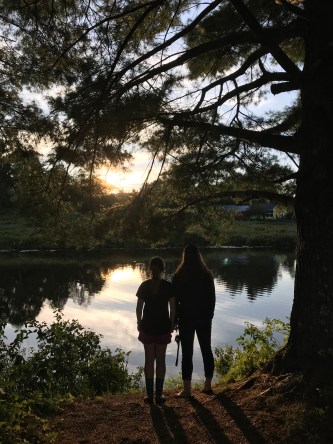
Sitting on the back deck after dinner last night, in jeans and long-sleeved shirts, the girls asked if we were going swimming.

Well, why not?

The girls sprawled on the grassy bank while I swam down the pond, from the shadows into the sunlight, the water warm, the surface rippling with feeding fish.

All summer long, we swam in this cupped bowl in the earth, our bodies both in all that dragonfly-filled sky and the water with muck and weed, minnow and turtles. A curled oak leaf floated on the surface. I floated on my back, staring up at the fading blue sky, a single cloud laced pinkly at the edges with sunset.

Later, knitting scrap yarn into a scarf, I shivered. Hours later, still cold, a cat crawled with me until the blankets while I read with a flashlight.

During the siege of Leningrad:

The heat in the (public) library gave out early, and the plumbing eventually froze and burst. In late January, the building finally lost its electricity. The librarians still searched the shadowed stacks with lanterns, and, when they ran out of oil, with burning pieces of wood. They still served patrons and sought out the answers to practical questions posed by the city government: alternative methods of making matches or candles, forgotten sources of edible yeast. As the building grew colder and more battle-scarred, they closed the reading rooms one by one. Finally, patrons and librarians all huddled in the director’s office, where there was still a kerosene map and a buzhuika stove.

— M. T. Anderson, Symphony for the City of the Dead: Dmitri Shostakovich and the Siege of Leningrad

IMG_0391

Hardwick, Vermont

Cat’s Heart

My daughter’s cat lies on the gray-painted floor at the top of the stairs, just outside her room, looking in. She’s away with friends in Maine. Over email, her sister and I see pictures of her swimming in a lake and the ocean — all that great blue and green wilderness around her 13-year-old self.

Her cat, of course, knows nothing of this, but simply lies at the threshold to her door, waiting for her return.

This morning, the rain’s returned, a great downpour. In the garden, yesterday, I pulled out handfuls of dead lily leaves, the broken and blackened remainders of lupine stems. Middle of August, and school and soccer start soon. The evenings come earlier, and the Black-eyed Susans burst brightly along the weedy roadsides.

Things do not change; we change.

— Thoreau

IMG_3025

Ides of August, Buying Gas

Stopping to buy gas late in the evening, I walk into D&L and immediately stop: the familiar clerk is mopping the floor. It’s so muggy, even long past dark, that he holds the back of his wrist to his sweating forehead.

Go ahead, he tells me. Walk on it. And he crosses the wet tile floor himself.

We talk a little about this hot, sultry summer, now winding down. Already, I’m waking in the dark, turning on the light over the kitchen sink to feed the mewling cats.

In this liquor and gas station on the edge of town, the clerks are sharp-eyed, scanning the crowd, but this evening, it’s just him and I. He leans on his mop handle, nearly finished with his day’s shift, nearly closing time.

I mention that six months from now, in lightless January, I’m going to be complaining to him about the subzero cold.

He laughs out loud. Oh, boy, I can’t wait.

Outside, the gas station lights are an illuminated bubble in the surrounding darkness. Most people sleep at night in this little town. I’m sure there’s mothers and fathers awake with crying babies, the heartsick or troubled who wander their dim rooms, drug users or simply those who are sleepless. The crickets whirr their song, this still night, with not even any passing-through traffic. August: season of t-shirts and sandals, and, this morning, rain sweetly falling.

The Chinese junk
not stopping
moving on through the mist

— Buson

IMG_7078

A Sweeter Version of Macbeth’s Day to Day

On our back deck yesterday, my 19-year-old and I talk about the crickets, how their songs are lengthening and yet quieting at the same time, their strength slowly leaking away with summer.

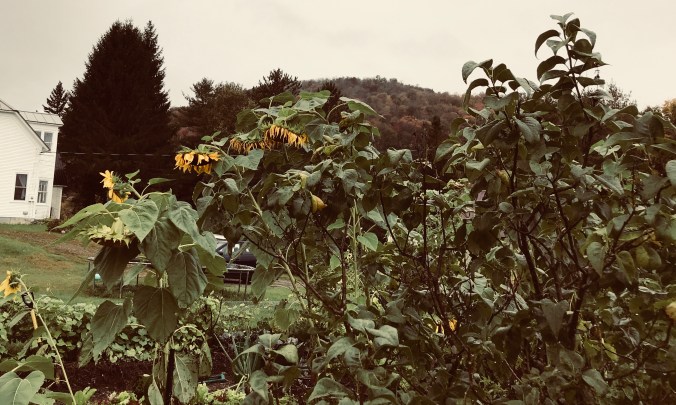
The sunflowers are high in our garden.

This summer has been one of the daughters coming and going, and myself mostly staying put. The younger daughter’s suitcase is packed again, as she happily heads to Maine with friends. The older daughter has been working mixed-up nursing home shifts — most recently the graveyard hours. Her bags are packed, too, as she anticipates returning to college.

We’re busy, sure, but not that busy. In the midst of all this, we cook dinner together when we’re all home, and in these long dusky evenings, we go for walks.

Last night, we were in the town’s community gardens, taking photographs in the pink-leaved echinacea. I remembered that very first year I was a mother, and I kept trying to grab some stability — Oh, this is what being a mother is like. This is how our life will go. But my baby kept changing. She slept, or she didn’t sleep. She crawled, and then she ran. She babbled. Sometimes, she cried fiercely. She was radiant and fierce and deeply loving — a babyhood version of who she is as a young woman.

But she grew and changed all the time, which is — and I really don’t know why this came as such a shock to me — the essence of this earthly life. But the deep down elements of our lives haven’t altered: her eyes are the same curious, merry upside-down crescent moons I first saw on the night she was born.

All this, I suppose, means that I intend to swim in the nearby pond as long as possible. The water is warm yet, and the banks are brilliant with goldenrod.

I had to learn that I was a better mother and wife when I was working than when I was not.

— Madeline L’Engle, Walking On Water

IMG_6927.jpg

Photo by Molly S.

Snippet

For dinner last night, my daughter fried beef for enchiladas. From the garden, I brought in a basket and began washing vegetables. Here, throw in slender leeks, sweet red peppers, onions with their fat greens. I filled a salad bowl with mesclun, radishes, sun gold tomatoes.

Do people talk about the weather as much as Vermonters do? What a summer, we say.

Yesterday: muggy heat, steady rain, a perfect evening. We swam in the nearby pond again, a little chillier after the rain. Then we gathered up our towels and went home.

More from that stack of donated books:

Our story is never written in isolation. We do not act in a one-man play. We can do nothing that does not affect other people, no matter how loudly we say, “It’s my own business.

— Madeleine L’Engle, Walking on Water: Reflections on Faith and Art

IMG_2658.jpg

Girls camping, Lake Champlain: water, rocks, sky, and s’mores