The Lion, and The Lion Again

These days, I’m always writing about the weather and here’s why — with a vengeance, winter hurls at us.

In a select board meeting last night, someone paused and said, The wind. Soon afterward, the lights snapped out. In the utter dark, I stood talking, bodiless, about agenda. The town clerk appeared with two battery lanterns, her face flickering with shadows.

The 13-year-olds pulled me into the town vault where the clerk had shown them a book of vital records, each certificate in a plastic sleeve. The girls had gone wild about the death certificates, reading aloud cause of death: thrombosis, carcinoma, asphyxiation from car exhaust in a closed garage.

I read about a woman who had shot herself in the chest, in the 1950s, down the road from where I once lived. In my mind, I repeated her name and age.

The town clerk showed me handwritten ledgers from when the schoolhouse was built in 1914. Nails, $6.50.

At home, the power was out, too, and I finished knitting a baby sweater by candlelight. Before we went to bed, we looked out the second floor bedroom windows at the dark valley, a snowplow carrying its own light along Route 15. I reminded the girls of reading about wartime, in so many other times and places, when families shut off their lights, in fear of bombing. Three degrees. The wind shrieked around our house.

I lay on my daughter’s bed, listening to her day of babysitting and kid stuff. She knitted by her little lantern while I watched the shadows of her moving hands on the ceiling. A cat curled between us and slept.
6rI36jhT

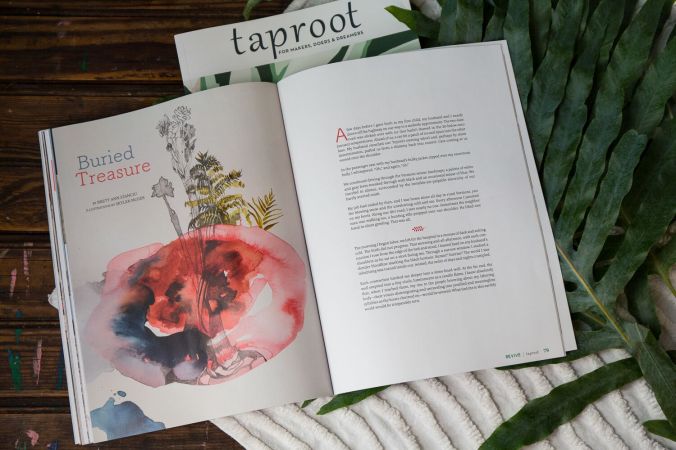
Artwork from the recent Taproot issue — appropriately titled Revive — where an essay of mine appears.

Above Freezing

Thaw. First thing, when I step outside the kitchen, I smell melting snow, the slightly sweet and fecund scent of the earth in just a few patches—the flower pot I’ve left outside on the deck all winter.

Some days, we have long days, beginning before dawn and packed full of so much. Some afternoons linger, but those are few now, sparse, far beyond those countless hours of nursing, when time was swallowed in baby care.

After dinner, the 13-year-old walks down our road with me, not far at all. Waiting for her while she puts her chickens away for the night, I lean against the barn door, gazing through the twilight. I’ve never lived in a house with the sky so open overhead. On a ridge, we look down into the shallow, mist-covered valley, where the town, at dusk, is beautiful, flickering bits of lights.

We’re so many months yet from working outside on the deck, me and the chittering birds, the sunlight on my keyboard and hands. But it’ll come: this reprieve is a reminder of spring, a certain promise of evening swims again.

Never forget:
we walk on hell,
gazing at flowers.

—Kobayashi Issa

IMG_1996

This.

Midnight, my 19-year-old pulled free the extension cord on the Christmas lights around our barn door and came in the house, banging snow from her boots.

On my bed, the cats pricked up their ears and hurried downstairs. I followed.

Cheeks flushed with full moon sledding down Mt. Mansfield, my daughter and I talked about the history of birth control — the political is personal — ate cold clementines, and fed the cats shreds of turkey from our fingers. Over our metal-roofed house, the moon made her silent, luminescently gorgeous way through the heavens. We turned off the lights and headed upstairs to bed. I parted the curtains and touched a single fingertip to the cold glass.

In this season of a new and vulnerable family on the move, of the ineffable mysteries of angels and holy gifts, a prayer for domestic peace, in odd and unexpected moments.

IMG_4253

Christmas Eve, Hubbard Park, Montpelier, Vermont, 2018


Joyful Interlude

A few years back, I told the man at the dump about an argument I’d had with my now ex. The old man always assessed what I had for garbage and recycling and then suggested what I should pay. Are you okay with that price? he’d always ask me. We had a sugaring and carpentry business then, and I often had strange assortments of things like moldy sap lines or boxes of broken syrup jars or a busted stroller.

The old man — who always spoke to my rowdy toddler daughter — told me to take her swimming for the day. That’s what you need to be doing today.

I think of him every time I go to the dump.

Before my second daughter was born, he suffered a terrible burn accident and died a prolonged and horrific death. I know this because I read his obituary in the newspaper one fall when I was crumpling up newsprint to build a fire in my wood stove. Those days when I pulled into the dump with my lively daughter and the million things I was doing then — syrup and mothering and trying to figure out my life — the day of his death seemed far away.

There’s a lesson in this I repeat to myself, that I must swallow down into the marrow of my bones. Seize joy — the unremarkable days of swimming that make up a life.

… We are not wise, and not very often kind. And much can never be redeemed. Still life has some possibility left… very likely you notice it in the instant when love begins…. whatever it is, don’t be afraid of its plenty. Joy is not made to be a crumb.

— Mary Oliver

IMG_0663.jpg

Reprieve

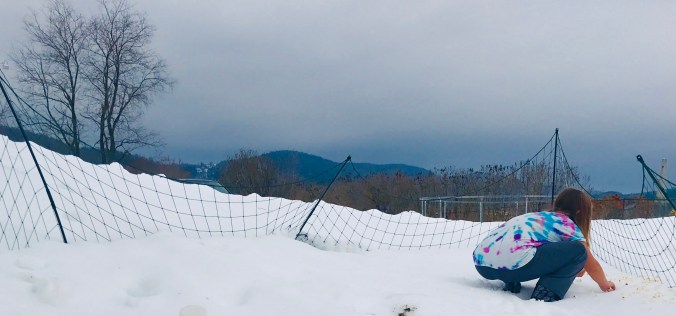
This morning, I’m in the snowy garden assessing the remaining kale. As I lift the limp leaves, crusty snow crumbles fall into my boots and around my sockless feet.

Walking back to the house, my daughter’s outside in a t-shirt, feeding her chickens leftover popcorn.

Kale, garlic, onion, fennel-sweet sausage for a savory soup. Mid-December. Take heart.

We look at the world once, in childhood.
The rest is memory.

— Louise Glück

IMG_4187 2.jpg

Bog Trip

No school for 13-year-old, day off for 19-year-old, no snow yet, and November’s scant light: I fold up my laptop and, impromptu, declare we’ll visit Chickering Bog.

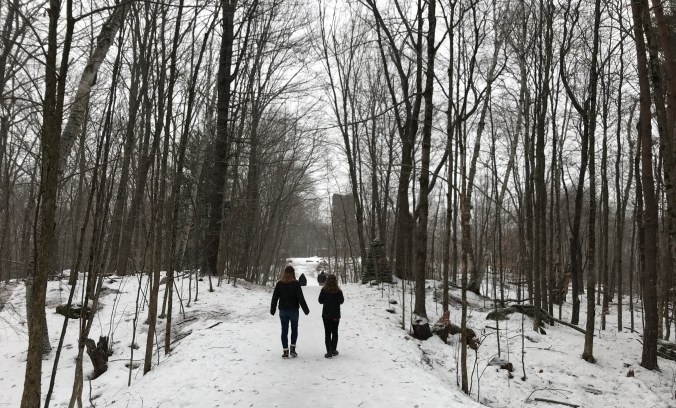
We follow a path through the woods, our boots brushing through fallen maple and ash and cherry leaves, then through a stand of tamarack where the dirt path is scattered with tiny gold needles. On the easy walk, the girls chattered, moving quickly against the damp, the three of them in their black down jackets and myself in turquoise. We’re not far from the world from houses and cars, yet the forest folds around us. I’ve been walking in various New England forests since I was a child, and although this particular path isn’t familiar, the woods are — filled with both that allure of what’s around that next bend or behind that glacial erratic? and, simply, the woods’ loveliness.

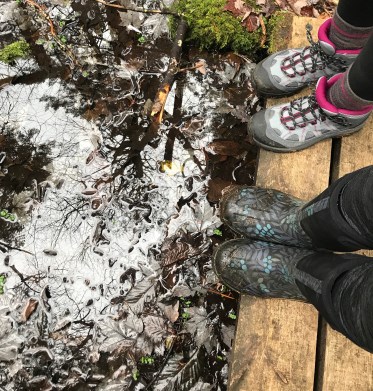
The path leads up to what’s more properly a fen. The boardwalk takes us near the middle where the girls find cranberry-red carnivorous pitcher plants. Beneath our boots lies the thousands-of-years-old mysteries of peat. And over our heads, all that sky.

A lake is a landscape’s most beautiful and expressive feature. It is Earth’s eye; looking into which the Beholder measures the depth of his own nature.

— Henry David Thoreau, Walden

IMG_3897.jpg

Calais, Vermont