The Pleasures of Parenting

Standing in line at the DMV this afternoon, I recognized a local poet in the waiting room reading The New York Review of Books. As the line was long, I stood watching the poet and his teenage daughter converse about something in the Review. She wore high heeled red leather boots, laces neatly tied around her ankles.

Still waiting in line while my daughters walked around Montpelier in gently-falling snow, I remembered an article my own father had forwarded me about the name of the Buddha’s son: Rahula, which means fetter.

Like most parents I know, my life is intensely fettered, by some unnecessary things perhaps, but bound also by the everydayness of waiting in line for a license renewal, something on the surface overly simplistic and sometimes downright irritating. Yet when my girls walked across the marble floor of that office building, with snowflakes melting in their eyelashes, laughing at some joke between them they had no need to share to with me, I wouldn’t have traded these fetters for the moon.

It ought to make us feel ashamed when we talk like we know what we’re talking about when we talk about love.

– Raymond Carver, “What We Talk About When We Talk About Love”

IMG_0476

One More Reason to Like Vermont

Vermont’s Congressional delegation came to our local high school yesterday, Hazen Union in Hardwick – Bernie Sanders with his mighty vehemence and voice, Leahy with his longevity, and Welch with his even-handed thoughtfulness. Welch joked that Vermont’s delegation could meet in an elevator – and does.

But Bernie was the one who got the packed gymnasium cheering loudest. He began with acknowledging that these are tough times, strange days indeed, but, nonetheless, he said, I woke up feeling pretty good this morning. To his loyal crowd of fellow citizens, this boundless optimism shone: the steadfast belief in goodwill, the persistent faith in a moral universe.

All of us share this world for a brief moment in time. The question is whether we spend that time focussed on what pushes us apart, or whether we commit ourselves to an effort – a sustained effort – to find common ground, to focus on the future we seek for our children, and to respect the decency of all human beings.

– Barack Obama

FullSizeRender


Dissolution

My dad, the physicist, had a phrase when I was growing up: this is a high entropy day, kids. Generally, this involved car repairs, a busted hot water heater which happened surprisingly frequently in my childhood home, cracked roof valleys, or any other number of household calamities.

Entropy is an apt word for my existence these days, as – in addition to my broken washing machine – I’m breaking apart a business I spent the bulk of my adult life building, sending physical pieces to this nice couple, that retired gentleman, and so on. Here, again, is that theme of creation and destruction braiding together: any gardener knows growth and decay are not opposites but different bends of the same process, always coming and going, ceaselessly.

And so, in my pre-dawn reading these days of Chinese poetry, I’m evolving to know on a deeper and more biting level that literature is as real as the mound of scrap metal my daughters and I moved today: that poetry is essential precisely because it reflects that universal experience of dissolution and rebirth, the immutability and inevitably of change. More than anything else, I’m reading this poetry because it pulses with the same pounding heartbeat of ceaseless desire that – in varying tones and intensity – links us all.

Vast and deep, everything and everywhere: existence is alive somehow  – magically, mysteriously, inexplicably alive. Nothing holds still…. nowhere does it appear so directly or dramatically as in the twisting and tumbling form of dragon. Fear and revered as the awesome force of change, of life itself, dragon is China’s mythological embodiment of the ten thousand things tumbling through their traceless transformations. Small as a silkworm and vast as all heaven and earth, dragon descends into deep waters in autumn, where it hibernates until spring, when its reawakening manifests the return of life to earth.

– David Hinton, Existence: A Story

IMG_2288

Hardwick, Vermont


Why I Like Kids

I’m at a point in my life where I’m often more surrounded by kids than adults; fortunately, some of my kids’ friends are sweet, some witty, and all far more entertaining than annoying – a feature which goes a very long way with me, regardless of child or grownup.

I was thinking of this again when the neighbor boy stopped by on his bike today and cheerfully helped move a load of scrap metal. But what I was really thinking about was David Hinton’s book Existence I was reading extremely early this morning. When I asked the kids to pry open up a door in the sugarhouse that was seriously nailed shut, they said, Oh yeah, and scavenged around for a crowbar and maul. They accomplished the task, but, more precisely, they accomplished the task with gusto, and then each ate a Klondike bar, my younger daughter’s new culinary find. Who knew you could buy a six-pack of Klondike bars at the Hardwick Village Market? My daughter knew.

Maybe one of the reasons I enjoy these kids so much (besides their inherent lovableness) is that kids are often, hands down, better people than adults. Braver, certainly more honest, and generally right there. Reading David Hinton made me realize children are far nearer to Chinese sages, too.

…China’s ancient sages assumed that this immediate experience of empty awareness was the beginning place, that dwelling here in the beginning, free of thought and identity, is where we are most fundamentally ourselves, and also where deep insight in the nature of consciousness and reality logically begins….you can begin at the beginning anytime, anywhere. A simple room, for instance, morning sunlight through windows lighting the floor; a sidewalk cafe, empty wine glass on the table, trees rustling in a slight breeze, sunlit passersby; a routine walk through a park, late-autumn trees bare, rain clattering in fallen leaves.

– David Hinton, Experience

IMG_2273

Molly on a photography shoot, Craftsbury Common, Vermont


Cutting Wood and Soul

The first piece of writing I ever published that I made any kind of money from was titled “Maple,” and it was about the intense labor of cutting wood. As a family of sugar makers, for years we cut and split wood at far greater amounts than almost anyone else we knew. Particularly through my older daughter’s life, cutting, stacking, and hauling wood, has been a constant.

In that autobiographical essay, I wrote: “Perhaps it’s that Puritan streak driven so deeply in my soul, but I believe that living demands its toll: that creation is lockstep with destruction. As such, wood forms the crux of our life, the cycle of our turning days, months, years. And yet this rural life has also bequeathed my girl her wild wood.”

Today, undergoing yet more repair of a tooth broken twenty years ago when a piece of firewood fell from a pile stacked too high, I realized, again, our souls may be fierce, but we live and die by the body. It’s a marvel to realize something as small as tooth may do in a body. In the chair today, with my eyes closed, I smelled an antiseptic that reeked of bleach, and then…. cloves. Cloves? Exotically rich, sensual, nourishing. Could there be a greater juxtaposition?

The young endodontist showed me the film of my tooth, its root illuminated like a miniature splinter of lightning. In his pleasant, southern accent, he advised me to think good thoughts. I intend to. But I will also never stack wood higher than my shoulders again.

…When I was ten
we lived in a bungalow in Indianapolis…
Once I got up and went outside.
The trees-of-heaven along the track swam in white mist.
The sky arched with sickle pears.
Lilacs had just opened.
I pulled the heavy clusters to my face
and breathed them in,
suffused with a strange excitement
that I think, when looking back, was happiness.

Ruth Stone, from “What We Have”

IMG_1542

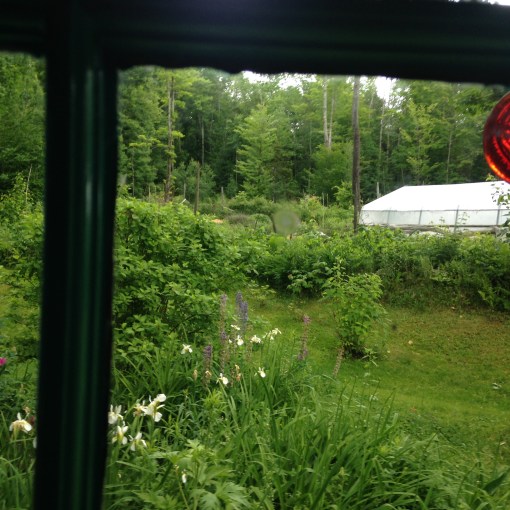
the kitchen window


Dear David Budbill

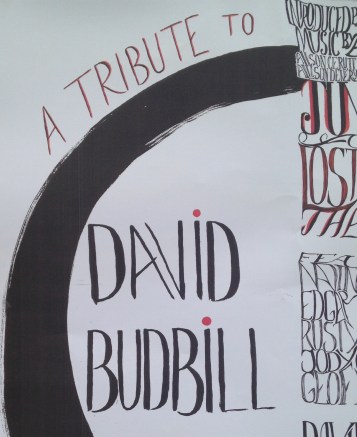
I laughed out loud and cried at David’s tribute, held by a ring of poets and actors on the stage where his work has been performed so many times. In the front row of the balcony, my friend and I talked about our children, and how our lives had shaken down. Later, driving home in the dark, up familiar route 12 I’ve driven so many times – with children, with friends, with family – now alone, not passing another car all those miles, save for an old Volvo station wagon that followed me out of Montpelier before turning off at a house with two lit windows.

Following the narrow sweep of my headlights, I thought of the final speaker’s words: from human suffering rises song. Thinking of David’s own kindnesses to me, and the great wealth of this man’s work and life, I followed those headlights like a unwinding stream of moonlight all the way home.

My children lay in their beds, sleeping. For the longest while, I stood on the balcony in the dark, listening to the frog’s steady chorus, rain falling lightly on my face, and then I, too, went inside and slept.

…These are not the rare and delicate lemon yellow day lilies
or the other kinds people have around their places. This one
is coarse and ordinary, almost harsh in its weathered beauty…

…A plant gone wild and therefore become
rugged, indestructible, indomitable, in short: tough, resilient,
like anyone or thing has to be in order to survive.

From “The Ubiquitous Day Lily of July” by David Budbill

FullSizeRender