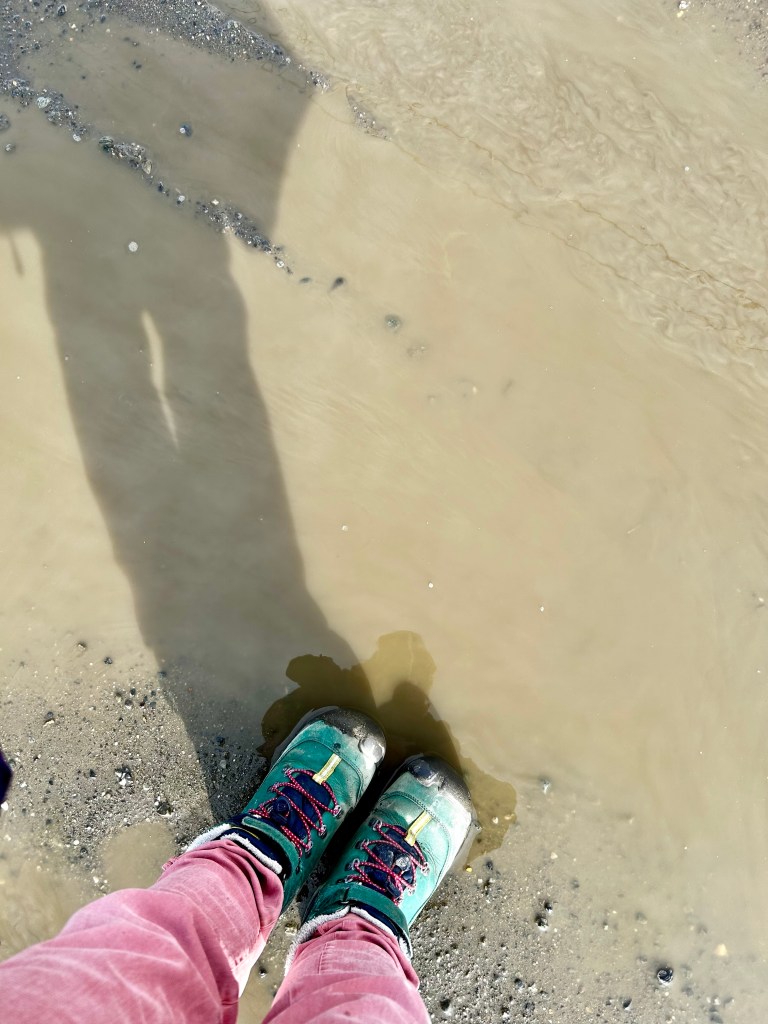
“Listen, no one signed up for this lullaby…”

Incantation of the First Order 

Listen, no one signed up for this lullaby.  
No bleeped sheep or rosebuds or twitching stars  
will diminish the fear or save you from waking  

into the same day you dreamed of leaving—
mockingbird on back order, morning bells 
stuck on snooze—so you might as well  

get up and at it, pestilence be damned.  
Peril and risk having become relative, 
I’ll try to couch this in positive terms: 

Never! is the word of last resorts, 
Always! the fanatic’s rallying cry.  
To those inclined toward kindness, I say 

Come out of your houses drumming. All others,  
beware: I have discarded my smile but not my teeth.

~ Rita Dove

Beyond words.

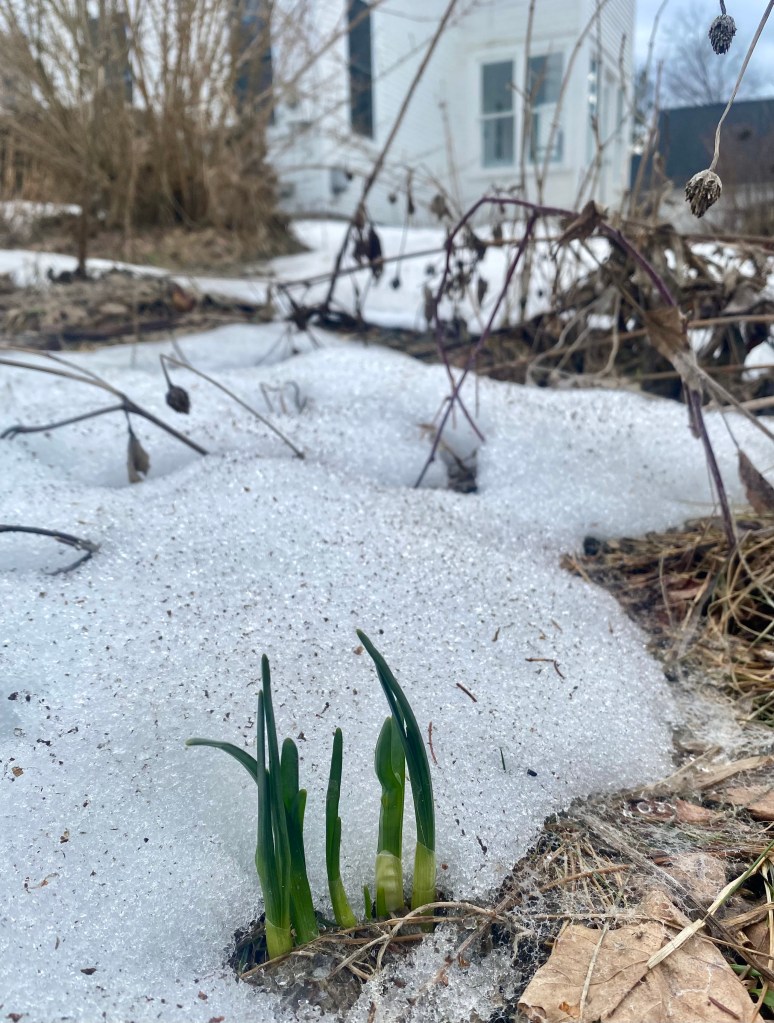
A few days of streaming sunlight. I wander around outside, over the crusty remains of snow, the thawing grass. The garden yet lies covered. A junco picks at seed scattered beneath the feeder. This far along in the chemo, staring at the end, I’m hard used up, muscles withered, fat trimmed near to my bones. But here, here, alive.

My life – physically, mentally, economically, spiritually – has been crumpled up by disease. Now, ahead, lies the unfolding, the remapping. A friend visiting with her three-year-old, with daffodils and chocolate, points out what I’ve recently reckoned with: that my fierce independence, my raving insistence to live my life, on my own terms and never shaped to the pattern of any man (as Tillie Olsen wrote), has long been my lifeline, the way through lean times, betrayal, uncertainty. But cancer, that mighty devil, flipped that in my face and revealed it as my hollow weakness, too.

Day by day here, determined to remain free from the hospital, to finish to the final drop this course of so-called treatment, glean back what I can salvage. Four months ago, I didn’t think I would live to see this season’s Chionodoxa blue flowers. This afternoon, my daughter and I remarked that the walnut tree I planted seven years ago as a mere twig has plump buds on its lengthy branches. Buds, blossoms, leaves. Beyond words.

“Why do you want to shut out of your life any uneasiness, any misery, any depression, since after all you don’t know what work these conditions are doing inside you? Why do you want to persecute yourself with the question of where all this is coming from and where it is going? Since you know, after all, that you are in the midst of transitions and you wished for nothing so much as to change. If there is anything unhealthy in your reactions, just bear in mind that sickness is the means by which an organism frees itself from what is alien; so one must simply help it to be sick, to have its whole sickness and to break out with it, since that is the way it gets better.” ~ Rilke

❤️

In the night, snow. My youngest ventures downstairs from her second-floor lair and feeds the wood stove, asks if I’m still reading, and don’t I think I should be getting some sleep… Around my knees, the cats yawn at her, nestling into their cat-dreams for a winter’s sleep. Outside, the town plow rumbles up our road, backs around, beeping, and disappears into the falling snow.

2024, a year that’s meant so much to so many. In our house, the year my mother died, the year I almost died, too. The inside-out year of reversal. In these quiet December days, getting better, getting stronger, getting weaker, moving along that jagged zigzag towards health, I’ve been lucky to read and think, to be warm and tended, to savor small sweets. Games of gin rummy. Poems Jo reads in her clear strong voice and sends every day. Brad’s photos of wintry Lake Champlain, luminescent portals of ice and drooping snow and runny sunsets. For so many of you, some whom I know well and have gone in and out of the depths of friendship and family, and some whom I hardly know, the circle around me has made all the difference.

When I first knew I had cancer, an acquaintance who had survived breast cancer told me it was the loneliest experience of her life. Like anyone, I’m well-acquainted with loneliness, have battled this shackled companion through divorce and betrayal. Where now has fate sent me? Illness was a forbidding shore where I never wanted to land my kayak, bend down in the cold murky waters and hoist my flimsy craft to safety. But illness is our common terrain, and those who dwell here – through happenstance or vocation – welcomed me in with compassion. As The Good Doctor told me, We are all patients. More plainly, perhaps, we are all mortal, conjoined.

Wishing you all some radiance from Vermont, prettied up this early morning beneath a downy snowfall….

“The Verge”

Reason is a fine thing, but remember there are other ways
to live: by instinct or passion, or even,
maybe, by revelation. Try it. Come around again to the verge –
that place of about-to-open, near where we comprehend
and laugh and see. Why shouldn’t something marvelous
happen to you? Take even an occasion like this:
A man reading at night looked up at the window to find
a moose looking in, interested and unafraid
with quiet dark eyes. He reports he has never been the same;
he finds the ungainly and miraculous everywhere.
He said it started the next night in the empty window
as he watched his reflection looking right back through.
He said he saw his own beauty, how even in his same old face
the quiet eyes were curious and ready to be true.

– Annie Lighthart

Chemo ride…

… took a bitch turn. Dreaded day 5 passed (thank goodness for the amazing anti-nausea meds), but with the last bag of this poison/healing fluid, a fist immediately grabbed my chest and squeezed my breath. My cheeks coursed with blood.Terror, say the word, terror. So much back and forth, oxygen and treatments and more liquids through this purple spaghetti plastic that drip, drip, drips near my heart. I shook fiercely – rigors – the nurses said. I was stuck on the word as my molars hammered, rigors!, where is this hard ride taking me? The fluid was stopped with a promise not to start again until I knew.

In and out of a fog, a dream of a herringbone jacket with a pleated flair my youngest wore as a two-year-old. In the evening, a nurse sits with me. As the drip-drops begin again, she talks, right beside me, watching me, close eye, about this disease, about infection and rest, about what I will need to do and avoid – do not knick your fingers with a knife, no dirt, no cat litter, no flowers, no illness. I ease from tension and realize, yes, yes, I am still breathing, I am still taking in this toxin that quite possibly will save my life. I glance up at the round analog clock on the wall that reminds me and my brother of school days. These are the moments Burlington’s Phoenix Books is hosting the Almanac intro in an online event. In my haze, I imagine the Almanac editors and reading and answering questions, this book filled with farm dirt and blooming flowers, hay chaff and sneezing, insects and sheep, and stories – so many stories – of people working on this northern place on the globe. In my half-dream, exchanging novels to read with this steady stranger, I feel my place in the world opening up, both descending into the long trek of illness and healing and, miraculously, an upward course, too, as this illness strips me down. Your bone marrow, the stranger says, marrow, a word I love and have been content to let lie, bone marrow doing its bone marrow thing. All this is changing, too, from nature, from medicine, from my fierce intent to reclaim my body.

All of you who have traveled or will travel this journey, bone marrow and rigors and fear, how simultaneously far and yet close this feels, all of us.

….. Everyday, a dear friend texts me a poem read in her clear strong voice. Here’s Rilke’s “Let Darkness Be a Bell Tower”

Quiet friend who has come so far,

feel how your breathing makes more space around you.
Let this darkness be a bell tower
and you the bell. As you ring,

what batters you becomes your strength.
Move back and forth into the change.
What is it like, such intensity of pain?
If the drink is bitter, turn yourself to wine.

In this uncontainable night,
be the mystery at the crossroads of your senses,
the meaning discovered there.

And if the world has ceased to hear you,
say to the silent earth: I flow.
To the rushing water, speak: I am.

Sonnets to Orpheus II, 29

December, Holy/Unholy/Holy Season

Anyone who lives in a northern climate must inevitably come to some reckoning with the descent into this month’s darkness, the steady whittling away of daylight at either end, noontime oftentimes scrubbed to a soapy haze.

To my surprise, this month began on an ascent for me, an elevator rise at the end of November, crammed into a silver metal box on a gurney with my weeping daughters and brother, and an anesthesiologist who might have drawn the short straw to collect the patient in the otherwise sleeping hospital. He was actually assured me he was a much better anesthesiologist than a gurney driver. Bring me back safely to these people, I pleaded.

Here at Dartmouth, I’m in a major medical facility (of which I’ll someday write much more). There’s no illusion that this is giant Health Care. Within this, my tiny 4’8″ body and the fraughtness of grave disease and uncertainty, and so so many patients. Yet all these interwoven days and nights, I’m surrounded by an arch of kindness, by skilled and unskilled staff who labor so patiently. I’m humbled by this secular holiness. The respect is repeated among colleagues here, aiding each other (and all us needy patients) with their own thank you, thank you as they work together.

A friend, driving home to Vermont from family Thanksgiving, leaves me Time of the Child by Niall Williams. Late into the night I read, taking these hours to relearn the slow joy of novel immersion. Sleep, sleep, I urge myself, and yet Williams’ world entrances me. Here’s line from this novel that an elderly Irish country doctor remembers from his doctor father: “The sick are ourselves, was a thing his father had said. When you stop understanding that, take your name off the wall and throw your bag in the river.

…. Whatever way this month transpires — for rise or for misery — and it’s all holy, isn’t it, this sacred and profane mixture of spirit and blood and bowel. The journey itself we take together is the gem.

Although I will say, I was ineffably joyous to return from that dismal night and see my curved-to-exhaustion people. After all, I am in the only one in our household who devours the cold leftover French fries with gusto. Why would we waste cold potatoes?

Thank you again, all.

Koan answer.

It’s dark in the mornings now when I wake, the light silently seeping over the hillside, creating a new day. Late afternoons, I swim after work. Ten geese accompany me. The next afternoon, I swim towards two young boys fishing from the bridge. Their line holds the sunlight, a line thin as a spider’s web.

Late July, I’ve been here before, the garden wealthy in basil. July: the season to relish the fatness of hydrangeas, cucumber vines gone rouge among the onions, ice cream made on a nearby farm. The overcast sky touches the line of trees, the green fields. As my friend and I talk, a hawk circles low over the field. Our conversation winds back to that question I keep asking these days — where to find solidity in a time that increasingly veers to stridency, to a yawping against a fracturing world.

The hawk dives and nabs its meal, then vanishes into the treeline.

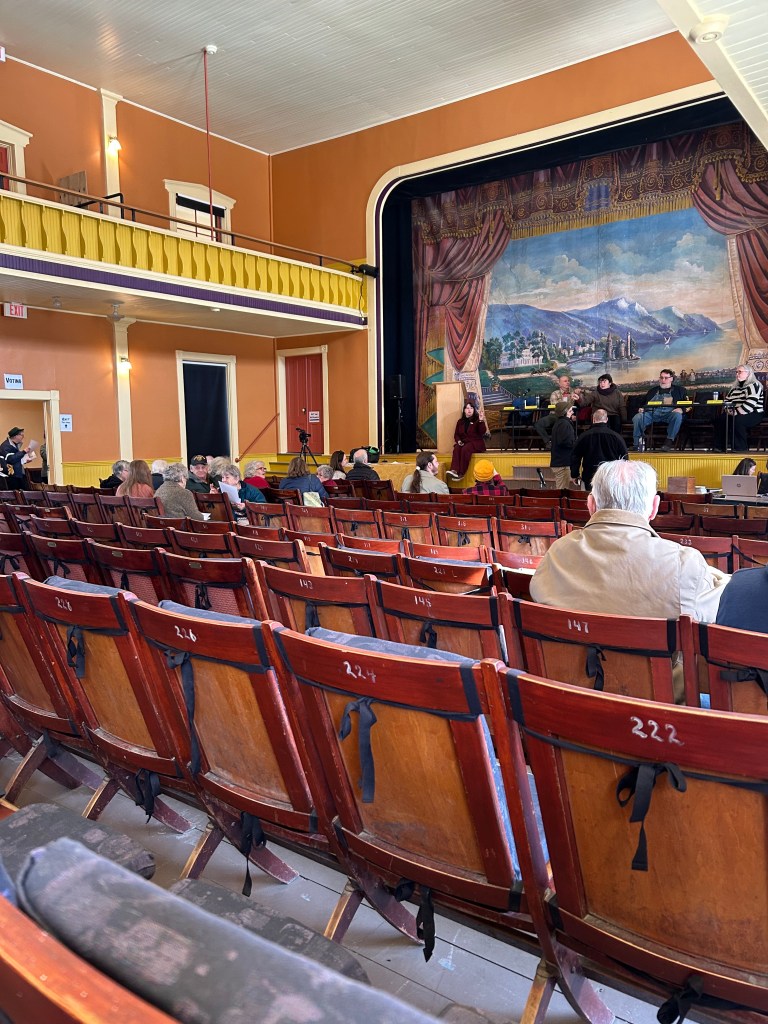
Rain begins to patter. All this past month, as I’ve been traveling across the country and then working with a Vermont Selectboard, listening to the news and following the storylines of those around me, I keep thinking of Yeats’ famous line that “the worst/Are full of passionate intensity.” An ordinary late July early evening, the swallows dipping in and out of the treeline. I stand for a moment, watching. The boys’ fishing line shone like the thinnest rod of light, vanishing into the dark water. The two children stood on the bridge, chattering and pointing. Perhaps the answer to my koan.