Brutal and Brilliant Lights.

My brother drives us out of the Dartmouth-Hitchcock conglomeration of soaring windows. Somewhere in the afternoon, the gloaming sifts down through the interstate traffic. The stream of trucks bends south. We head north. Evergreen and gray, a pale blue of mountains ahead. Midwinter, I mutter, but it’s yet late fall, the solstice ahead.

All the way back home, up and down the ribboned swell of interstate, coal night tapping down, I’m jumbled in an unbroken stream of searing hospital lights, the sparklingness of The Good Doctor who sits beside me and then phones me with good news, that the lymphoma and I are parting ways, disease shedding from my unseen flesh.

Now home again, drifting in and out of this perpetual river — of appointments and results, in an unfamiliar body swollen with water that, trickle by trickle, the chemo poisons are doing their fierce work to keep me alive, thrust me towards full health — the strangeness of not being able to lift a piece of birch to feed my stove, kindle my own hearth.

Grave illness is the void. The void is always with us. I know this even as I write with my tabby purring at my knee, epitome of domestic bliss. Maybe that’s why I was compelled to write so savagely in this place about terror. Late summer, as I’d descended into this cancer, without knowing that I was sickening, I could feel myself gyrating in a sucking whirlpool of negativity — from my own particular life and in this unusual time we inhabit. On the eve of the election, the cancer word smashed into my life. A levee burst in me. For me, a woman with cancer (this is no flip joke), these are fraught days, months, more months. But even in illness I’m part of the whirling flux of this time. As we drove out of that glass complex for the first of what will certainly be many times, I was imbued with a sense of magnitude, the mightiness of the tension between life and death and the mightiness of our collective lives, each dear, each interwoven.

I left Dartmouth with a bright red card in my hand from a kind stranger. At home, the sky was overcast. The stars were shrouded. Our dear white clapboard house twinkled with colored and white lights. I stumbled on the top step and fell. My daughter lifted me up and helped me in.

“You have come to the shore. There are no instructions.”
― Denise Levertov
Your place in the world.

A rare mid-December day of sunlight, and the town seems festive, stirred by the truly false promise of spring. Not true, not true.

December’s a season of reckoning, of that inevitable look back across the months, to a year ago, to five, more. I’m old enough now that the seasons jumble into a Jacob’s Ladder of years: the Christmas of the hoar frost, the year a mouse drank from our Christmas tree stand, the 60 degree Christmas Eve my brother’s dog went swimming and gasped from the cold. The December snow fell every single day. That year, holed in the house with sick children, I wondered if I would go mad; I did not. All past, all somehow yet still with us. Heraclitus reminds us that the single constant in this life is change, and yet it’s still the same molecular stuff arranging and re-arranging, by the force of the universe and our sheer human will.

Oh December: you heartbreaker, you. Sleet and radiant sunlight in the span of a few days. Icicles drip. Chickadees whistle in the white pines. My wood chores finished, the compost bin dug out, I linger in the sun, leaning against the house, reading Paolo Cognetti:

You find your place in the world much less predictably than you’d imagine.

There is No Such Thing as Atheism.

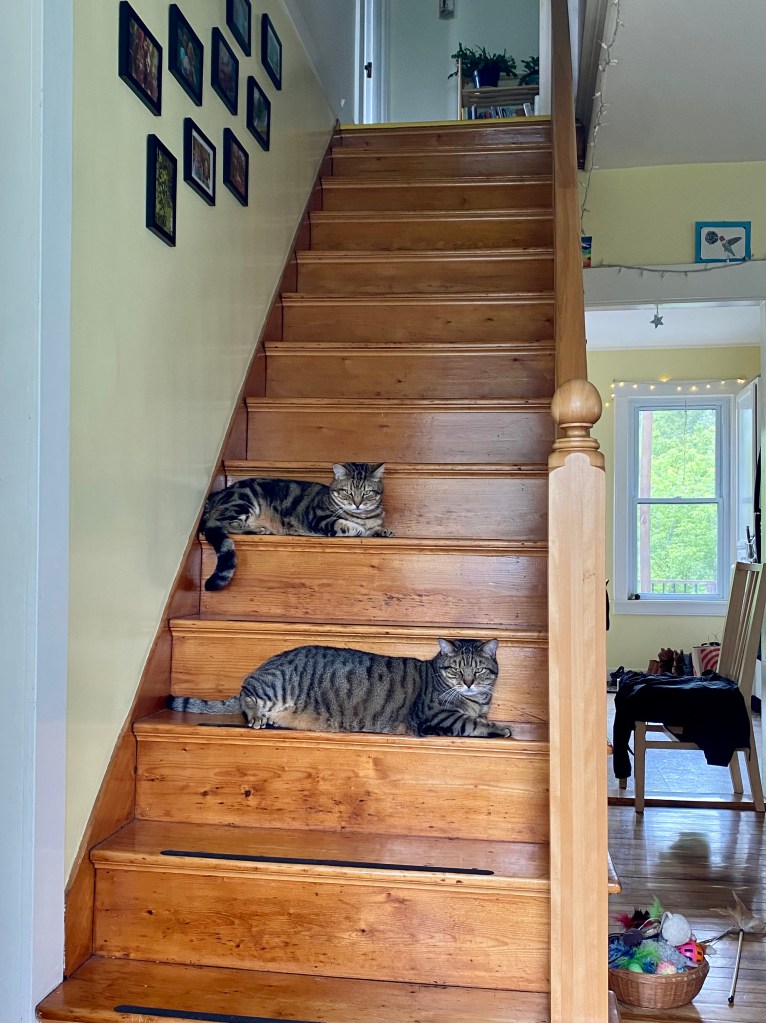
One of my favorite parts of our house is the small glassed-in porch at the bottom of the stairs, just large enough for two small loveseats. In this high school graduation weekend, we’ve spent a lot of time hanging out, talking, talking, the weather alternately switching from cold rain to sparkling sun. The cats sequestered themselves on the stairs while my daughter’s dog lingers around her feet. The dog wants to play. The cats cherish their dignity. The humans hover around this heartfelt drama.

Graduation and its platitudes… and yet the moment is such a pivot point, a marker between childhood and what will (god willing) be a very long haul of adulthood. Unplanned, the day spans the present, old friends I haven’t seen in years, and ends with a chess game with my brother at the kitchen table. Graduation isn’t weekend to solve anything, fix out the phone bill or shore up the back deck.

On this graduation weekend… the best commencement speech I’ve ever read is David Foster Wallace’s “This is Water,” gritty, savvy, and full of heart….

Because here’s something else that’s weird but true: in the day-to day trenches of adult life, there is actually no such thing as atheism. There is no such thing as not worshipping. Everybody worships. The only choice we get is what to worship. And the compelling reason for maybe choosing some sort of god or spiritual-type thing to worship—be it JC or Allah, be it YHWH or the Wiccan Mother Goddess, or the Four Noble Truths, or some inviolable set of ethical principles—is that pretty much anything else you worship will eat you alive….

— David Foster Wallace