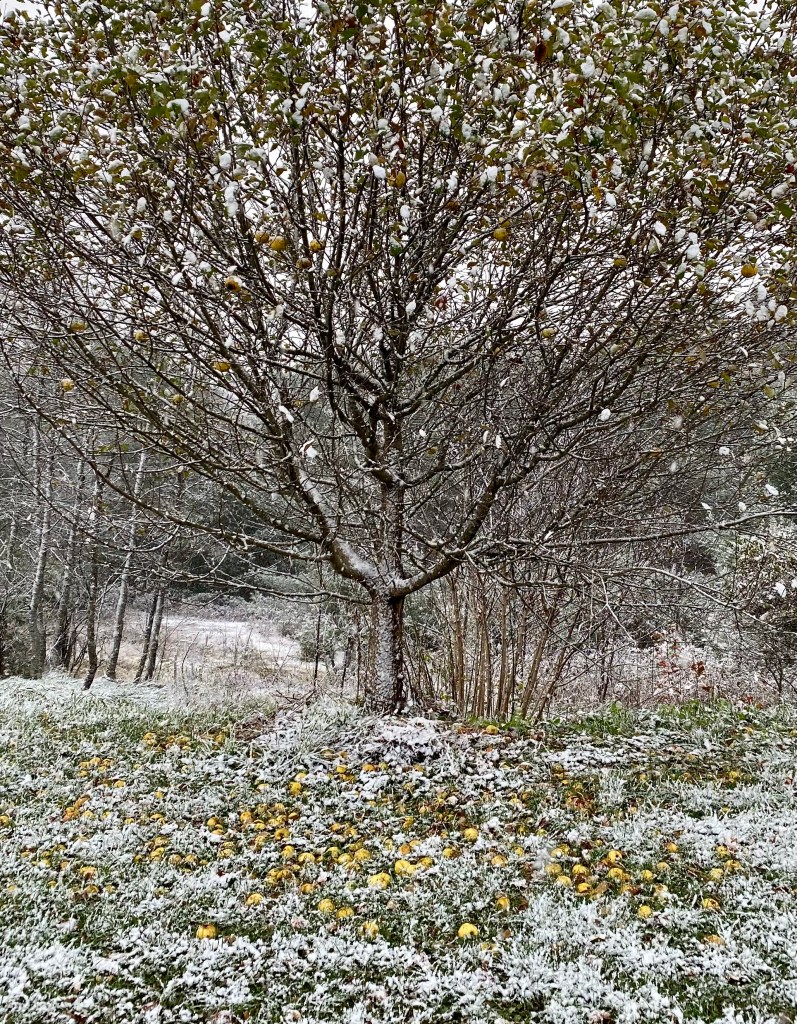
The true religion, the religion of snow…

I stand at my kitchen’s glass door devouring blood oranges and watching the sifting snow. Blood oranges — could I choose a less local delight? I open the door and cast out the peels for the birds.

The cat Acer sits on my feet, listening to the morning radio news, too. Just over the river, my home state New Hampshire revels in the Presidential primary. Meanwhile, Vermont prepares for its March Town Meeting Day, with the calculations and passion of budgets and petitions. Close an elementary school? Pledge to become a pollinator-friendly town? So much of January in my state is devoted to public meetings and discussion/debate, to a reckoning of the way forward, a jostling for who’s running for what seat — and what seats might remain empty.

Meanwhile, snowy winter has finally arrived, spare and elegant. Fearsome and enchanting. As the days deepen in cold, the light hours increase: no stasis in this world.

A fan of local chicken, bacon, milk, my cat stares at my orange-sticky fingers with disdain. I crunch the orange seeds, too, devouring this sunlight sweet.

Here’s Billy Collins’ poem about shoveling snow with the Buddha:

[Shoveling snow] is so much better than a sermon in church,
I say out loud, but Buddha keeps on shoveling.
This is the true religion, the religion of snow,
and sunlight and winter geese barking in the sky,
I say, but he is too busy to hear me.

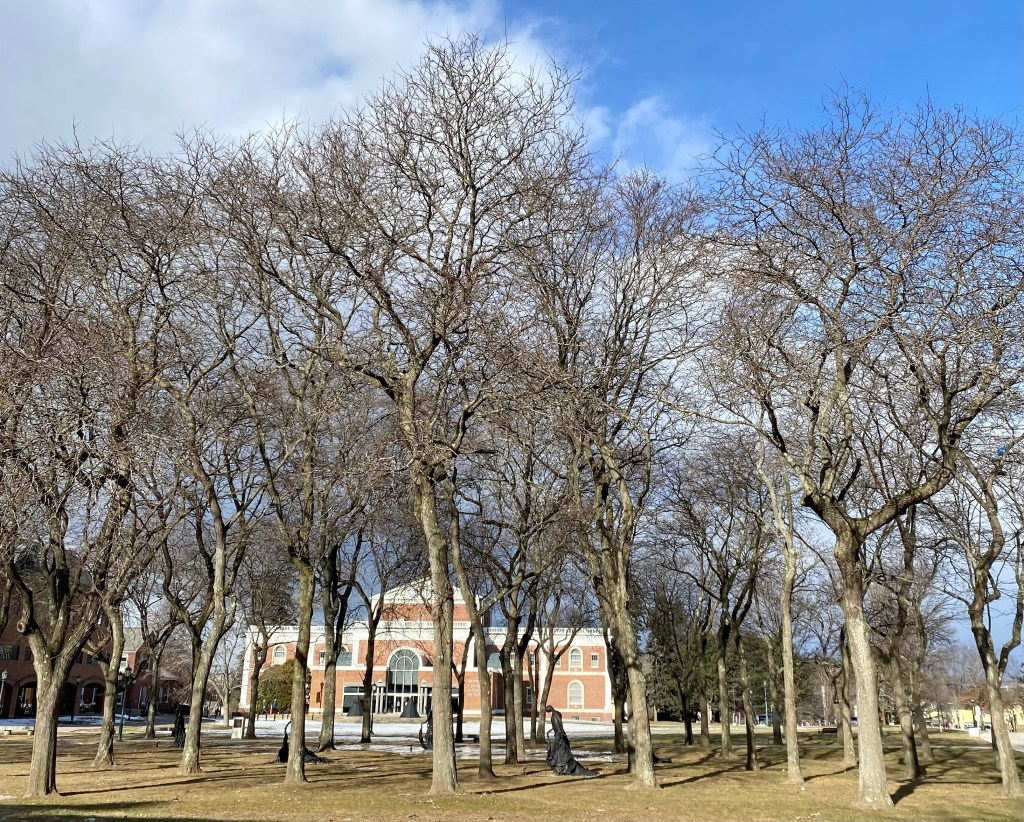
The sound of one hand clapping, revisited.

This week, I unexpectedly find myself waiting for someone I don’t really know and end up reading a copy of Ken Wilber’s collected writings. Winter has finally come. The purest and loveliest of snowfalls fills up our world. I wait much longer than I had guessed. A woman comes in to sweep the floor, and we talk for a bit. Sunlight pours through enormous windows.

Here’s some Ken Wilber I soaked in:

You know the Zen koan, “What is the sound of one hand clapping?” Usually, of course, we need two hands to clap – and that is the structure of typical experience. We have a sense of ourselves as a subject in here, and the world as an object out there. We have these “two hands” of experience, the subject and the object. And typical experience is a smashing of these two hands together to make a commotion, a sound. The object out there smashes into me as a subject, and I have an experience – the two hands clap together and experience emerges.

And so the typical structure of experience is like a punch in the face. The ordinary self is the battered self – it is utterly battered by the universe “out there.” The ordinary self is a series of bruises, of scars, the results of these two hands of experience smashing together. This bruising is called “dukkha,” suffering. As Krishnamurti used to say, in that gap between the subject and the object lies the entire misery of humankind.

On my way home, I do something I’ve never done in the winter. I park along the edge of an unfamiliar road. I’ve forgotten my hat. The wind is wild, as if I’m on a stormy sea. My hair tangles over my eyes. Oh sun, oh wind, oh endless snow.

Midwinter, here.

Onset of Pre-Cabin Fever.

I shake stunningly beautiful snow from my mittens onto my cats. Mid-January. Winter’s loveliness has just arrived. My house is again the three of us, two fluent in Cat and one marginally fluent in Human. The one who speaks Human gets the deciding vote, so we get up very early. The Cat speakers are wholly in favor of this, as the wood fire is fed and the cat kibble rationed into bowls. Eventually, the dawn finds us, and the rest of the world creeps in.

If this keeps us, the prognosis is mad-as-a-hatter by Honest Abe’s birthday. No fear of that. Any hermiting is constrained around here. Two small excerpts from my novel are accepted by journals. The cats and I nestle into our narrative. I let them lick butter from my fingers. Snow silently fluffs around us, concealing the stars, the sunflower stalks, the ash bucket I left by the step.

The Word Domestic, Depths.

Snowglobe snow falls in the late afternoon. November light: clear and sharp. Not much warmth here, not any season for sleeping rough and roofless, but sparkling as if our world has expanded. In an inexplicable way, the light seems washed full of hope.

The summer folks have fled elsewhere, to Florida condos or back to city jobs. The gardeners and landscapers have put away their rakes and trowels. Around the lake where I walk at midday, only the builders persist in their bulky jackets and gloves. There’s so few of us in town that me wandering by is the chance to stop and remark about stick season. At the lake’s pebbled edge, I dip in my fingers. Before long, ice will rim the bank.

Stick season and the wood stove’s warmth make my cats deliriously joyful. Rumaan Alam (such an amazing novelist!) writes in his intro to Helen Garner’s The Children’s Bach:

Let’s agree to abandon forever the idea that the depiction of family life is the province of women artists, and therefore insubstantial. Let’s refuse to hear a sneer in the term domestic.

And a Little of This Loveliness…

A few streets down from me, a pregnant woman leans on a shovel in a driveway covered with a few inches of dense, soggy snow. It’s late afternoon, and a light snow swirls down as I walk. A pickup truck stops on the road, and I hear the driver offer to plow. There’s a little back and forth, and then she steps back. He sets down his plow and goes to work.

Every snowfall has its own kind of knowledge. As I walk through the streets and then across the former railroad bed and into the woods, I marvel at how much I know about snow, too. How a scattering of snowflakes can remind me of being 10 years old again, and a fourth grade teacher caught snowflakes on her tongue. Delicious, delicious, she said. Or how the three-foot Valentine’s Day storm snowed us in when my daughters had fevers and I wondered if I would ever return to the world of adults.

In the woods, the snow swallows up all sound for a handful of hours.

In these winter months, I’m reading about Claude Monet and his gardens. Here’s a line from the master: “… people must first of all learn to look at nature, and only then may they see and understand what we are trying to do.

Somewhere in Vermont’s February…

Summers, the dawn is raucous with songbirds. In February, I stand outside in the dark, the cold swirling around my hands and head, hungry, hungry, it seems for my warmth. The icy snow makes the lightest tap against the kitchen window. We’re socked in by sleet and ice and snow in Vermont, the winter wrapping around us. When my daughters were little, how I chafed against those endless winter days. Now, I’m glad to be awake and working while the household sleeps. The cats have wandered downstairs for their breakfast, and curled up for their post-breakfast rest. Our house is warm; the daughters are well; the bills are paid; I have work.

Let the snow pile up. Among those many motherhood lessons is a solid carpe diem — and to log in a few more hours of work before the day drifts along….

Winter solitude—
In a world of one color
The sound of wind.

— Basho

IMG_7170