Local Wanders

When I lived on 100 acres in fairly rural Vermont, I didn’t imagine we’d change that story. 100 acres is a large chunk of land, and those 100 acres didn’t end at any boundary save a single dirt road along one side. The corners were rebar pins, surrounded by thousands of acres alive with fisher and bear and moose, jack-in-the-pulpit and hobblebush.

Living in Hardwick village now, the wild still surrounds us. Along our former road, tumbled-in stone foundations are reminders of farming families, who at some point packed up and moved along.

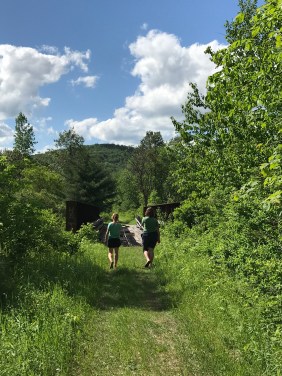
Yesterday, we walked along the railroad tracks, walled in at times by forest, and crossed the Lamoille River over a questionable bridge, hidden in this oh-so-June green beauty behind the town. I could imagine a hundred years ago, terrain cleared around the tracks, the rail bed studded with cinders. Save for the four of us, we saw no one but a crow.

The first step … shall be to lose the way.

— Galway Kinnell
l

IMG_5392

Photo by Molly S.

Playing

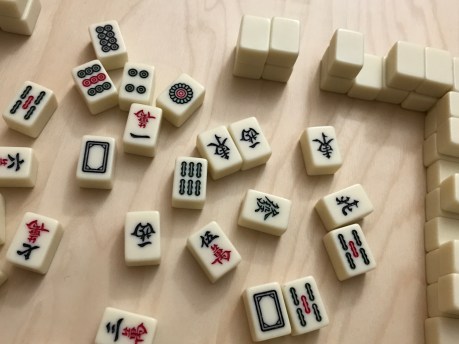
When I was in college, one of the houses I cleaned was for an older woman who usually had me set up a square table for mahjong. Three of her also-elderly friends arrived around that time — one hobbling in with a walker — and they were always so darn excited about this game. I laid out a wooden box of tiles, coasters, a cut glass bowl of cashews while one of the husbands made drinks.

My 12-year-old, lover of games and puzzles, studies instructions with our tiles, piecing together patterns, possibilities, in what can only be described as our unique version of play. Need four players? We’ve bastardized that, too, and make do with the two of us.

Across the table, the bridge of her nose sparkly gold from a friend’s shared paint, her eyes glow mischievously.

Do the best that you can in the place where you are, and be kind.

— Scott Nearing

IMG_1223.jpg

Postcard #10: Uninvited Guest

This marks an even dozen of Hardwick posts, despite the #10, but all of these have skirted around the jagged edges of where I’m really aiming: that community, like family, is suffused with some of the best and some of the very worst, too, of human nature. The little, one-room library (nearby, but not the Hardwick library) where I reign as Chief Cataloguer and Window Washer is visited by kids who sprawl on the carpet between the shelves and read, who crawl behind the wing chair and create magical worlds with puppets and stuffed animals — toys I leave when I vacuum and then turn off the lights, for children I expect will return.

My library has also been visited through a window and burglarized. My desk, where I keep stickers and budget sheets and book orders has been touched by hands not mine.

There’s a story behind this that’s not a nice story, about this visitor I didn’t invite in, but whom I would have, had he used the door like anyone else. My face, writing this, must reflect my anger and my fear. I’m no tabula rasa, and this entry into a place I’ve considered a kind of personal sanctuary cuts me.

And yet — and this is a very, very big and yet — I’m familiar with that ghastly howl of addiction, and my guess is that this intruder seeks the intrinsic human need of coming in out of the cold.

Yet, he didn’t come through the open door.

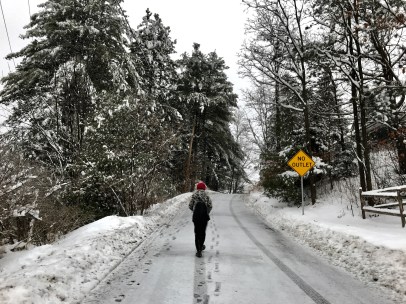
Driving home with my daughters over snowy roads in the dark last night, listening to their music, we drove around Lake Willoughby with no one else on the roads, and the waxing moon pushed through a scrim of clouds. Cold, cold: nearly zero. Enchantingly beautiful. A terrain known and yet unknowable.

I don’t have answers to why some children are well-tended and dressed, while others have drawn a short stick of basic things like food and clothing. I’m not naive enough to think the uninvited guest will ever use the library door, nor do I ever intend to welcome him through a window. But in this Christmas season of redemption and giving, I keep returning to that reality that doors and windows open, and the world is wider than I’m often inclined to credit.

I wanted to try to write a book about poverty that didn’t focus exclusively on poor people or poor places. Poverty was a relationship, I thought, involving poor and rich people alike. To understand poverty, I needed to understand that relationship. This sent me searching for a process that bound poor and rich people together in mutual dependence and struggle. Eviction was such a process.

— Matthew Desmond, Evicted: Poverty and Profit in the American City
IMG_0699

Hardwick, Vermont


Hardwick Postcard #9 1/2: General & Particular

On this eve, two photos: one of generalness of American life, the sludge of hurrying here and there, fueled by the genericness of roadside gas and plastic-wrapped convenience food.

Within all this, the utter uniqueness of my older neighbor opening her storm door for a long-haired feral cat, the loud boys across the street pummeling each other with snowballs, my daughter walking home, eggnog and a gift for her friend on her back.

I do not understand the mystery of grace — only that it meets us where we are and does not leave us where it found us.

— Anne Lamott

IMG_0668.jpg

Hardwick, Vermont

IMG_0665.jpg

Hardwick, Vermont

Hardwick Postcard #7: Middle School

At the middle school concert’s intermission, my merry-eyed daughter sat behind me with a girl I didn’t know, so I turned around and introduced myself. Being 12, the girls laughed at this weirdly formal introduction, and then the couple beside me began laughing, too. I had been sitting beside the girl’s parents.

It’s a little world we live in.

I chatted with the new friend’s parents. Quickly, the girl’s mother and I realized we had both served on an elementary school board. The lights dimmed just as we started a conversation that could have launched into a very long conversation about school consolidation.

For all its myriad faults, public education — at least in Vermont — is still all about the local community. Chances are, at a middle school concert, you’ll sit beside people you like, and, equally possibly, besides people you don’t.

But you’re all still there.

My father sent me this Wendell Berry essay. Read it.

In 1936, moreover, only a handful of people were thinking about sustainability. Now, reasonably, many of us are thinking about it. The problem of sustainability is simple enough to state. It requires that the fertility cycle of birth, growth, maturity, death, and decay—what Albert Howard called “the Wheel of Life”—should turn continuously in place, so that the law of return is kept and nothing is wasted. For this to happen in the stewardship of humans, there must be a cultural cycle, in harmony with the fertility cycle, also continuously turning in place. The cultural cycle is an unending conversation between old people and young people, assuring the survival of local memory, which has, as long as it remains local, the greatest practical urgency and value. This is what is meant, and is all that is meant, by “sustainability.” The fertility cycle turns by the law of nature. The cultural cycle turns on affection.

Wendell Berry

IMG_0622.jpg

Main Street, Hardwick, Vermont

Hardwick Postcard #4: Jumble of Stuff

December’s New England sings monochromatic variations of gray, white, and conifer dark green – except for us, who live here.

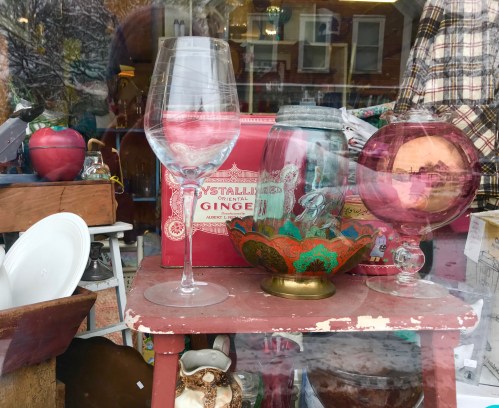
Like a jigsaw puzzle, this Hardwick storefront window of used things perpetually enchants my girls. Years ago, I raided a treasure trove on the back shelves, of used anthropology books.

Never depend upon institutions or government to solve any problem. All social movements are founded by, guided by, motivated and seen through by the passion of individuals.

– Margaret Mead

Here’s an essay of mine recently picked up that begins, When my daughter was 17, she smashed her fist through her dad’s car window in a fit of anger….

IMG_0563

Hardwick, Vermont