Fresh Lilacs, Late October.

My daughter sends me a photo of an apple blossom she discovered in Montpelier, Vermont, just this weekend, end of October. For anyone not a Vermonter, this is odd news that evokes suspicion and distrust. In New Englanders, distrust is a carefully curated character trait. Good lord, don’t be naïve. Naïve people don’t put on snow tires, and those people drive off roads.

Later that same afternoon, we walk through a pasture and then cut through a town cemetery. There, the lilac bushes are sticks, as you’d expect at this time of year. But at the very top of one bush, lavender flowers bloom. My daughter stands on her tiptoes and gently pulls down a branch. My house is surrounded on three sides by lilacs; late May is a joy. But this year, there were hardly any blossoms. Now: lilacs in late October in northern Vermont? Any sane person would look at this askance.

Nonetheless, I stand on tiptoes, too, and breathe in that ineffable scent of fresh lilacs.

Here’s a few lines from poet Amy Lowell:

Even the iris bends

When a butterfly lights upon it.
Post-Flood, Montpelier.

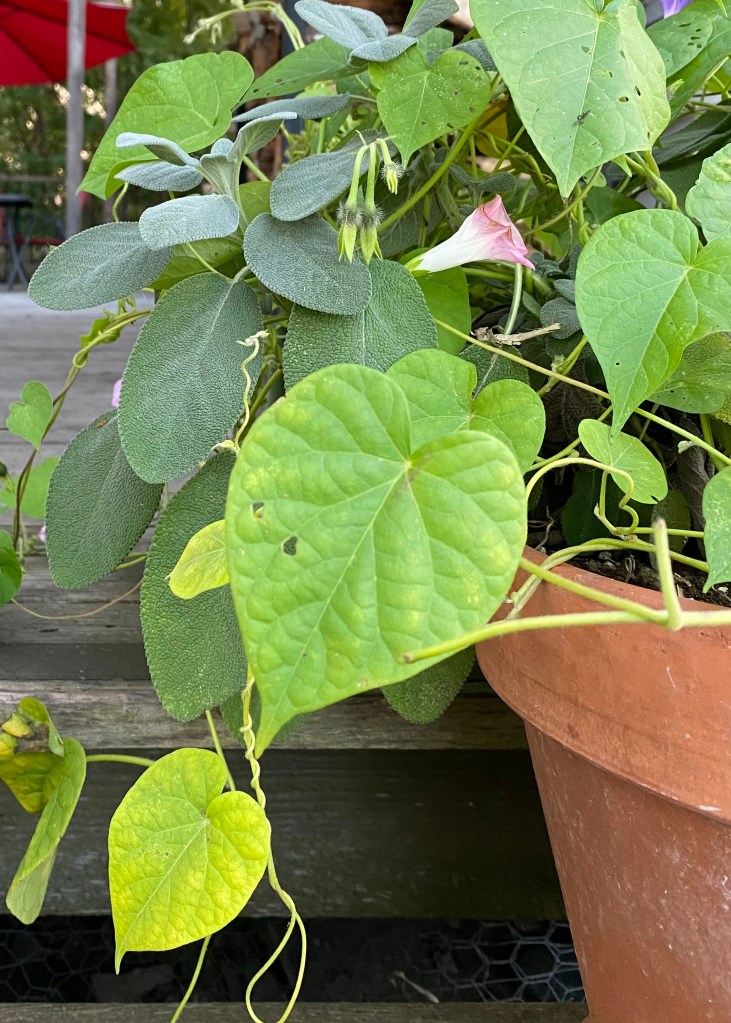
As if overnight, the fall foliage has vanished, swept into gray. The secret of Vermont’s autumn is the long lingering twilights, languorous and violet. Branch by branch, the trees are emerging from their summer splendor. Before frost yet, my garden rages on, orange tithonia, candy-colored cosmos, the morning glories that intrepidly vine through sunflowers and tomatoes and borage.

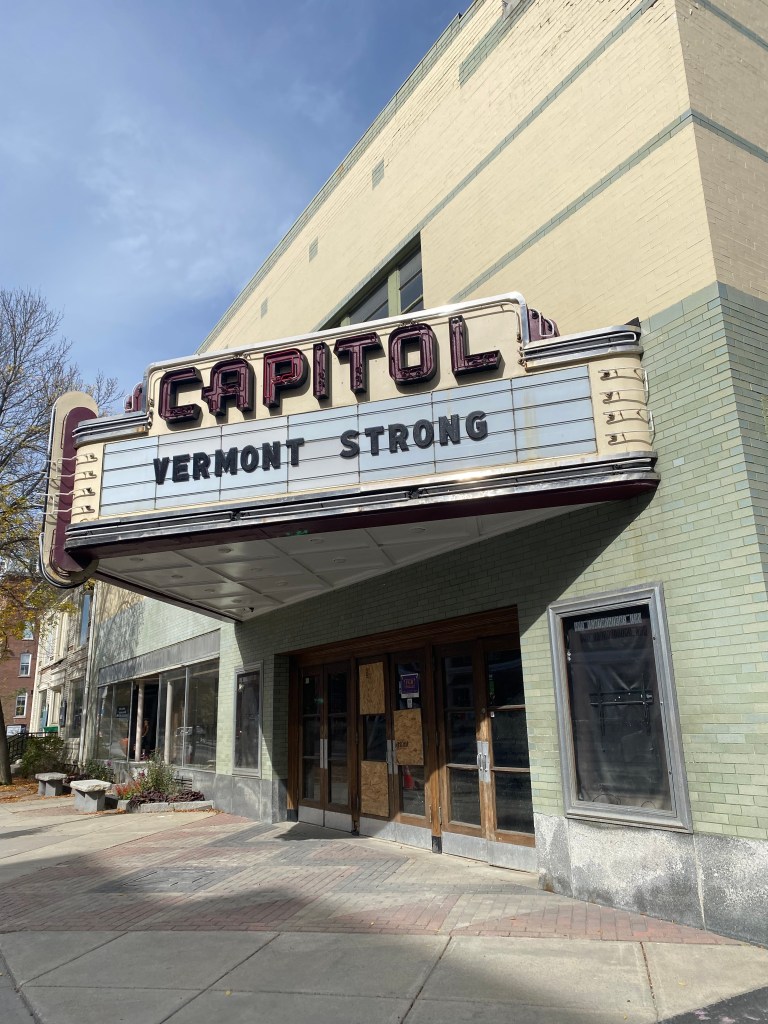
This weekend, I walked through Montpelier. So much of Vermont’s capital remains boarded up after the July flood, in need of money or labor. Other folks have shuttered up and headed elsewhere. It’s impossible to pretend that the world around us isn’t swirling in chaos. Nonetheless, when I come in with my fingers and toes cold, I build a fire. The neighbors string up gold lights. Quickly, quickly, and immensely slowly, the season settles in.

“You must try,
the voice said, to become colder.
I understood at once.
It’s like the bodies of gods: cast in bronze,
braced in stone. Only something heartless
could bear the full weight.” 

— Jane Hirshfield

Good Weight of Firewood.

The wood man delivers me green firewood, wood I plan to burn next year, God willing. He brings bees, too, or maybe the creatures simply appear magically from my gardens or trees, hovering on this sweet-smelling-of-sap pile. The day’s flawlessly sunny, and we stand beside the wood and butterfly bush my daughter bought me, talking. His truck is 40 years old, older than him, and he yarns on from there, telling me about his sugarbush and the taps he leases and how much syrup he made last year and the year before. A former sugar maker myself, we talk the talk about reverse osmosis and arches and how he nearly but not quite burned his front pans last year. We talk ropy sap. We talk how long it takes to fill a 40 gallon drum.

I write him a check for a week’s worth of my wages. He heads out, still laughing, leaning out his window, telling me his wife expects him home for lunch.

When he’s gone, I lift a piece of maple, heft its weight, breathe in its smell. This wood man’s given me good weight.

Getting Lost & Found.

There’s that old saying You can’t get there from here, which in Vermont means, It’s not easy to get there, but use your wits and you can. Yesterday afternoon, leaving for a Vermont town I’d never visited I hedged bets on the map, avoiding the route that I guessed had wash-outs and detours yet, and headed down two-lane blacktop through villages where hydrangeas are just beginning to bloom.

I was invited to read with Alexander Chee at the Meadow Meeting House, a righteous 1830s former Baptist Church. The ceiling was stenciled in original colors, over straight-backed wooden pews not designed for the listeners’ comfort. The entryway has two wood stoves. The black pipes extend over the pews before exiting. That would have sufficed for heat.

By chance (or maybe not), Alexander Chee and I each read about spaces — churches and homes — particularly apt in that lovely building that had its own generations-long story. It’s a question that fascinates me: how do we hold the past and also make our lives anew? The question links inexorably to the physical places where we live.

Afterward, in a sunlit house surrounded by gardens and apple trees heavy with fruit, I met a woman who’s the daughter of a long-ago friend of my father. Our conversation pulled me back to my college days. (How would I ever explain that I first fell in love with rural Marlboro College lying in fields, awestruck at the undiluted Milky Way and constellations?)

Driving home, threading my way back along unfamiliar roads, I had the strange sensation I held that afternoon and that conversation in my ribcage. Outside of my town, Hardwick, I had a long wait at a temporary red light on the broken highway. The asphalt washed down the Lamoille River. I stood up and leaned out my Subaru sunroof. In the gloaming, I saw how the river had cut a new course, its old path a great swath of boulders.

In the cavern of my ribs: wildfire smoke. The stories of my past, that afternoon, the future, too.

Four Feet of Mud.

Friday afternoon, when the Fed Ex man drops off a package, I ask what he’s seen on his route, his perception of flood damage and how folks are faring. In places, he says, nearly nothing. In others, houses perch over streams.

This stranger keeps going — and I keep asking questions — about his experience in the national guard, a tour in Iraq, and then a month in New Orleans after Katrina.

We’re back in blistering July, and I’m sweaty and dirty from weeding in the garden. On our sandy hillside, this summer the grass flourishes, a benefit of months of rain. I’ve finally mowed the grass (hardly a top priority these days in our house), and that ineffable and sweetly delicious summer scent of cut grass washes around us.

Our conversation bends back to Vermont and our washed-out valleys, how Hardwick’s Walgreens had four feet of mud. He looks at me and ask how tall I am. It’s true; I’m not that much taller than four feet. For a moment, we stand there, two strangers, contemplating four feet of mud. Then he heads to his truck.

Which pieces of our world will go back together, and which won’t? It’s a metaphor for many of us, perhaps.

All the way I have come

all the way I am going

here in the summer field

— Buson

Post-Flood, More Rain.

Nearly a week into Vermont’s floods, I’m surely not the only one in this town awake at night, listening to rain through my open windows. Lush, lush, our world is. Sunday, I trim the rose bushes that thornily cover a window, then discover moss creeping towards the house. I snip and scrape, then dash inside beneath a sudden downpour.

Sunday, I walk along the Lamoille riverbanks, silty and sandy where the river rose far above its usual path. Red metal lies in twisted sheets, remnants I’m guessing from the motel that tumbled into the river. Twisted towels and clothing, tires, a stepladder are jammed into tree trunks and roots. Cassette tapes of bible stories lie in a puddle, oddly more or less intact. Down the river, smoke churns into the sky where a flooded sawmill has burned debris for days.

There’s an odd kind of quiet hovering around here. What I’ve witnessed is shock and disbelief, a heady kind of euphoria to fix and repair, and now a sodden dullness, the earth as drenched as I’ve ever seen it. My pink poppies have blackened before they’ve bloomed.

We keep on, of course. Our beloved capital city, Montpelier, hoes and bleaches. Word goes around and around about passable and impassable roads, who needs helps, who’s yet marooned by great rifts in the earth.

In the late afternoon, I buy poppyseeds at the co-op and pay off my tab. The staff is out-of-sorts there, too, grousing about a broken cooler and the mud we’re all tracking in. Rain falls, quits, but the day doesn’t cool. I bake a cake and listen to someone on VPR talk about the Buddha. In the evening, that fat woodchuck darts among my gardens. A flock of starlings scatter on the lawn. Robins and rain. The daylilies are brilliant, the flowers poet David Budbill called coarse and beautiful.

As I said, it’s coarse and ordinary and it’s beautiful because
it’s ordinary. A plant gone wild and therefore become
rugged, indestructible, indomitable, in short: tough, resilient,
like anyone or thing has to be in order to survive.

David Budbill