The dress my daughter wore in the photo below was a thrift-store find. A soft flannel, the dress was her favorite those years she was two and three. She wore the dress until it was above her knees. I can still remember how her bare knees fit perfectly into the palm of my hands, her skin suntanned long into the fall, often lightly scratched or bruised from playing.
At fifteen, now, she feels light-years beyond those days.
Here’s a piece I wrote about this summer when she and I switched places in the car, beginning, “This fall, my 15-year-old daughter Gabriela was at the wheel of my Subaru when I panicked….”
By chance, I start reading a new novel — The Father Clause by Jonas Hassen Khemiri — and I’m back in those young motherhood days I thought would go on and on eternally — changing diapers, mashing peas, carrying little kids. Those days didn’t, of course. The youngest is now learning to drive.
My youngest logs in hours for her driver’s ed class. Sunday morning, we head to Montpelier. She parks in front of the statehouse, and we walk up the enormous granite steps. There’s no one around, save for five joggers decked out in full Santa suits. They wave merrily at us.
We head south along Route 2, through stoplights, towards Barre, talking about green arrows, lane changes, and the rules about turning, or not, on red. I’m giving my daughter a road map. At the same time, she asks questions about her father and where he’s gone. Talking with my daughter, on this sunny Sunday morning, at the end of a November that hasn’t even gotten cold yet, I know there’s so much unknown in all our lives, that the mystery of pandemic and chance and human relationships is a piece of participating in the human world.
Be wary, I caution my daughter. Look before heading into intersections. Read signs. Get out and admire the view from the steps, and wave to the silly Santas, too.
Dead my old fine hopes And dry my dreaming but still… Iris, blue each spring ― Shushiki
How could I have forgotten that the light in October is exquisite?
Unlike hazy summer, Vermont autumn is clear. The woods are emptying of leaves. The wind sweeps through the towns and over the hills.
From my garden, I cut a cabbage, boil the leaves slightly, and roll up meat and rice, filling the pan with sauerkraut — a Romanian recipe from my grandmother, who died before I began cooking.
Bit by bit, our hours migrate from the garden and back porch in the house. We no longer eat dinners in the sunlight. When I return from work, I see crumbs on the kitchen table, remnants of my teen and her friends.
I imagine these girls figuring out their online chemistry class and plotting their future. When I ask what’s happening in those hours, I hear, We’re fine.
In the evening, the teen spreads out her graph paper and notebook. I knit on the floor with the cat beside the wood stove while her sister reads the day’s news aloud.
The teen shoves her graph paper to me and asks if her approach to problem-solving is correct.
I look at the paper and suggest, Call your uncle. That’s out of my skill set.
The cat flips over and purrs.
The teen bites the end of her pencil and goes back to work.
“The world begins at a kitchen table. No matter what, we must eat to live.”
I wake before dawn thinking of shuffleboard and listen to the rain pattering.
It’s Wednesday, and my high school daughter is home today. With high school in session two days a week, she’s patched together a strange schedule. Yesterday, she walked to school around ten (skipping the idiocy of study hall in the gym), had algebra and driver’s ed, and spent the afternoon playing soccer.
I lie in the dark, grateful beyond grateful for soccer.
When her father and I divorced, I kept thinking, my god, we need to do better for this girl. So it goes with school this year. Really? I keep thinking. Is this the best I can do?
I remind myself, again, that I’m part of the problem. At 15, she’s stepped into a kind of college schedule, coming and going, utterly responsible for her own work, burrowed on the couch with her school-issued Chrome book, determined.
The truth is, the best has long since slipped out of vision. Hence, perhaps, the appeal of a shipboard game, hours of leisurely chat, surrounded by the glittering sea.
I’m not about to get that shuffleboard option. I rise and feed the hungry cats, brew coffee and open my laptop.
Rain falls steadily — a welcome sound. The chaos of the world is clamoring loudly. Meanwhile, my daughter leans into her work. I brew more coffee. Day by day — the only way to parent.
Three years ago, I sold our house on a back road and moved into the village, for a few reasons, for mostly so my daughter could walk to school. By then, I was a single parent, hustling a livelihood, and I needed my youngest to be able to get herself around. Rural Vermont, for those not in our world, depends on the car or pickup to get yourself around.
In the pandemic world, where I often find myself ticking off what I’m grateful for, as an antidote to the long list of what I’m decidedly not grateful for, that 15-minute walk ranks pretty high up my list.
These days, I’m wondering how this pandemic will shape my daughter’s generation.
A year ago, she was a freshman in high school, with a regular slate of classes and fall soccer games. As a sophomore, she’s more like a college student, grabbing in-person classes instead of online classes, insisting I’m not to interfere; she’s worked out her own schedule.
Study hall on Monday afternoon? I’ve given her permission to walk home with her friends.
So, while she’s hoping her year will be filled with chemistry, anatomy and physiology, trigonometry, Spanish, and French, I see a different kind of education this year. When her father and I divorced, her childhood had a hard line — a Before and an After. Now, across her whole generation, I see a Before and an After.
I’m incredibly curious to see how that unfolds.
The Uses of Sorrow | Mary Oliver
(In my sleep I dreamed this poem)
Someone I loved once gave me a box full of darkness.
It took me years to understand that this, too, was a gift.
My daughter texts that she left a few things behind for her camp out with friends. The back porch, where I’m working, is so hot I’m worried my laptop might actually begin to overhead.
I pack up those things and head with my older daughter, who’s on staycation this week, to the next town over. We walk down a short path into the woods. In mid-July, Vermont smells phenomenal — of wet soil and broken leaf and wild roses. On the pond, blue damselflies dart near our faces.
Oh, the world of being 15-years-old.
In the evening, my older daughter and I walk through the town, admiring flowerbeds while she maps out her future for the fall. At the high school, the lot is completely empty save for a blue mini van. As we walk near, I see South Carolina plates and an elderly couple eating from a box of pizza.
I raise my hand and wave, and they both wave back. What’s your story? I wonder. Later, driving by us in town, they wave again.
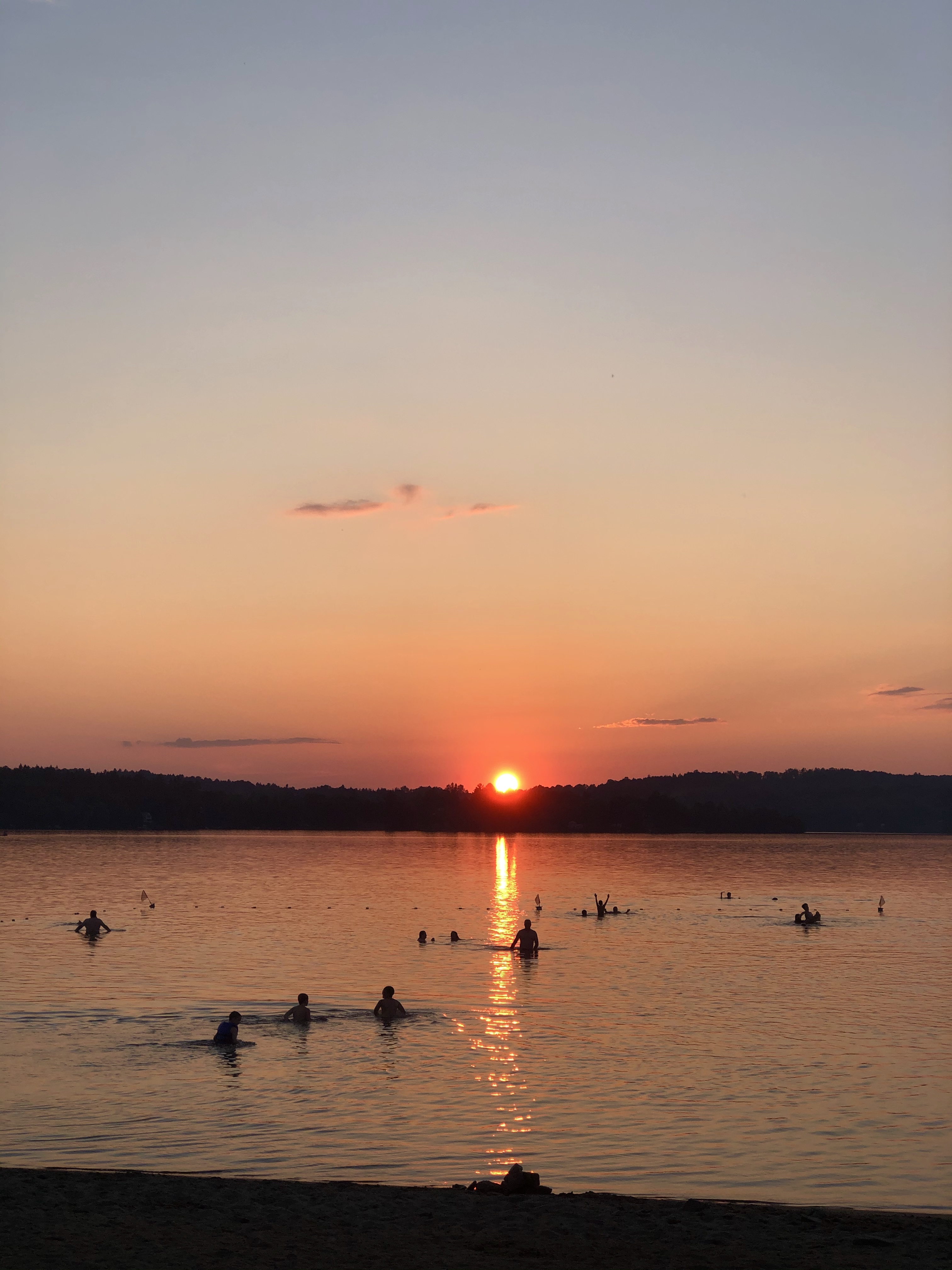
Friday was a day of two swims — in Walden and Hardwick. I’m storing these summer days in my body, as if I can hold sunlight and warmth and the tangy scent of green tomatoes in my skin. May these summer days be long, long, long.
Caspian Lake, Greensboro, Vermont/photo by Molly S.


 Stony Soil Vermont