A sense of urgency…

My youngest and I are watching a track-and-field race in the Olympics when a commentator remarks that a runner needs to up her sense of urgency to medal. In the humid night, the fan whirring through the crickets’ amped-up August songs, I keep riffing on the sense of urgency… My god, what does that actually mean?

Early August, and I always remember Hayden Carruth’s poem “August 1,” its line: The world is a/complex fatigue. Which perhaps sums up these days, so humid the yellow coreopsis flowers gleam, the cats sprawl on the kitchen floor, hungry for coolness. This summer has been fat with growth, the butternut and walnut trees I planted seven years ago spreading into their own canopy, already offering shade for me to lie beneath, as I read in the late afternoons.

Someday, perhaps, I’ll look back at this year as it’s own of kind of waiting — which way will this world tip? Even as I’m busy, busy with my urgency of work and gardening, my perpetual lists, of finish these three projects and then paint the back of the house, the outside world burrows in. Some of this is our own story, as my daughter heads back to college soon, but some are my own observations — the two battered cars crammed along the riverbank from the last flood, the perpetual national dialogue — and my wondering, which way might this go?

Urgency, raw want. At the farmers market, I see my daughters’ father across the field, appeared again from wherever he’s hidden. I hold a hot cardboard box of dumplings while the market crowd swirls around me. I turn to talk with a friend and when I look back again, he’s disappeared. Meanwhile, dumplings and curry in my hands: the urgency of eating, the words and life we’ll share over this savory meal, this evening, these moments.

August First

Late night on the porch, thinking

of old poems. Another day’s

work, another evening’s,

done. A large moth, probably

Catocala, batters the screen,

but lazily, its strength spent,

its wings tattered. It perches

trembling on the sill. The sky

is hot dark summer, neither

moon nor stars, air unstirring,

darkness complete; and the brook

sounds low, a discourse fumbling

among obstinate stones. I

remember a poem I wrote 

years ago when my wife and

I had been married twenty-

two days, an exuberant

poem of love, death, the white

snow, personal purity. now

I look without seeing at

a geranium on the sill;

and, still full of day and evening,

of what to do for money,

I wonder what became of

purity. The world is a 

complex fatigue. The moth tries

once more, wavering desperately

up the screen, beating, insane,

behind the geranium. It is an

immense geranium,

the biggest I’ve ever seen,

with a stem like a small tree

branching, so that the two thick arms

rise against the blackness of

this summer sky, and hold up

ten blossom clusters, bright bursts

of color. What is it — coral,

mallow? Isn’t there a color

called “geranium”? No matter.

They are clusters of richness

held against the night in quiet

exultation, five on each branch,

upraised. I bought it myself

and gave it to my young wife

years ago, in a plastic cup

with a 19cent seedling

from the supermarket, now

so thick, leathery-stemmed,

and bountiful with blossom.

The moth rests again, clinging.

The brook talks. The night listens.
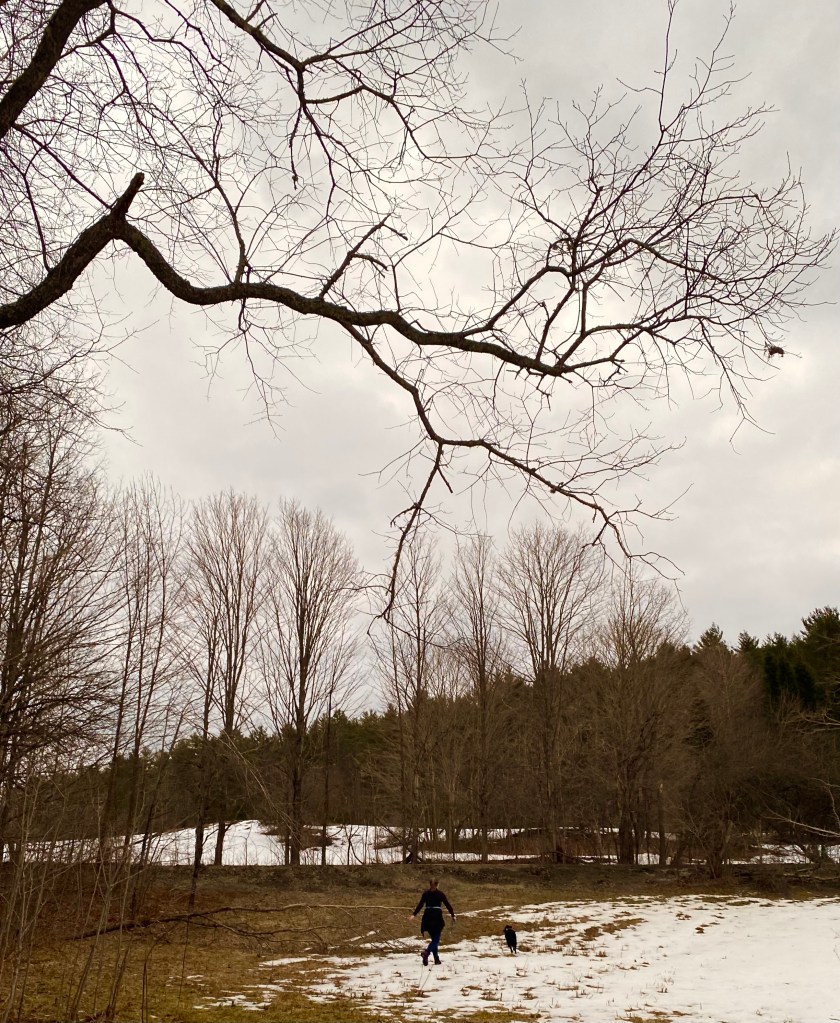
March 1: Cabin Fever, the Impossibility of Spring.

March: a day of singing chickadees, mushy ice, all the little paths running with thaw, twinkling in the sunlight with the promise of what I cheerily call early spring! The next morning, the temperature pegs itself solidly at 15 degrees and refuses to budge. I walk down to the post office, the wind scraping my cheeks. What grit of sandpaper is this? 80? 60?

Vermont late winter/spring is the season of vehement vacillating, of freeze and melt, sun, snow, rain. It’s the season of cold hands, flushed cheeks.

Late into the night I lie on the floor reading Leslie Jamison: “It’s what fairy tales have been trying to tell us for centuries. Don’t be afraid of never getting what you want. Be afraid of what you’ll do with it.”

March: the lurching season of cabin fever, of Where are those crocuses, anyway? Will flowers ever bloom again? I bake a cheesecake, fill bird feeders, have one, two, three essays picked up by little mags. The waning moon shines up the rutted mud, the dregs of snow. Early morning, the birds are at it, singing for dear life, tugging in spring.

Monsters. Childcare.

I stand outside the town office building, eating leftover beet-carrot-garlic salad for lunch, watching the sky alternately break apart in sun or drop rain. If there’s a rainbow, it eludes me. A retired couple who lives up the street walks by, returning from their daily post office walk. We kick around the news: a petition to close the town’s elementary school and how last night’s snow turned to rain.

Slushy, slushy.

The wind kicks up a hint-of-late-February warmth, the way that month can smell of thawing earth, of the gradual thaw-and-freeze-and-thaw that morphs into spring. Midwinter here, the weather out of whack. The afternoon opens into sunlight. The sun’s rare January appearance carries me through the afternoon and into a cheerily ebullient Selectboard meeting, and home again along an icy road, the stars glittering over hayfields, to play cards with my daughter while the cats savor their feline leisure, sprawled before the wood stove.

I lay awake late reading Claire Dederer’s Monsters. Dederer writes:

… the genius is not you. Not me. The genius, as we understand it, is not the person who spends most of her time, and I mean that quite literally, thinking about childcare. My major artistic concern for the past twenty years has been childcare, it has preoccupied me more than any other subject; even now that my children are mostly grown I’m still not sure I managed it well, I lie awake worrying about it, and meanwhile old Pablo was putting out cigarettes on his girlfriend’s face.

Myself, the Householder.

Furious, long before four this morning I’m at my desk with coffee and manuscript and my needy cat who must have his nose rubbed. A few months ago I asked a neighbor to knock off his cash carpentry payments to my ex-husband, a father who’s never made a child support payment. The neighbor brusquely told me I didn’t understand the complexity of the situation and walked out.

Now, he’s sent word that I made him and his wife feel unsafe. Oh Lord…. me and my 4’9″ stature and my insistence that I do know the complexity of my story and my uncomfortable female rage. I’ve doubtlessly repeated this, but his is a Kafka-esque flip of the word unsafe. And since when are other people’s children negligible?

I’ve been here before — like too many others, as this is hardly my unique problem — and I do what seems sensible to me. I tell no one where I’m headed and hike through the forest and up along a ridgeline. The hike cools my head. I discover white trilliums and wash my face in a low-running stream. The woods are hurting for rain, thirsty, thirsty.

I left with a question — what will I do? — and returned with my answer. Out of chaos, always, springs the pulsing might of creativity. At home, I hole up with Joanna Biggs’ A Life of One’s Own: Nine Women Writers Begin Again, and Biggs points me to Toni Morrison. In the evening, I pull a few weeds from the lily-of-the-valley that guard my house’s foundation. Such a delicate, pure, tiny flower.

 Q. You don’t feel that these girls (of teenage mothers) will never know whether they could have been teachers, or whatever?

A: They can be teachers. They can be brain surgeons. We have to help them become brain surgeons. That’s my job. I want to take them all in my arms and say, “Your baby is beautiful and so are you and, honey, you can do it. And when you want to be a brain surgeon, call me — I will take care of your baby.” That’s the attitude you have to have about human life.

— Toni Morrison, Time Magazine

Water. Ice. Rain. Cold. Mud.

The light is slowly returning; I repeat this to myself in defiance of the gray and brown. How bright a fresh sparkle of snow would feel.

Is it mud season? Sugaring season? Has winter barely begun? One thing that does seem evident is that cabin fever has set in extraordinarily early this year. At work, a stranger phones in and asks for info. I offer the facts, just the facts, and then the stranger remarks, What I’d really like is a small piece of good news to start the new year. I can’t resist; I laugh. I note his bar is pretty darn low. I tell him about seeing a flock of evening grosbeaks Christmas morning in the box elders behind our porch.

That’s something, he agrees. He asks me a few more questions, then remarks that he doesn’t even need to care about these questions, anyway. He could let this go. He says thank you, goodbye, and hangs up. In a strange circumstantial way, I realize I was his good news.

“Caring for each other is a form of radical survival that we don’t always take into account.” 

― Ada Limon

Stitches and Snippets.

At night, I knit and read, diligently counting stitches two-by-two before beginning the yoke pattern. I read about witches in 18th century New England, about muddy roads and fieldstone chimneys, about hunger and families and the complicated passions of small communities. About fear and remorse.

Around my house, the wind howls, lifting pine needles and crows’ feathers. November is the season of reckoning and looking towards the new year, of town and school budgets, of placing what you have beside what you want, of financial cost-and-benefit analysis, of a personal reckoning, too.

I remain awake unreasonably late, determined to proceed carefully this time to avoid ripping apart these stitches, anticipating the pattern work, the joining of color to color. Outside, I imagine smoke rising from our chimney, dissipating into the starry sky. A mouse nibbles in the wall. I keep counting.

“Writing a novel is a terrible experience, during which the hair often falls out and the teeth decay. I’m always irritated by people who imply that writing fiction is an escape from reality. It is a plunge into reality and it’s very shocking to the system.” 

— Flannery O’Connor

Last the third Vermont Almanac —one of the loveliest (and most useful) print publications — is out. The Almanac folks are virtually kicking off the third edition at Burlington’s Phoenix Books Thursday night, 7 p.m. You should come!