Among Lilacs-Gone-to-Sticks…

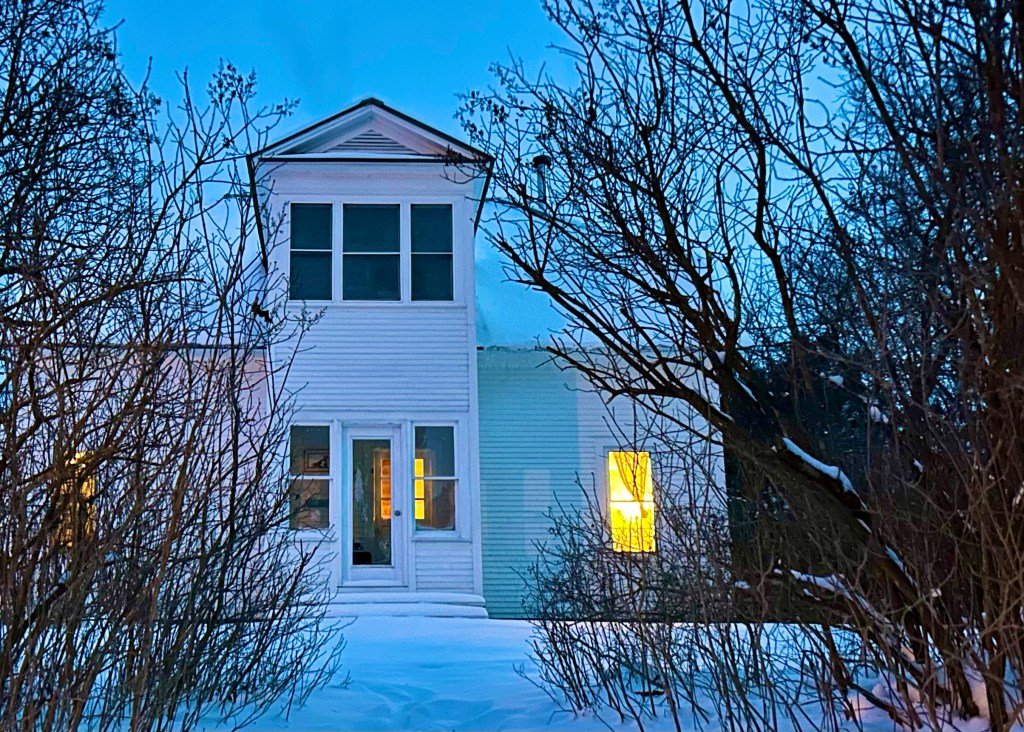
Late afternoon in Vermont December is twilight; I’m hustling along my road, a glass container of hot soup wrapped in a pink cloth in my hands, and I stop for a moment and talk to the neighbor boys who are sledding. The light is dim enough that I squint to count the three children, shadowy figures in snowsuits. The cold is fierce on my face. This day has been sprint from one thing to another, more yet to come, but I pause, that glass steaming in my mittens, the sunset sprawling over the great sky, the stars already emerging in the east’s darkness. A small moment, a tiny exchange of hellos. Such luck to be in this ordinary afternoon.

I walk through the parting in the lilacs-gone-to-sticks for the winter, study the bird feeder hung in the mock orange, the seeds sprinkled in the new snow. Behind me, the boys call to each other. In their lit kitchen window, I see the boys’ parents. Dinnertime nears. The cold is so mighty a body without shelter could and would perish. In the snow that gleams with the last of the day’s light, my boot prints lead to me, my lit window and cat, the upstairs bedroom dark where I stood a year ago and wondered if I would die. Wrong question. Not if but when. For this moment, however (a great big however), I remain in this simple-not-simple equation of laughing children, hot soup, the night swooping in. I study my bootprints with satisfaction and then head towards my own kitchen door.

“The Way It Is”

There’s a thread you follow. It goes among
things that change. But it doesn’t change.
People wonder about what you are pursuing.
You have to explain about the thread.
But it is hard for others to see.
While you hold it you can’t get lost.
Tragedies happen; people get hurt
or die; and you suffer and get old.
Nothing you do can stop time’s unfolding.
You don’t ever let go of the thread. ~ William Stafford

Stopping in the Snowy Forest.

In the woods, I hear voices and pause, thinking a cluster of children might emerge over the hill. Instead, a flock of clangorous geese wings low overhead, then a second V, a third. Town traffic sounds filter into the woods. I am not in the deep wilderness, not so far from high school and road and village, but for this hour, it’s just me and the sweep of wind and drifting snow and the human and dog prints of whoever walked here before me.

As a kid, my father was never one to be daunted by adversity. Evenings, he often set down his coffee cup and took us on walks to the library or around the block, and around the block often meant across a thin-grass soccer field to the woods. Who owned those woods, I never knew. We jumped across the stream and along worn logging roads, past the piles of New Hampshire boulders and stone walls in the forest where fields had dominated not so many years ago. The woods were alive with rabbits and deer, birds and ferns. We wondered about the Natives who lived here and the colonists who cut down the trees, and then the trees grew up again.

On this twilight Monday, I lean against a hemlock, snow in my eyelashes, remembering when my daughters filled their snowsuit pockets with tiny hemlock cones. Intentionally or not, my father instilled love and not fear of the forest in his kids, the understanding that our feet could carry us to unexpected and miraculous places.

Here’s that classic New Hampshire poem threading through my childhood, my daughters’, and so many others:

Stopping by Woods on a Snowy Evening

By Robert Frost

Whose woods these are I think I know.   

His house is in the village though;   

He will not see me stopping here   

To watch his woods fill up with snow.   

My little horse must think it queer   

To stop without a farmhouse near   

Between the woods and frozen lake   

The darkest evening of the year.   

He gives his harness bells a shake   

To ask if there is some mistake.   

The only other sound’s the sweep   

Of easy wind and downy flake.   

The woods are lovely, dark and deep,   

But I have promises to keep,   

And miles to go before I sleep,   

And miles to go before I sleep.

“… hard wind and the rain that unsettled the creek…”

Evening, I linger on the porch swing, talking with my siblings as the long July day ebbs down to twilight. My neighbor texts me that a bear’s been seen in our neighborhood. As the gloaming, like a tide, washes in, I water the tomato plants. The white hydrangeas hover like magical pompoms in the dusk.

July, Vermont’s growing month. Walking with my neighbor, she points out the height of the wild grasses and flowers around her house. Already, this summer, taller than she’s ever seen. The heat and the rain have propelled immense growth. The box elders rub my house; I’ll need to ask another favor from someone with a saw.

I have not forgotten this winter when I drifted from one variation of cold to another, my body and mind fiercely bent to the intertwined goal of finishing cancer treatments and remaining alive. On the other side, what remains is what plagued me before, my own variation of hard wind and rain. And yet, a whole July hangs like a promise: sunshine all day, pink cottage roses, laughter with my neighbor about the burgeoning woodchucks.

In the late afternoon, I take a long walk in the town forest to the reservoir’s edge. Deer prints press into the mud. On this walk, I don’t see a soul. In the distance, children call to each other.

“Kitchen Sink”
Today she would change nothing,
not even the wallpaper peeling,
like dead bark. Nor, outside, the shadows
approaching the yard where ants
toil like women in their houses of sand.
Never mind that the sun will be setting.

When she was young she felt afraid
of hard wind and the rain that unsettled the creek.
But the earth never left her,
not once did the floods reach her feet.
The reward of a long life is faith
in what’s left. Dishes stacked on a strong table,
Jars of dried beans. Scraps of cloth,
And the ten thousand things of her own thoughts,
Incessant as creek water. She has been able
to lay up her treasures on earth,
as if heaven were here, worth believing.
In the water her hands reach
like roots grown accustomed to living,the roots of the cat-briar that hold to the hillside
and can never be torn free of this earth completely.

~ Kathryn Stripling Byer

And another turn in the plot…

My body falls apart again, and my daughter drives me to Dartmouth. “My car only goes to this ER,” she tells me when I hint at negotiating a closer ER. She asks her blunt and even-toned questions, “What are you afraid of?”

Among other things, I’m afraid of waiting, in pain, which is what happens, and I survive that, of course. The hours in the ER waiting room introduce us to an intimate slice of others’ lives. The man who drove a screwdriver into his hand and didn’t seek antibiotics (not a good choice), another who crammed his hand between his two fighting dogs (the hand lost), a woman with a damaged foot who phones her mother on speakerphone. Across the large room, listening, I wince at the painful distance in that relationship.

Eventually, I’m given a bed in what’s labeled Hall 3. Shift change, a kind nurse hustles to give me meds. In the hallway, we are yet in the swirling mix of others’ lives. A hall mate (not a roommate) who I never see but who’s recently widowed; his companion struggles to figure out his meds. Later, my daughter steps outside and sees a prisoner who’s a patient run through the parking lot, high drama. She leaves after midnight. “Drive safely,” I say, “text me when you’re home.”

In the night, the surgeons stop in, and again the next morning, when the surgeons and the Good Doctor my oncologist meet in my room. Like a rushing train, surgery is coming rapidly and unavoidably towards me. Much as I’d rather not, really rather not, I begin to accept this. I think: get my tools together to survive this. Print out my manuscript, collect books and a knitting project. In all these countless hours in varying hospital rooms and hallways, I’ve never been bored. Frustrated and weeping, laughing and curious, but never dull. Another thing to be grateful for.

I’d rather not, but here’s another bend in my story, as with my hall mate and waiting room companions…

Is that church door open?

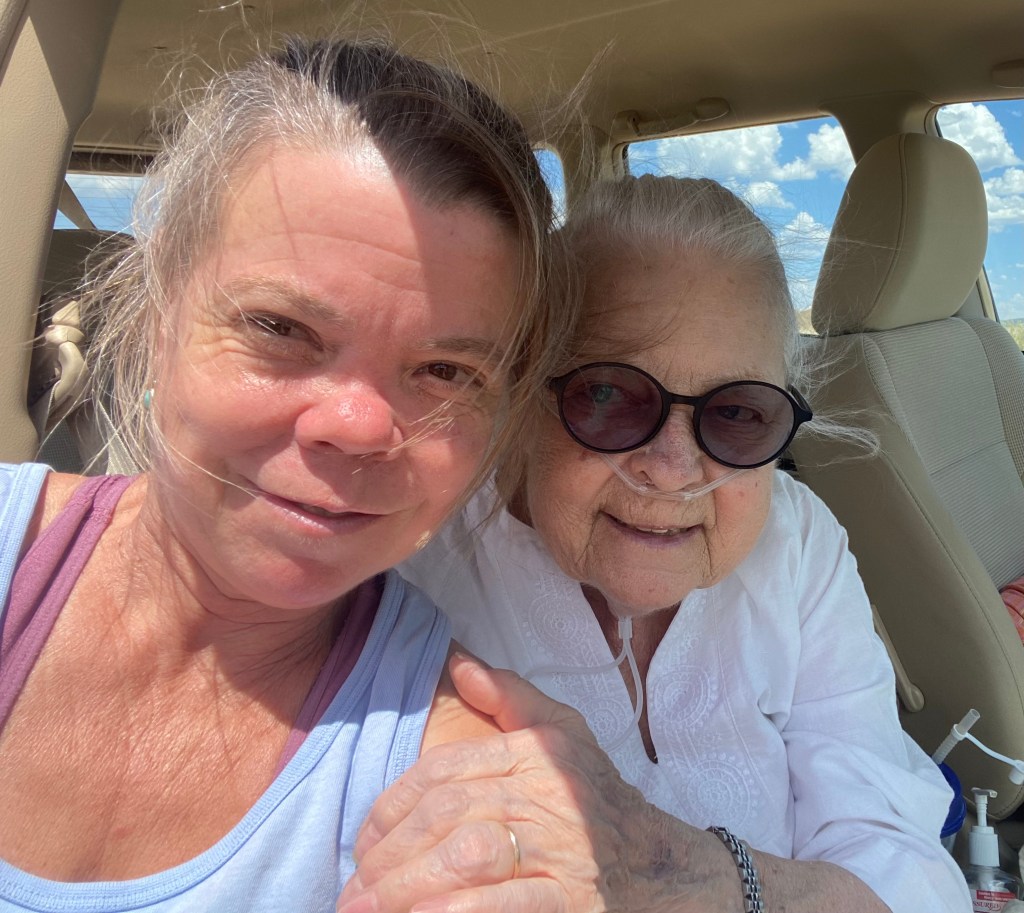
About a year before my mother died, I visited my parents in northern New Mexico. My mother was on 24/7 oxygen then, which she understandably chaffed against, and I took her on long drives so she could leave the house. One afternoon, I drove the rural roads to the Lamy train station. Take the Amtrak to Santa Fe, which I’ve done, and you don’t disembark in the quaint plaza town. 20 miles outside the adobe city, there’s the small Lamy station and an old saloon named the Legal Tender, and not much else. I parked at an old church that appeared to be abandoned and told my mother I’d be right back. I called over my shoulder that I wanted to see if the door was open, as church doors often are. When I looked back, my mother had her car door open, one foot on the earth, determined to follow me. She said cheerily, “I’ll come, too.” She was attached to a heavy oxygen tank on tiny wheels. The terrain was rocky, and there was no way I could navigate my mother to that door.

Somehow, I talked her into staying in the car. That was my mother, usually up for an adventure, willing to rattle a locked door, peer through a window, maniacally curious. It’s me, too.

In these brown-grass April days, as I begin to walk again, further and further each day, I think of my mother, how she would search for daffodil buds and admire the blooming snowdrops. Robert Frost is famous for his line, “In three words I can sum up everything I’ve learned about life: it goes on.” Bitter, perhaps, or maybe not so. Having faced my own (blessedly at this moment passed over) demise this winter, I’m beyond happy to immerse myself in the stream of life going on…. This life.

I woke this morning with a dream that I’d never had cancer. In the dream, I’d overslept and was late to work…. I was sweating, nightmarish. The dream haunted me all morning, trailing me, while my dear friend visited and brought me birthday presents that reminded me of my mother, and then fetched my library books so I could lie on the couch these afternoons and recover from this last cancer dose. When she’d left, I slept again. When I woke, the dream had broken and lay on the floor like broken glass: rubbish.

Such a labyrinthine world – mothers and daughters and granddaughters – disease, too. In these still days, waiting for spring’s rushing green, I embrace what I know, and that I never will.

… we are all

the dead, I am not apart from you,

for long, except for breath, except for 

everything.

~ Sharon Olds