Why Read Literature, Anyway?

For my seventeenth birthday, my dad gave me a slim copy of Point of Departure, a slim collection of nineteen stories of adolescence.  That was back when you could buy a paperback for a buck and a half, read the book over and over, and the pages wouldn’t fall out.  Thirty years later, I still have this book.  Some of these stories I read over so many times, I could reiterate passages.  “A Summer’s Reading” pointed me to Bernard Malamud.  Even though I didn’t grow up in a city, I could envision myself, like the main character, George, skulking around the nighttime summer streets.  Updike’s “A&P”? What I wouldn’t have given to have sashayed through those aisles.

At seventeen, I was fortunate to have the world seem so inherently possible.  The options for my life were so manifold and mysterious, and, frankly, much like my own adolescent daughter now, I couldn’t wait to step into my future.

But two scenes in these stories resonated most powerfully, and tonight I found them immediately.  One was in a Saroyan story, “Seventeen.”  At the story’s end, the mother calls to the father that their son is crying.  The boy had a profound experience of grief and uncertainty — “the impossibility of laughter” — and the mother realizes their son is entering adulthood.  The second scene concludes the Nadine Gordimer story, “A Company of Laughing Faces.”

The girl heard, but felt no impulse to tell her mother — knew, in fact, that she would never have the need to tell anyone the knowledge that had held her secure since the moment she looked down into the lagoon:  the sight, there, was the one real happening of the holiday, the one truth and the one beauty.  

This one truth and one beauty, assuredly, is not a photo-opt view of the Grand Canyon or a rosy sunset; the girl discovers a drowned boy in a lagoon.  These stories center on adolescents who experience a complex shift in paradigm, from childhood’s relatively cosseted innocence to the substantially more dynamic range of adulthood.  Yet, in each of these nineteen stories thrums the heartthrob of beauty.

That’s my two cents on the appeal of literature:  relentless quest for wisdom suffused all the way through — even when it aches — with beauty.

DSCF9880

Saroyan and the (Stolen) White Horse

Today, in the weird way of New England weather, it’s fall again.  Cool, crisp, the leaves tossing in a breeze.  Yesterday, a scorcher, has already slid off the memory horizon.  Today, I built a fire again in the wood stove.  Tomorrow — who knows?  Maybe that memory of yesterday will reincarnate in tomorrow’s heat.

I remember reading a lot of Saroyan as a teenager.  His books I came across were all old and had been read many times, and, who knows, maybe some of them were out of print even then.  As one of my odd rules of thumb, whenever I come across Saroyan in a used bookstore, I generally buy the book.  I love reading him, for one thing; I don’t often these days come across either used bookstores or Saroyan; and an extra copy of Saroyan is always good to have on hand, because someone might need it.  Surely one of the best short story opening lines is from “The Summer of the Beautiful White Horse.”

One day back there in the good old days when I was nine and the world was full of every imaginable kind of magnificence, and life was still a delightful and mysterious dream, my cousin Mourad, who was considered crazy by everyone who knew him except me, came to my house at four in the morning and woke me up by tapping on the window of my room.

The story, and the entire story collection, unfolds from here.  “The Pomegranate Trees,” also in the collection whose image I’ve freely lifted below, remains one of my favorite stories. But sad, my own nine-year-old would protest.   Too sad.

But Saroyan’s also one of the funniest writers I’ve read, that profound sadness (he was Armenian, after all) tempered with a marvelous joy and comedy.  American life these days is often so stridently angry — justifiably so, perhaps, perhaps — and so serious, so often driven to compete and succeed, make something of yourself, and so on, etcetera. Imagine the unfettered joy you might have, if you were woken at the earliest dawn by your cousin and a beautiful white horse — stolen, no less, by your cousin whose family has been honest for “something like eleven centuries”?  Horse-crazy as you likely are, I hope you leap out that window and not let this opportunity gallop by.

DSCF9847

Taking Apart A Book, with apologies to Saroyan

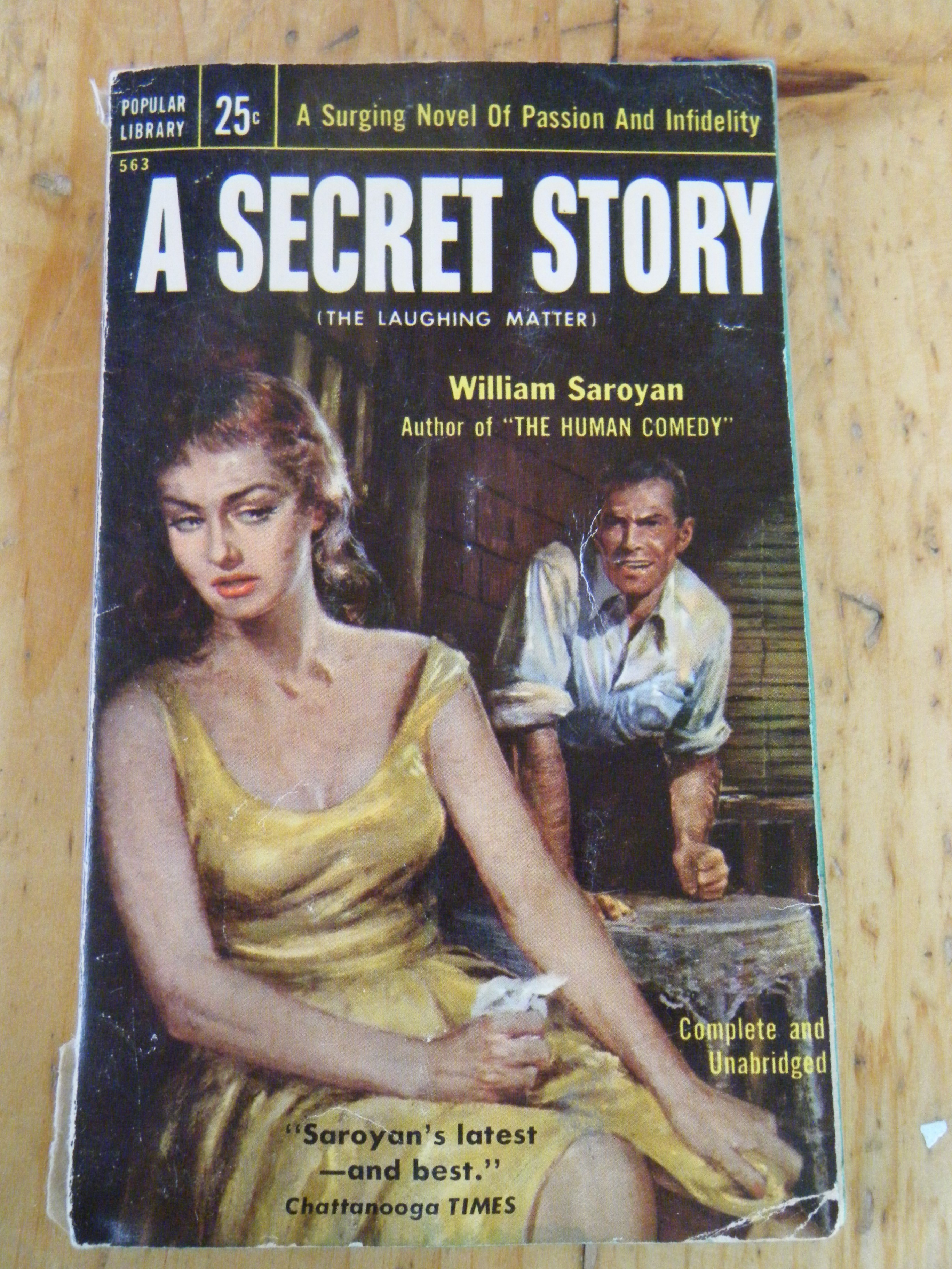
I picked up a copy of William Saroyan’s The Secret Story for fifty cents.  No doubt out of print now, this copy must have been sold on a drugstore rack.  I paid double the original book cost:  one whole quarter.  Check out the garish cover below.  It’s so slutty I’m a little embarrassed to be seen reading it on the elementary school playground.

The novel, however, is classic Saroyan, and for anyone who loves Saroyan that means exquisite.  The story has a tender appreciation for its characters, particularly its children, who often figure prominently in Saroyan stories and are never trivialized or portrayed as naive.  The underlying adult relationships, however, are rife with sin — greed and lust and unfulfilled desire — often cataclysmically playing out.

When I learned to knit sweaters, every time I saw someone in a handknit sweater who was amenable to undressing a bit, I asked to have that sweater handed over.  Then I turned the garment inside out and ran my hands and eyes over the knitting and seaming, to figure out how the sweater was created.  Likewise, with writing, I can’t help but turn a novel inside out.  How is this piece of writing put together?  In this Saroyan novel, I immediately noticed the vocabulary is simple, just a handful of words really.  A well-placed image of weeds in an irrigation ditch comes and goes with the characters:  nothing flashy or show-offy, merely a ditch one-fifth full of water, and remarking whether or not to dredge weeds from the ditch.  The writing relies heavily on characters revealing themselves through their own dialogue, distinctive and natural to each character.

Yet, reading this novel is like journeying down into a very deep pond, clear and transparent at the surface, increasingly murky and filled with microscopic, teeming life as the journey progresses.

David Budbill’s advice to himself is:

                                    Never be deliberately obscure.
                                    Life is difficult enough.
                                    Don’t add to the confusion.

I’d add here that might mean:  rely on your material.  Rely on the craft of your material.

A word again on that cover.  How I wish novels were still a quarter a book.  Wouldn’t we all read more?  The Secret Story is a racy story, filled with illicit desire, a scandalous pregnancy, a husband’s rage.  But aren’t we drawn to those elements because wild desire is part of our human world?  Isn’t plot — story — one of the most engrossing elements of who we are?  Why not revel in story?  Why not seek our own redemption through story? Why not love reading?

DSCF9846