“Like a definition of love…”

Eight summers ago when my daughters and I first moved into this house, we swam in a nearby pond, usually with friends who lived nearby. In those eight summers, the kids grew up and are now swimming in other lakes, other ponds. I kept on. The swimming and conversation was a peaceful way to end jammed and often chaotic working days.

Late last fall, as part of extensive testing after I was diagnosed with lymphoma, I realized I had Giardia, too, proverberial small potatoes compared to cancer and easily treated. This year, I never started swimming. In May, I’d endured a painful surgery with a lengthy incision that needed to heal. That nearby pond was the most likely source of the Giardia.

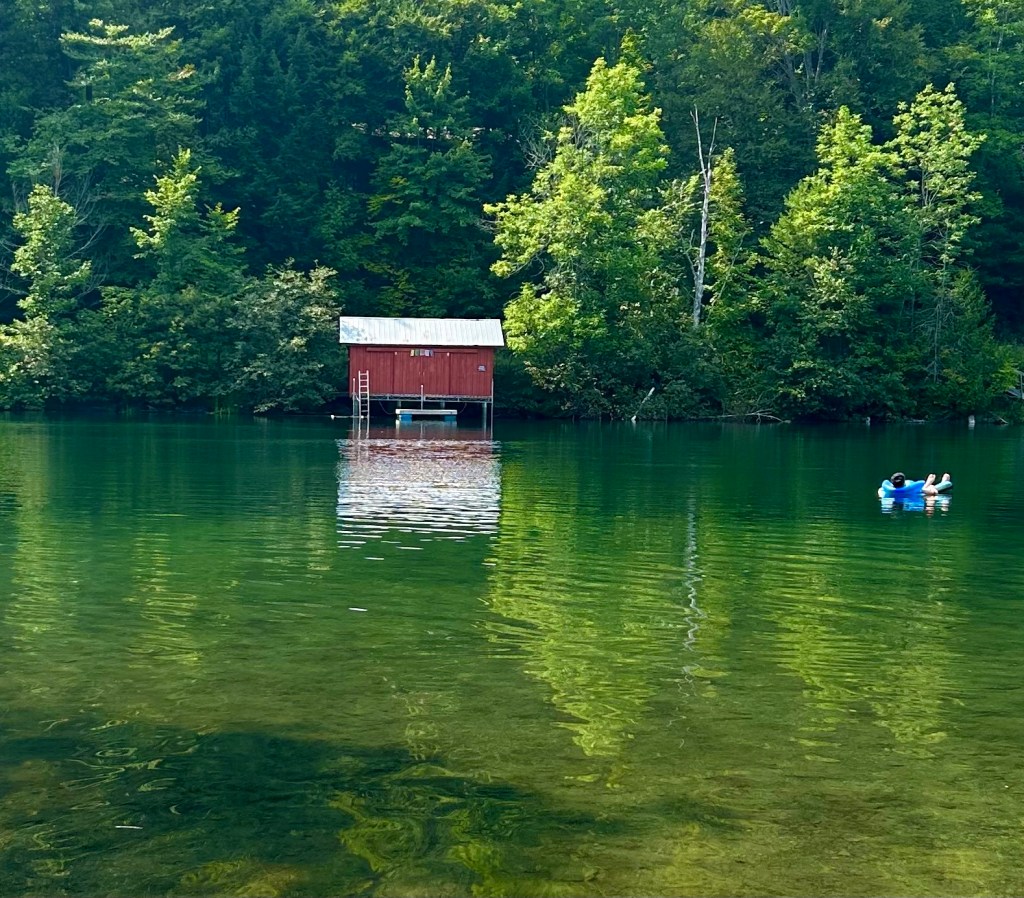
This August, a friend convinced me to swim at #10 Pond, familiar territory between our two houses, another place where my daughters and I swam and kayaked and picnicked. I arrived a few minutes early, opened my book, and the loons cued. This pond has always been one of my favorites: clear water, friendly fellow swimmers, scant motorized boats, little development. The water was cool. Kicking my legs, I felt my incision tug, but it was a sensation, nothing more. Afterwards, we lingered, drying and warming in the sun.

Yesterday, I was in sultry Barre and drove by the pharmacy where I had the go-around with the pharmacist and sharply insisted he fill my dilaudid prescription. I was on my way home from yet another lengthy stay at Dartmouth. We had to wait for the prescription, so my brother and I walked around Barre. It was early spring, hot, and the trees hadn’t yet leafed out. He’d parked on a hill and worried I couldn’t walk back up. I’d been on blood thinners, and the bandage around my IV site was soaked with blood. Don’t open it up! he warned me. It was so dusty and hot, and I was exuberant to be in the world where daffodils were blooming.

So yesterday, on my way home, I stopped at #10 Pond again, swam and read and listened to a nearby conversation between two men who were fishing — and the loons, of course, the loons.

We’ve now crested beyond the high summer. Each August day offers its own potential, for swimming or heartbreak or simply eating ripe peaches. Reader, wherever you are, love at least slices of your lives and places.

I’m about to send off a third novel manuscript to an interested party. In the dark this morning, I woke and began the book I’ll write about cancer and motherhood. Sure, cancer changed my life in small and great ways, but a year later it’s still the same me, rowing my life against the common current, compelled to write something that seems impossible.

And, for historical and record-keeping notes, I’ll add that the full moon, the Sturgeon Moon, rose smoky and red, ineffably beautiful over the cricket chorus.

“Green Apples” by Ruth Stone

In August we carried the old horsehair mattress
To the back porch
And slept with our children in a row.
The wind came up the mountain into the orchard
Telling me something:
Saying something urgent.
I was happy.
The green apples fell on the sloping roof
And rattled down.
The wind was shaking me all night long;
Shaking me in my sleep
Like a definition of love,
Saying, this is the moment,
Here, now.

… send what you will, I will listen.

This winter, I joined a Dartmouth Writing Circle for cancer patients. At that time, my waking hours were pretty much confined to the couch, endeavoring to stay alive, and I thought why not? I’ve kept on with this Circle. Compulsively, I keep writing about disease, but others write about aging parents, children and memories, picking strawberries — the necessary pieces of our everyday lives. Their poems and short essays amaze me. Maybe the lesson is this: suffer from a disease, pay attention, unfold your heart.

So yesterday, another trip to Dartmouth, but this time not to the door of the ER or 3K — the cancer center. My youngest daughter had signed up to walk in The Prouty, a weekend of fundraising. The four of us drove together, my daughters drinking coffee and laughing in the front seat, the boyfriend and I in the back. In the thousands of participants and volunteers, I met a few of my Writing friends as if kismet.

My family ate doughnuts and drank chocolate milk. We walked and ate watermelon and the sandwiches that appeared on tables as if by magic. At a long table, we lingered beneath a white tent, admiring babies and small dogs. It was at once a family event (my family, who pulled me through this winter) and a community embrace. When my daughter signed up (and a HUGE thanks to those who donated to her team), I didn’t, as I could hardly stand two months ago. Walk a few miles? Forget that. Now, my legs gaining muscle, my body healing, I walked between my daughters, so full of youth and quickness, of wit and curiosity. So profoundly of this world.

We live lives of forgetting, but I have not forgotten those long days in 3K’s infusion center, the chemo drugs dripping into my veins while I stared through the window at cardinals in the snow, or that night in the ER when the MDs in scrubs posed the possibility that I couldn’t finish the chemo treatment, that enough was enough for my body which was now, I noticed, described in my chart as frail. An adjective I immediately hated. Fuck frail. By that time, my flesh and my blood was suffused with zofran and dilaudid, lactated ringer’s, with the mighty rituximab…. But even though my bones and my flesh are my domain, my life is not. There’s a tendency in my circle of leftish rural Vermont to look at the medical world askance — an indulgence that immediately dried up for me when I first arrived in the ER. All along, I’ve asked for the data and facts; what am living through now and what might this mean? Beyond this, I was encouraged to embrace the mysterious complexity of disease, data, determination, the universe’s toss of the dice. When I said, go ahead, make me more frail, I’ll endure, the Good Doctor made that possible.

I have not forgotten that I am alive by the grace of medicine and strangers, by my family, by illusive fate itself. I carry this knowledge as all day long I go about my life of writing and working, of watering the flowering nasturtiums, eating peaches, reading novels and poetry and cancer research beneath the apple tree, as I walk through the sultry July twilights, that this will someday — this year, or 30 years from now — change for me, too, as it changes for everyone.

But for now, luscious watermelon. Later, a family dinner on the back porch, summer sweet.

From Ruth Stone:

… send what you will, I will listen.
All things come to an end.
No, they go on forever.

The limits of what we do.

Friday night, driving home along a familiar road from visiting friends, I stop by the elementary school. Solstice, the Strawberry Moon, the daylight lingers, and the dusk is long, multiple hues of blue. No one’s there, of course. I follow the path along the wetlands. Shimmering with lilypads and twilight, the water chirrups, sings, buzzes. Fish leap and splash. I loiter, and the dusk closes in. Still, I keep walking, following the path through the brushy woods up a slight hill, so I can get to the other side.

In my twenties, I had a tendency to get lost in the night woods, stumbling off the path. Years before cell phones, we were always searching for flashlights with working batteries, to visit somebody in a remote cabin. But I’m in familiar territory, and I take my time, in this bowl of evening, letting the cacophony of the wild chorus diminish my stringy thoughts.

I haven’t been back here for a good long while, but this school and the town and the library where I worked was a warm place, with its own complicated stories, sure. Those were the years when my life fell apart. I pause, hoping to see the quicksilver flash of a fish. Across the wetlands, a single vehicle rolls along the road. Maybe it’s the passage of time, or the evening’s mellifuous beauty, but I see suddenly that I was following two strands of my story in those years. I was leaving my husband (and for months, I wasn’t at all certain how to do that), and I was also recreating my life (and how exhilarating and hard that was, too.) I’ve written about my struggle with addiction; when I began to lift that veil, my fierce hunger quickened for what I had wanted all along — to pursue my own creative and often dicey life. In this throbbing evening, I sense the limits of language, that words fail here, that to divide creation and destruction into two words, held in two hands, is illusory.

The fish I didn’t see smacked through the water. Fireflies winked around me as I threaded my way back to civilization in the dark.

“Train Ride”

All things come to an end;
small calves in Arkansas,
the bend of the muddy river.
Do all things come to an end?
No, they go on forever.
They go on forever, the swamp,
the vine-choked cypress, the oaks
rattling last year’s leaves,
the thump of the rails, the kite,
the still white stilted heron.
All things come to an end.
The red clay bank, the spread hawk,
the bodies riding this train,
the stalled truck, pale sunlight, the talk;
the talk goes on forever,
the wide dry field of geese,
a man stopped near his porch
to watch. Release, release;
between cold death and a fever,
send what you will, I will listen.
All things come to an end.
No, they go on forever.

— RUTH STONE

Don’t confuse hunger with greed.

At breakfast, I mention to my daughter that June 6, today, is D-Day. I’ll write what perhaps she would not want me to write: that she’s standing at the counter making avocado toast and drinking yesterday’s cold coffee. She pours sriracha over the cut avocado. She’s 19, and, lord, a sheer miracle of youth, this gorgeous young woman.

I say, The soldiers were your age. Younger.

We stand staring at each other in our small kitchen of June sunlight. On our table lies a pile of unopened mail, our tabby cat Acer grooming his whiskers, car keys and lip balm, a hunting knife that could extract a man’s heart.

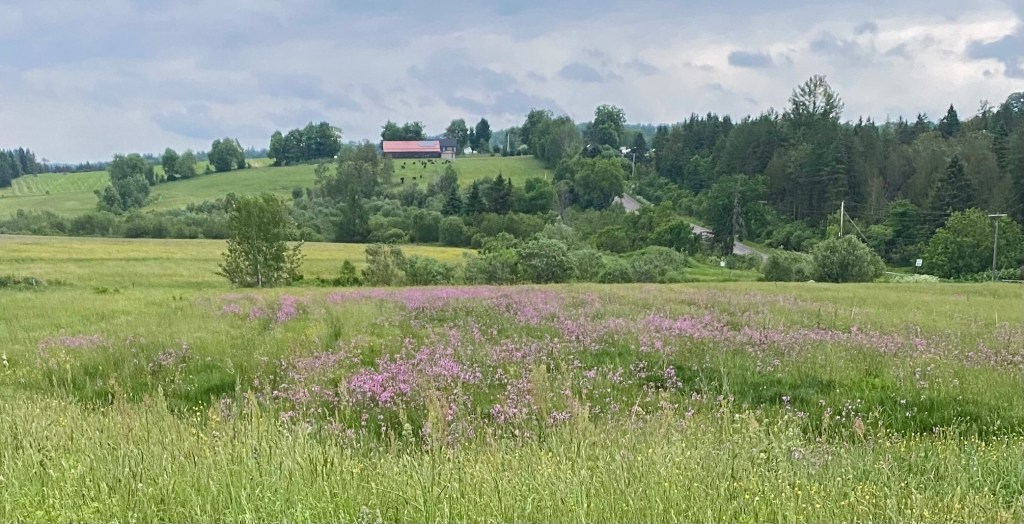
In the evening, I’m at the local arts center to see Nora Jacobson‘s documentary about poet Ruth Stone. The evening is still light when I drive home. I take the long way and pull over beside a field to admire the ragged robin, its pink spreading where the dandelions have gone to seed and green. In my Subaru, it’s me and that box of my mother’s ashes. I once knew a woman who kept her stepfather’s ashes for three years in a Datsun. Impossible, I thought. Now, I think, Sure, possible.

A day of such historical might, such profound sorrow. Yet, our own domestic dramas, the kitchen table stories: how real and meaningful these are, too. As a woman, as a writer, I’ve been thinking for weeks about Ruth Stone’s admonition: “Don’t confuse hunger with greed;/And don’t wait until you are dead.” In my garden, I grab a branch of lilac – the goregous white double blossoms, withering with rot – and breathe in the sweet fragrance.

There is only the wearing away,

The changing of means.

From Ruth Stone’s “Speculation”

Still Here, Hardwick, Vermont

I’m reading Ruth Stone in bed when my daughter comes up the stairs in her jacket and says I must go with her to look at the moon. It’s nearly eleven. We leave the younger sister sleeping with the cats, cross over the snow above my sleeping garlic, and leap the fence into the cemetery.

The moon shines like an enormous drop of cream, nearly round but not quite, waning. The two of us stand in the granite stones, over the sleeping dead, gazing up at the constellations sprawled over the dark sky, and the village below us, cupped in night-black mountains.

While my daughter sits on the ground with her camera, we talk about the landscape around us, and our family landscape. She’s so grownup now, so fully a young woman, that the terrain between us — always intimate, close — has opened like this starry sky.

On our way back, I’m tired, it’s true, and I carelessly place my Sorel boot sole on the jagged wire cresting the fence and not on the smooth bar. Carelessly, my eyes blinded with night, I ignore my own cautious worries about breaking a wrist and jeopardizing our slender livelihood. The wire snags my sole, and I fall to the cold ground at my daughter’s feet, my bare fingers in the snow. For a brief moment, the world turns upside-down, and I lie there in the beloved, beautiful moonlight, completely still.

And then life goes on. Isn’t that lesson enough? Life goes on.

Now snow falls again in ragged, loose flakes, and spring won’t hurry with my exhortations, but arrive when it will.

You have to take comfort where you can — in the nuthatches coming to the feeder, in the warmth of the wood stove, in the voices of your lovely grandchildren. You have to allow yourself to take joy.

— Ruth Stone

IMG_1457.jpg


Giggles, Girls, Growing

After a week of just too much, I sat knitting in the back row at the Galaxy Bookshop last night, surrounded by some adults I knew, and some I didn’t, listening to the four poets read in a round robin. The poetry and the poets all flowed into each other – stanzas about Garage Sale DayZ and an expectant father slid into a particularly exquisite love poem by Sean Prentiss.

Afterward, I spoke with his wife and admired how their baby girl smiles with her whole tiny, joyful body. In the warm June evening, scented with the town’s profuse lilacs, I lay on the grass under a sugar maple at the elementary school, waiting for my sixth grader at her first dance.

June’s blooming beauty – Siberian iris, deep purple lupine – and the children are happy. Beneath my palms, I could feel the earth herself, free from winter’s grip, breathing.

Do all things come to an end?
No, they go on forever….
The red clay bank, the spread hawk,
the bodies riding this train,
the stalled truck, pale sunlight, the talk;
the talk goes on forever;
the wide dry field of geese…
All things come to an end.
No, they go on forever.

– Ruth Stone, from “Train Ride”