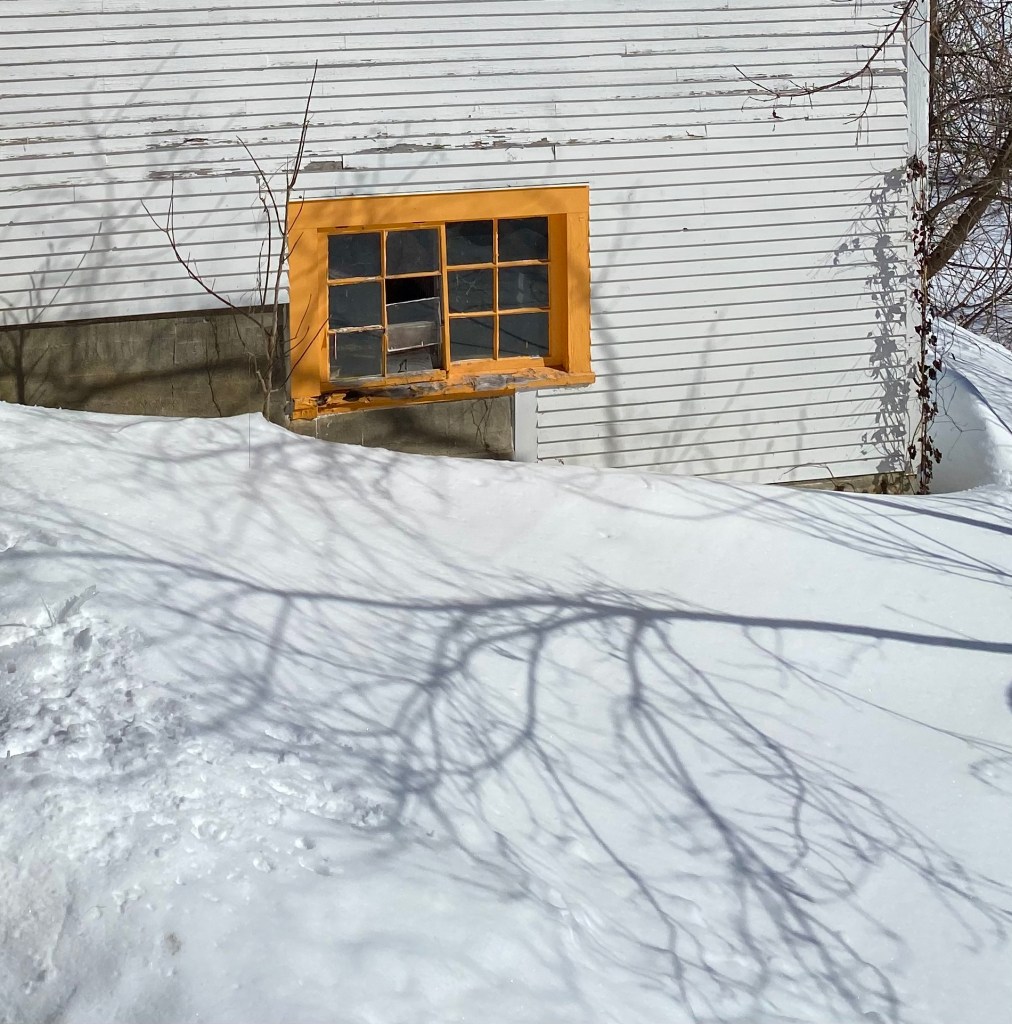
Town Plow, Wind Chimes.

Orange lights from the town plow sweep through my house, followed by the truck’s backup beeping. While I’ve been reading, the rain has fattened to snow. I stand in my kitchen, listening to the truck, wind jangling chimes hung on my back porch. All last winter, enduring through broken-sleep cancer, the plow’s whirling lights and safety backup were constants, a reminder that I was not the only one awake in town.

Again, winter.

I switch on the porch light and stand outside. Snow falls in infinite ways. This is not lacy and lazy flakes but dense wet bits. Quickly, quickly, the snow streams down. A new set of chimes this winter — not a replacement but a fresh voice for counterpoint — would be wise. This place no longer smells of broken leaf, damp earth, fragile fallen leaves turning to rot. Unstoppable, the falling snow shimmers in the lamplight, background of childhood delight.

Auto Mirror

In the rear-view mirror suddenly
I saw the bulk of the Beauvais Cathedral;
great things dwell in small ones
for a moment.

Adam Zagajewski, translated from the Polish by Czeslaw Milosz and Robert Hass

Small town, rural hospital, snapshot, tinge of the seventies.

Driving into the Dartmouth Hitchcock Medical Center, the soaring buildings with their blue-green windows inspire confidence. They’re just so darn topnotch, cream of the crest, but (in the cancer journey) I also use the nearby hospital, too.

At the local hospital, not far from our house, we arrive again in the dark, the crimson EMERGENCY sign glowing. My daughter leaves me at the door and disappears around the corner to park. Inside, it’s the same receptionist, who nods a little sadly to see me again. In the waiting room, there’s no one but me and the Mountain Dew machine, my reflection in the windows.

Months into this cancer, I’m familiar with the process (don’t ever put your feet on the ER floor without shoes!) of questions and fluids and meds, a room far away from the day’s flu and Covid patients. Here’s what has changed: the ER doctor and I know each other now. My brilliant oncologist calls me and thinks aloud, what’s going on now? and orders an unusual set of tests. The ER doctor listens, nods, yes, let’s try that. My daughter’s boyfriend appears. The three of us talk about xc skiing and DOGE.

I’ve crammed my backpack with my laptop and notebook, two books, and a few clothes. In the middle of the night, I’m admitted. The woman who takes me upstairs knows a longtime friend of mine. She tells me about growing up in eastern Montana. Wherever you go, she tells me, the sky is infinite. Vermont’s so small, I feel like I could put it in my pocket.

Having lived in the West, too, I sometimes chafe against the pocket-sidedness of Vermont but mostly I love it. I keep thinking of this woman’s description for these few days again, in this rural hospital that’s about the size of double pocket in the front of hoodie sweatshirt. The census is so low here the rooms are all singles. Each of the rooms where I’ve stayed seems to be finished with unique salvaged materials. Beadboard cabinets in my last room, painted glossy cobalt, line one entire wall. In this room, the window is trimmed with wooden rosette corners, the sill plastic faux marble.

The medical world is hurry up and wait, but this hospital leans back towards the 1970s. I drink Shasta ginger ale and chat with the LNA about the cold and maple sugaring. Here’s what changed in me: I see these people throwing everything they have at me. The hospitalist who advised me, just a day after the cancer was discovered, do not stay in bed; be part of the world. The social worker stops in and asks my daughter about her job. The chaplain and I talk Dostoyevsky and cats. The nurses who have survived their own savage cancers share their stories and let me ask my questions. I have so many questions. The questions narrow down to one: how will I survive?

Then I ask to leave. My daughter stops at the pharmacy for another prescription and texts that it will be a few minutes. I open the door and lean against her winter-salted car. I’ve been at this crossroads in this unremarkable section of town so many times. Across the road was the department store Ames where I bought this daughter her first pink ball so we could roll it between us, the baby version of Catch. In the Price Chopper parking lot, I used to meet people to exchange boxes of wedding favors in leaf or heart-shaped bottles, tied up with ribbons, for checks. Afterwards, I’d take my girls into Price Chopper and buy ice cream. Behind the pharmacy is a home center, where I’ll never go again, after my ex-husband absconded with his customers’ money and stiffed the home center… how many tens of thousands of dollars I never knew. I’d severed that cord by then. On the other side of the crossroads stands the hardware store where the girls and I used our pandemic stimulus money to buy a glass table and red umbrella for our back porch. We use those things every summer, nearly everyday.

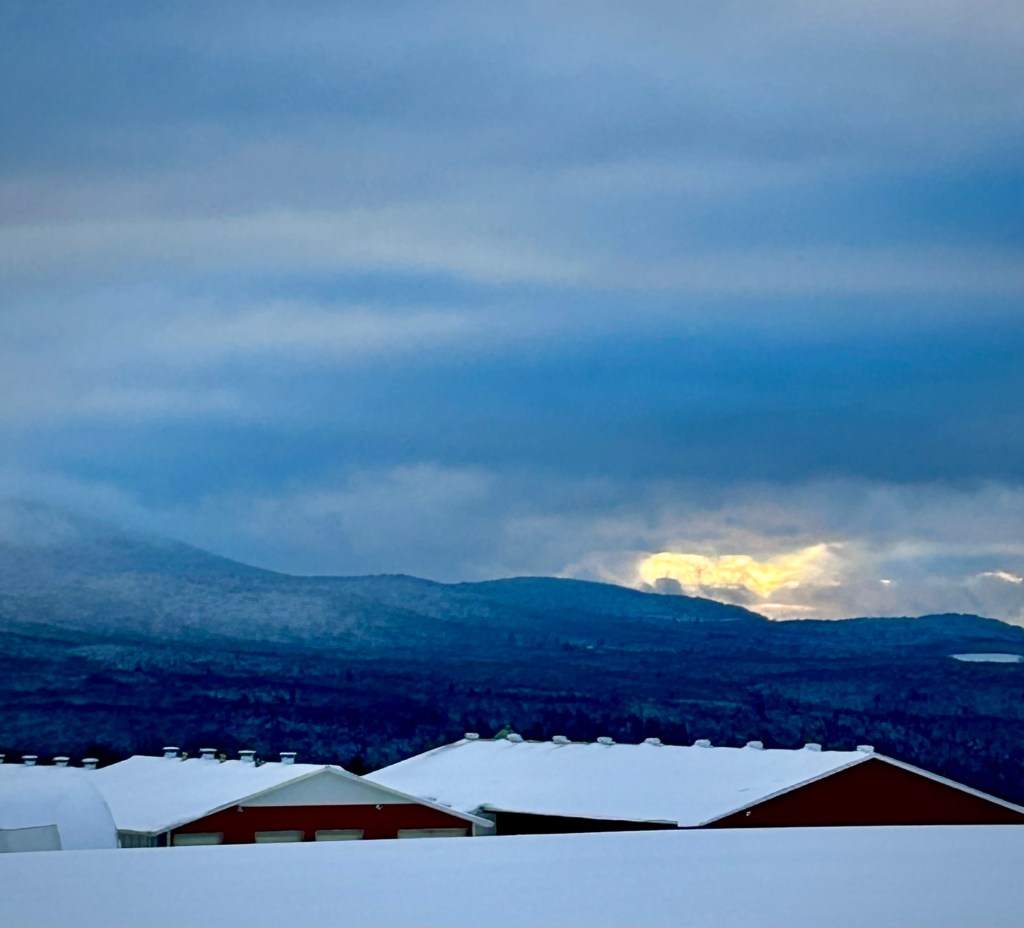
Behind Price Chopper, craggy Elmore Mountain looms, where I and the girls and their friends have camped and hiked and swam for years. The gentlest of snowfalls sifts down, swirling. My long-legged daughter crosses the lot, shades on despite the overcast sky, grinning.
In Very Vermont Fashion….

… I stopped by an art opening in a former brick stagecoach inn. In the Vermont way, the art was eclectic and superlative, the cheese local, the diminutive cupcakes homebaked, and the company excellent. My friend is the easy kind of person who doesn’t mind stepping forward with a plate of olives in her hand and introducing herself to a former library volunteer of mine whose name I can’t quite place….

Across the dirt road is an old barn where a stone labyrinth was placed a few years back. While my friend and I were talking, we watched two strangers do an excuse me, no, excuse me, sorting out who was going to enter the labyrinth first.

Small pleasures, friends, against the inevitable chaos of life.

Empty House

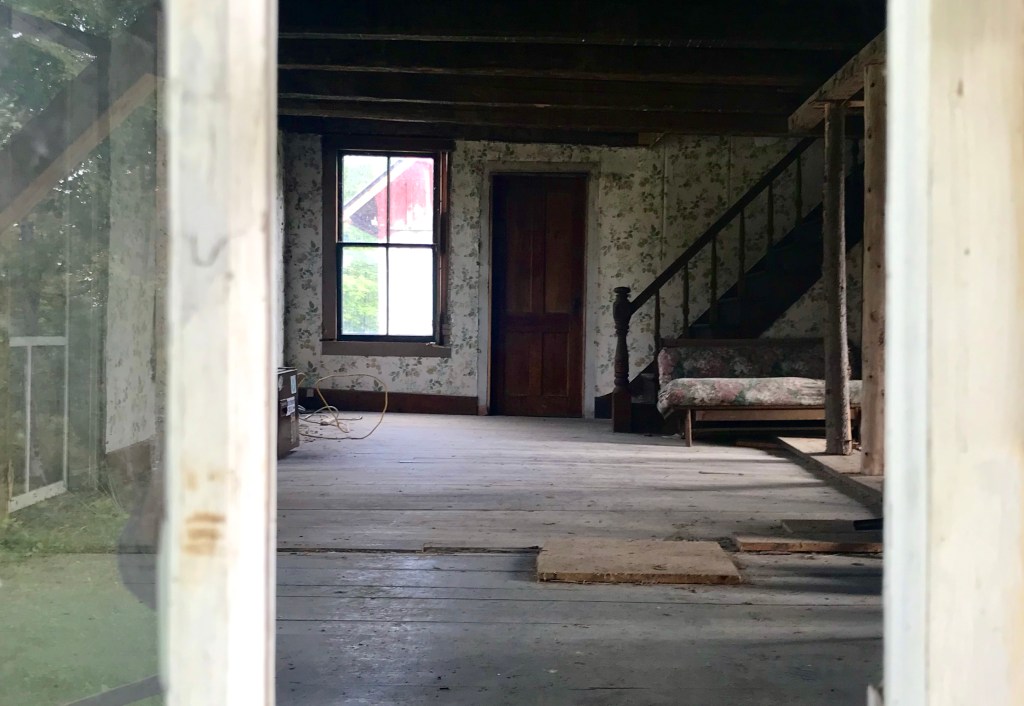
The afternoon’s end finds me on a remote road, looking at an abandoned house. No one’s lived here in a long time, save for intermittent squatters.

It’s the first day of school for my high school sophomore. Although I’m at this property for work, I keep thinking of my daughter.

Behind this house are two immense white pines. I stand there, listening to the breeze rising off Lake Eligo, imagining what it was like a hundred years ago to farm here. What will it be like a hundred years from now? The question looms impossibly.

I bend down and peer through a missing pane of glass in the door.

In Yaa Gyasi’s Transcendent Kingdom, I read a line from Thoreau: “Not till we are lost, in other words not till we have lost the world, do we begin to find ourselves, and realize where we are and the infinite extent of our relations.”

In so many ways, that sums up my experience. But that lostness I know now, is hardly a brief experience. The thing about the pandemic is that it’s exposed all the weaknesses in our society, and in ourselves, too. In my own world, I see acutely how pandemic has highlighted the near impossibility of single parenting, as I find myself these days unmoored, the thinness of my life exposed.

These days, in my work, I’m able to listen to people’s stories about how they’re experiencing the pandemic. These stories are often so much about loss — particularly about families separated — and worry about an uncertain future. Surely, I think, if there’s a time stories connect us, it’s now.

So on this first day of school, with the sweet scent of Vermont’s fall, with so much uncertain, I walk around this abandoned house, thinking of how time flows on. Near the step, I find a tiny plastic pig. Using the hem of my shirt, I rub dirt from the creature, then leave the toy on the broken step, hoping a child will chance upon it.

Visitor, An Ask

On a sleety day in rural Woodbury, the bright spot in my afternoon is the woman who walks to the library — a mile or so on slushy backroads because she and her partner have no vehicle. The truck died.

She checks out books, we talk about men and raising kids, the cost of living in Vermont. I’ve been working in rural libraries and schools long enough now that I quickly know who’s hard up versus who’s driving that old Subaru because an old Subaru might make them look a little less affluent. In the sogginess of March, my library visitor is sharp and funny, with an amusing eye for details. Sitting there, in the warm library, after a few hours of relative quiet to catch up on work, I winch, thinking of how carless-ness, unemployment, and rural Vermont can crowd up against a person.

When I leave, I drive her down the road to Hardwick, the two of us, talking, talking. It’s after 5, and while dusk isn’t far off, the day still holds light. She’s pragmatic about her chances for a ride back up the road. I never know. Then, just before she gets out, she asks for two dollars, for him, the boyfriend.

… understanding, and action proceeding from understanding and guided by it, is the one weapon against the world’s bombardment, the one medicine, the one instrument by which liberty, health, and joy may be shaped or shaped towards, in the individual, and in the race.

James Agee

IMG_1309

Broken Down Stuff

Vermont Public Radio is filled with cheery news. Worst Super Bowl. Lousiest State of the Union Address.

More locally, the Honda buried at the neighbors has fully emerged. Where the headlights should be are two gaping holes, the lights themselves on top of the car.

My 20-year-old sets her gas cap on top of her car and drives off in a rush. When she discovers this, I send her to the auto parts store, where she suspects the guys behind the counter are laughing at her. Why not? I ask. I laughed at you. Give me a little mirth, girl. She laughs, too, delighted the cap is nine dollars. What a deal I got, she says.

I resist pointing out that a better deal would have been not losing it. I’ve gotten a nine-dollar laugh out of this one.

It’s February. This is the time of year when things get worse in Vermont, but also better. I’ve lived here a long time, and generally I like living in Vermont. I actually like it very much, despite the things in Vermont that aren’t cool but are hardly endemic to Vermont—isolation and intergenerational poverty and the increasing bent in American life to see the world in narrowed vision.

This is the time of year when  cabin fever begins to creep in with a kind of communal silliness. We are all together in this. Even folks who foray out to Florida or California, winter is long, and then longer, and then even longer.

February marks the time of both weeping and giggling. The light floods back, more every day, crazy-making. Spring may be far off, but the scent is in the air.

IMG_4560.jpg