Wood.

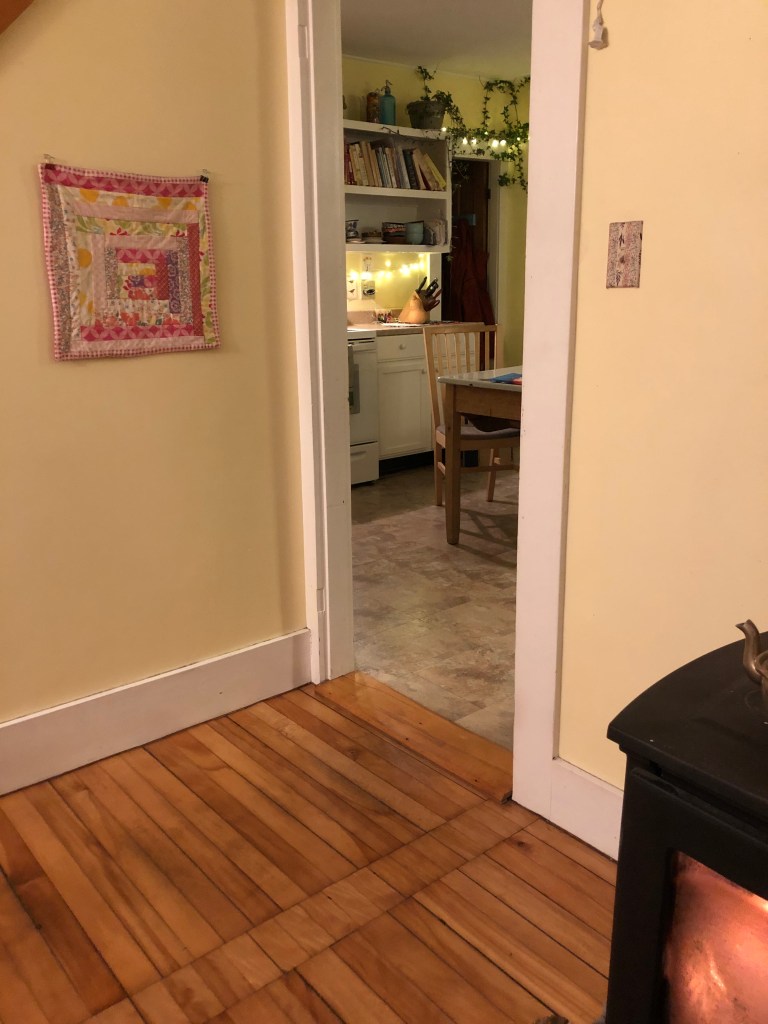
The wood man delivers cord wood not long after dawn. I’m in the kitchen with a manuscript spread over the table when I hear his truck beeping as he backs around the car my daughter left in the driveway’s middle late last night, returning from work. I lay clean spoons over my pages to keep them steady from my cat, who cares nothing about words or order.

The morning’s chilly, sunlight snagged in the crabapple blossoms, downy white.

I hand him a check, and we talk for a bit about maple sugaring and sap sugar content, about his mighty 17,000 taps, and burning wood. Can’t people remember to order their own firewood every year, anyway? He dumps the load and drives off into the rising day. Freshly split, the wood’s redolent with sweet sap, that forest scent.

Two weeks and one day out from surgery, each day I’m pulling along further. After a winter of chemo, I now have a gnash in my middle, a non-bikini scar, that renders all the more real this cancer. Nonetheless, I ordered a small $16 tree, a witch hazel. One daughter digs a hole, the other plants the tree. Healing, I’m required to restrain myself from stacking that wood, digging holes, tugging out last year’s Brussels sprout stalks that lingered all winter, blackening and rotting. My daughter rips up a stalk and shakes the soil loose. The plant’s tendril-like roots spread skyward.

Amazing, I say, what comes from a tiny seed, isn’t it?

She shakes it again, then tosses the stalk in the garden cart and moves on to the next plant.

“Tree”

It is foolish
to let a young redwood
grow next to a house.

Even in this 
one lifetime,
you will have to choose.

That great calm being,
this clutter of soup pots and books–

Already the first branch-tips brush at the window.
Softly, calmly, immensity taps at your life.
― Jane Hirshfield

“When the electricity shuts off, you boil water, you crack ice.”

In addition to showing up at Dartmouth-Hitchcock for chemo and consults to save my life, which thankfully appears to be going nicely, I also joined a writing group the hospital offers. Because writing saves lives, too.

Here’s a poem I read in this class, too good not to pass along.

“Chickens” by Kate Gale

I come from hay and barns, raising  
chickens. In spring, lambs come.  

You got to get up, fly early, do the orphan run  
sleep till dawn, start the feeding.  

When the electricity shuts off, you boil water, you crack ice.  
You keep the animals watered.  

You walk through the barn, through the hay smell, 
your hair brittle where you chopped it with scissors  

same ones you use for everything. Your sweater has holes.  
When you feed the ram lambs, you say goodbye.  

Summer, choke cherries; your mouth’s dry. Apples, cider.  
Corn picking. Canning for weeks that feel like years.  

Chopping heads off quail, rabbits, chickens.  
You can pluck a chicken, gut it fast.  

You find unformed eggs, unformed chicks.  
They start chirping day nineteen.  

You make biscuits and gravy for hundred kids  
serve them up good. You’re the chick  

who never got past day nineteen, never found your chick voice.  
You make iced tea. They say, you’re a soldier in the king’s army.  

At night, you say to yourself, Kathy, someday.  
We go walking. We go talking. We find a big story.  

A cracking egg story. A walking girl story.  
A walking out of the woods story. A not slapped silly story.  

A not Jesus story. Hush, Kathy you say, we get out of here.  
We find out where chicks go when they learn to fly.

Imagining a fox, two strangers in a canoe…

A fox runs out in front of me as I leave the library, so quick the creature might have been my imaginings in the night. Upstairs, people are still talking and laughing, remnants from the Selectboard meeting. Behind me, the man who lives down the road, with neither water nor electricity and is often at the library at night, his phone plugged into an outlet in the foyer that’s left unlocked, perhaps for this reason, says, “Saw it, huh? Fox.”

The sunset has simmered down to a liquified gold spill in the darkness. I pull into the beach. I’m alone here, and I get out of my Subaru and lie down on the wet sand. I can feel the damp sand clump into my hair. The waves lap. The spill of light shrinks. The crickets are doing their sizzling thing, and goddamn, here it is again, end of August, a goodbye to the sunflowers not far in the offing.

I spent so many hours of my mothering life at this beach, and now this summer has slipped by without a single visit to this particular beach. The sun goes down. And here’s the weird thing: while I’m lying there, dampening, dampening, wondering what’s up with the universe anyway? Why does it always feel like loss, loss, loss, a canoe paddles by. In a funk, I don’t bother to sit up and chat with strangers, but the couple steers their craft right onto the shore and asks what’s up with me….

So, I sit up and talk.

Turns out, even strangers, we have strangely similar intersecting points. In the dark, the lake lapping at their canoe, we stand talking while the stars blink on, just a few, in the cloudy night. Then, instinctively, as if in some kind of pact, we reach out and shake hands. Then I’m off to my home and my hungry cats, and the couple paddles on…. maybe an imagining, maybe not….

These Days…

Days and nights on the cusp of sugaring season. It’s been years since I made a living sugaring, but I haven’t forgotten the years the kids and I inhabited the sugarhouse for a month and more. Walking at dusk, as the night bites my eyes and the tip of my nose, I remember what close friends the weather and I were in those weeks of sugar and ash. The children were always in sodden snowsuits, or their fingers shivered from lost mittens, or their faces were crimson with heat, cheeks sticky with a maple patina. We ate oatmeal and nachos, drank coffee with syrup, baked pizza in the arch when the fire burned to coals. We were always hungry.

One night, a daughter sleeping against me in bed, I read a Louise Glück poem in the New Yorker while knitting a yellow bunny for that sleeping child’s Easter gift. I gobbled that poem, ripped it from the magazine, thumbtacked it over my desk. Forget it’s still February; the poem must be read.

March

The light stays longer in the sky, but it’s a cold light,
it brings no relief from winter.

My neighbor stares out the window,
talking to her dog. He’s sniffing the garden,
trying to reach a decision about the dead flowers.

It’s a little early for all this.
Everything’s still very bare—
nevertheless, something’s different today from yesterday.

We can see the mountain: the peak’s glittering where the ice catches the light.
But on the sides the snow’s melted, exposing bare rock.

My neighbor’s calling the dog, making her unconvincing doglike sounds.
The dog’s polite; he raises his head when she calls,
but he doesn’t move. So she goes on calling,
her failed bark slowly deteriorating into a human voice.

All her life she dreamed of living by the sea
but fate didn’t put her there.
It laughed at her dreams;
it locked her up in the hills, where no one escapes.

The sun beats down on the earth, the earth flourishes.
And every winter, it’s as though the rock underneath the earth rises
higher and higher and the earth becomes rock, cold and rejecting.

She says hope killed her parents, it killed her grandparents.
It rose up each spring with the wheat
and died between the heat of summer and the raw cold.
In the end, they told her to live near the sea,
as though that would make a difference.

By late spring she’ll be garrulous, but now she’s down to two words,
never and only, to express this sense that life’s cheated her.

Never the cries of the gulls, only, in summer, the crickets, cicadas.
Only the smell of the field, when all she wanted
was the smell of the sea, of disappearance.

The sky above the fields has turned a sort of grayish pink
as the sun sinks. The clouds are silk yarn, magenta and crimson.

And everywhere the earth is rustling, not lying still.
And the dog senses this stirring; his ears twitch.

He walks back and forth, vaguely remembering
from other years this elation. The season of discoveries
is beginning. Always the same discoveries, but to the dog
intoxicating and new, not duplicitous.

I tell my neighbor we’ll be like this
when we lose our memories. I ask her if she’s ever seen the sea
and she says, once, in a movie.
It was a sad story, nothing worked out at all.

The lovers part. The sea hammers the shore, the mark each wave leaves
wiped out by the wave that follows.
Never accumulation, never one wave trying to build on another,
never the promise of shelter—

The sea doesn’t change as the earth changes;
it doesn’t lie.
You ask the sea, what can you promise me
and it speaks the truth; it says erasure.

Finally the dog goes in.
We watch the crescent moon,
very faint at first, then clearer and clearer
as the night grows dark.
Soon it will be the sky of early spring, stretching above the stubborn ferns and
violets.

Nothing can be forced to live.
The earth is like a drug now, like a voice from far away,
a lover or master. In the end, you do what the voice tells you.
It says forget, you forget.
It says begin again, you begin again.

— Louise Glück

Falling.

The outside light flicks on early this morning, and my little cat Acer stares wide-eyed at a skunk making its snuffling and curious away around a flowerpot I left on the back step. Well before dawn, the cats are already fed, the kitchen warm, redolent with coffee, and here’s this wild creature, not in the least troubled by the two of us.

The skunk waddles on its way. Shortly afterwards, snow and chunks of ice rush down the house roof and crash on the porch, softened in the rising temperature. My cat runs. I wonder about the porch railing which snapped in prior years, but nothing appears broken. The design is poor — steep roof and wide porch and slender railings — and I let myself wonder just for a moment if this is some kind of hidden cosmic twist, a long-buried plan from when my former husband built this porch. I cut off that sentiment. This far along in life, I’m well-acquainted with the steepness of roofs and the precariousness of ice and snow and dynamic temperature. Gravity is not ruled by human desire.

At the other end of the day, I’m carrying in a few armloads of wood from the barn when another ice chunk falls, shaking the porch where I had tread a moment before. Through the glass door, my teen raises her hands — what’s happening? — Acer at her feet.

The cold’s drilling back in for the night. In the valley below, the village twinkles in the darkness. The wind whirls around the scent of woodsmoke. I step back, finally wary. The roof has cleared.

When you’re young, you are certain of your capacity to imagine a way out of the previous generation’s problems. There is a different way to grow old, paths that don’t involve conforming and selling out….

— Hua Hsu, Stay True

Onion Skins. Monday Morning.

In Vermont, winter has begun in earnest. My daughters ski in snow-and-freezing rain, then return home to sprawl around the wood stove with hot chocolate and homework. The red tulip bulbs I planted last autumn seem like a dream.

I carry the compost out, and a cold wind rushes over my potato patch.

My daughter makes toast this morning before heading to work in the bitter dark. I remember the winter she was four, and I baked a red velvet cake with her, to brighten our world. Little things, I remind her, are the stuff of our bigger lives. Day by day, towards spring ephemerals.

…. you who want to grasp the heart

Of things, hungry to know where meaning

Lies. Taste what you hold in your hands: onion-juice….

— Suji Kwock Kim, Monologue for an Onion