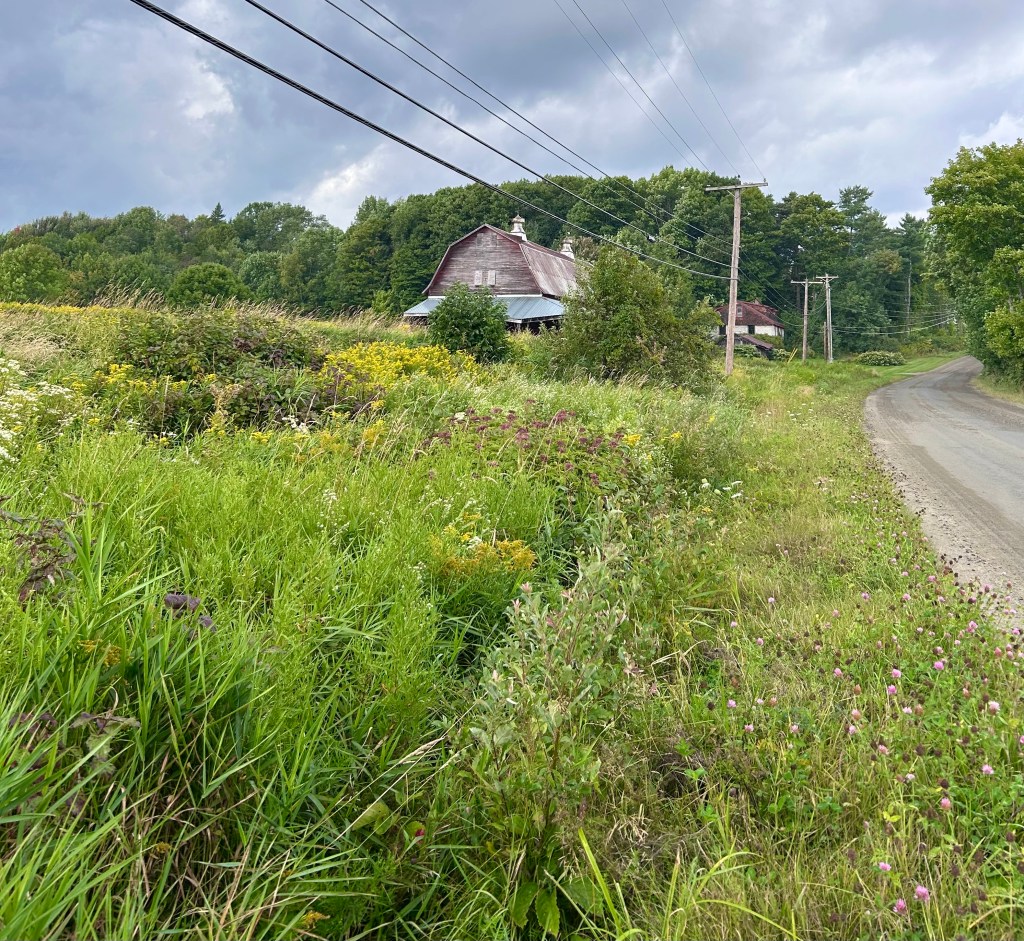
Tangled Wild.

A little rain falls when I’m done with work for the day, nearly seven in an evening filled with August’s sultriness. There’s no one in the electric department parking lot where I swap jeans for running shorts, and then head on the stony trail through the woods and down to the river.

August, the growing of weed and tended garden finished for this season. The apples are reddening. The blackberries that remain on the vine burst with juice, sweetness on the verge of rot.

I cross the river. Raindrops pebble its slow surface. I loop behind the old yellow barn that houses a warehouse of local cheese, then circle around the osprey nests where the Black River pools behind an old dam. My t-shirt is damp with sprinkles of rain and my sweat. Grateful I am to a friend who appeared with a glass cup of echinacea this week. In the spring, I’d mused that, a year out from cancer treatment, that was as far back as I would come. “Really?” she mused quietly. “You might question that.” Now here I am, running around the edges of this village, along this rain-kissed goldenrod.

Anne Sexton wrote about “the awful rowing towards God,” a poet I read in grad school, a woman crazed by not one simple cause. For so many years, I clenched my wooden oars, my rowboat with my children circling in eddies, plunged through rapids, in a journey breathcatching sometimes from fear and uncertainty, sometimes through the sheer awesomeness of the vaulting night sky, the companions of swimming dolphins.

Much as I chafe against a linear view of time, I see myself running around the brackish reservoir, then along the gentle slope back to my car and the mason jar of water I’ve left there to quench my thirst. I run with my whole story a whirlwind in my body and mind, known and unknown. Surely, as we rush headlong forwards, we’re always going backwards, too. And yet we row on, the work of this mortal life.

Oh, Anne Sexton, with her unhappy demise. Two years ago, I often ran along this path and discovered wild grapes down an embankment. The rain paused, I scramble through weeds. The grapes are there again this late summer. I gather these sweetly tart beauties in the hem of my t-shirt. Eating, I walk along the path, studying the soot-stained clouds. My friend with a new baby in a stroller appears around a bend. I offer this young mother a handful of grapes, and she spits seeds into the trailside milkweed. Sweaty from August and running, I bend down to admire the babe. Scuttling clouds are reflected in the child’s luminescent eyes, her smile quicksilver as a rainbow trout in a rushing mountain stream.

As the African says:
This is my tale which I have told,
if it be sweet, if it be not sweet…
This story ends with me still rowing. — Anne Sexton
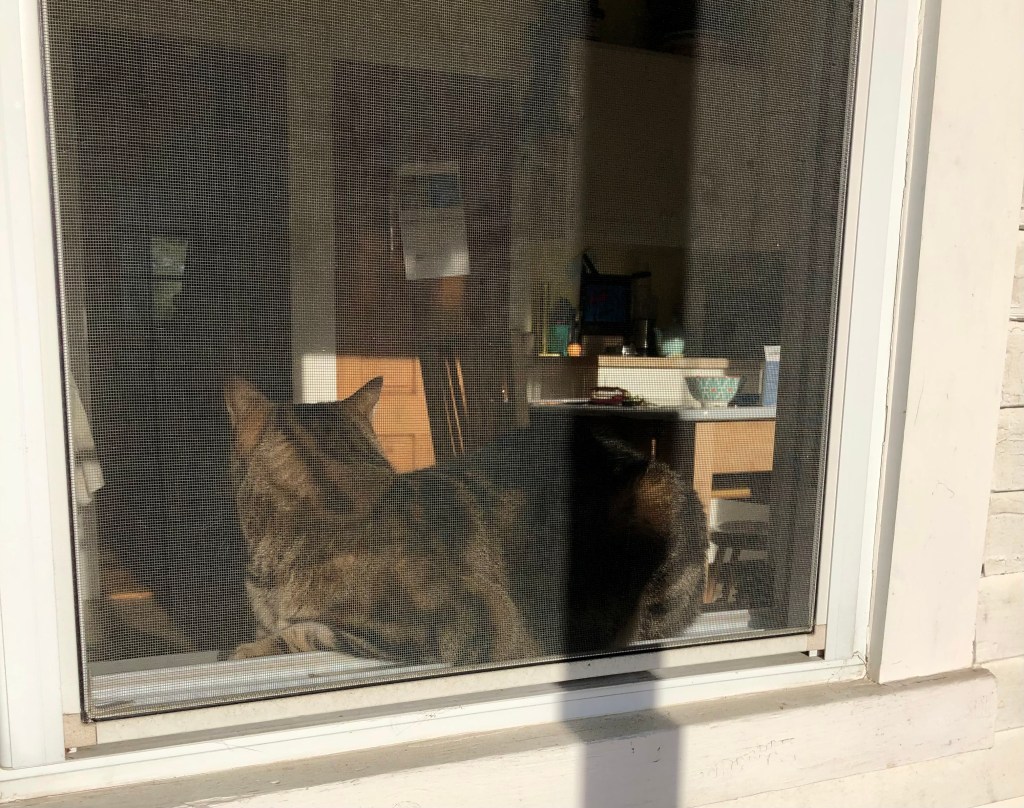
Time Out of Mind.

On the town forest trails, I spy two deer. Across the fallen leaves, now brown and dry, we eye each other. If I hadn’t seen a flicker of white tail, I would have kept running. But I have seen them, and so I determine to wait. I’m in shorts and a t-shirt; it’s so freakishly warm for November that people seem to be in a tizzy of utter delight tinged with dawning horror that this climate change thing, it’s really moving along. Nonetheless, these days are sweet.

The deer nearer me turns her? his? head just over one shoulder, checking in perhaps with the companion. Then they turn together and run. At the top of the hill, white tails bouncing, the creatures stop and look back at me, perhaps in nothing but curiosity. They vanish into the woods.

This is a November when I let the fire extinguish in the woodstove, hang the laundry outside, open the windows and make my cats happy. I chop apples into halves and quarters and eighths and throw the pieces into muffin batter, as if the world can measured and understood by rudimentary math, by counting two eggs and a quarter-cup of milk. In the afternoon, I abandon my thoughtful list of chores and lie in the weeds behind our house, reading Maggie O’Farrell, journeying imaginatively back in time to a Duchess’s life. It’s the same question that’s mesmerized me for years: how much of our lives do we determine and how much is dumb fate?

In the sunlight, I sleep and then wake breathing the complex scents of warm, humusy soil and spicy green leaves, and around all the dry crumbles of what this year’s frost has already bitten. In the cemetery behind my house, a man and a boy fly red kites, the long tails fluttering like ribbons.

Running.

Fisher Railroad Bridge, Wolcott, VT

Twice in one Friday, I’ve met acquaintances from long ago — the first at the coffee shop, the second at the transfer station. Now, having lived here for thirty years, I run into people who I’ve known in the past — maybe not well — but I know deep parts of their stories. I wonder what parts of my life they remember — and if I remember my story as they do.

On the way back from the transfer station, I stop along Route 15 and admire the Fisher bridge, the last of the covered railroad bridges in Vermont. Such effort went into building this infrastructure, and it was used for such a comparatively short time.

Because I’m wearing my running shoes, I follow the graveled rail bed. I cross the highway and follow the former track bed behind the lumber yard that smells sweetly of sap and freshly milled boards. There’s no one around on the rail bed at all. I run on the path right beside the river. The river is wide and slow moving, relatively tame for April. We’ve had little rain and less snow. I chance upon a pair of nesting ducks, and the mallard leads me away. I imagine in the heat of July how lovely it might be to swim across this water.

I stop to catch my breath. It’s me and the glossy mallard and the breezy cold afternoon. I wonder if we’re pulling out of the pandemic, truly. The brisk late afternoon takes my wondering and tosses it downstream. Eventually, I turn around and head back to wherever it is I need to be.

“It’s lovely to live on a raft. We had the sky up there, all speckled with stars, and we used to lay on our backs and look up at them, and discuss about whether they was made or only just happened.” 

~ Mark Twain