Life can only be understood backwards…

Kierkegaard wrote that famous line, “Life can only be understood backwards; but it must be lived forwards.” This is the story of my life, and probably of yours, too. I’m a few weeks shy of a year away from the last chemo session. During those hours of infusion, I dozed, watching cardinals and house wrens through the cancer center window. That night, I slept profoundly, believing done, done, not yet realizing an excruciating surgery would lear up unavoidably a month later, that I would phone my siblings and beg for their arrival, that I needed fresh horses, the calvary’s arrival, that the end to these months of cancer treatment seemed impossible.

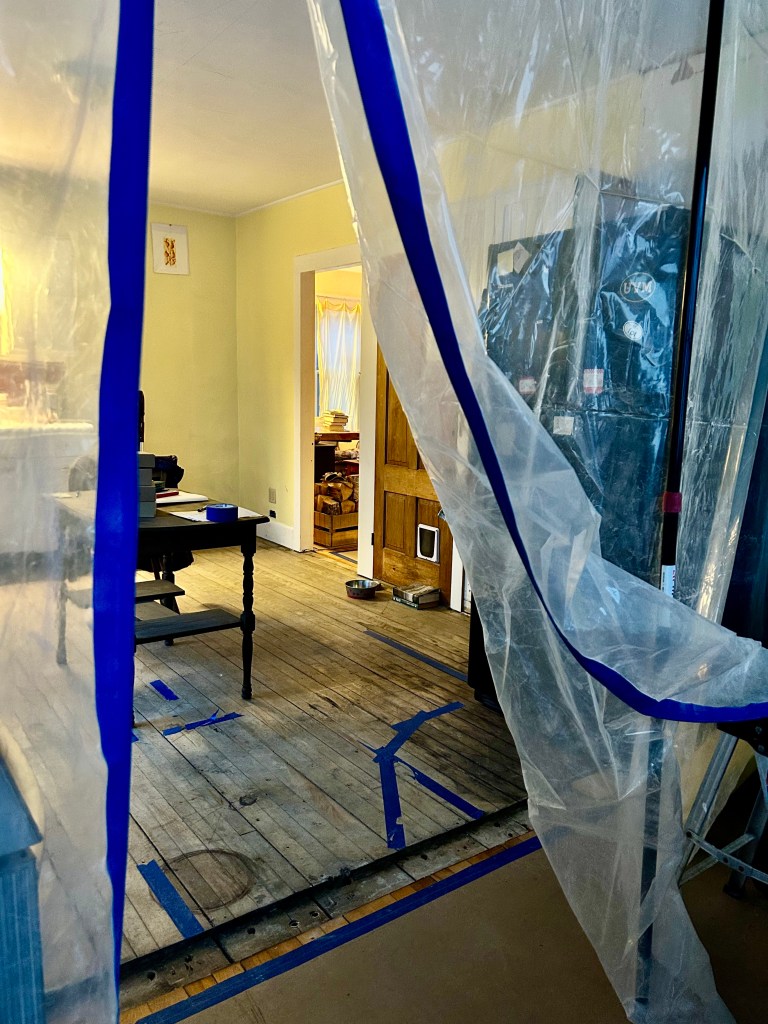
A year later, I’m still here, living forward, still waking before dawn to reckon what kind of light might kindle the day. A year ago, I could hardly lift my laptop. Now, I text a friend to borrow a belt sander. I am determined to lean my shoulders and back into revitalizing this old wooden floor that had been hidden for years beneath vinyl.

Cancer reshaped me in multiple ways, diluted my rage, cushioned my prickliness, whetted my fierceness to entertain no truck with catty foolishness. Disease fed my solitude and forced me to reach out and grasp hands. And now a sander.

A friend recorded Vermont’s poet laureate Bianca Stone speaking about Robert Frost. The recording is up for a few weeks on the local radio station, WGDR, on the March 22 Bon Mot show; it will feed your heart.

And one of my favorite Frost poems:

Into My Own

One of my wishes is that those dark trees,
So old and firm they scarcely show the breeze,
Were not, as ’twere, the merest mask of gloom,
But stretched away unto the edge of doom. 

I should not be withheld but that some day
Into their vastness I should steal away,
Fearless of ever finding open land,
Or highway where the slow wheel pours the sand.

I do not see why I should e’er turn back,
Or those should not set forth upon my track
To overtake me, who should miss me here
And long to know if still I held them dear.

They would not find me changed from him they knew—
Only more sure of all I thought was true.

Dusky December

Vermont December is not the season of picking garden zinnias or gathering wildflowers.

December is the season of intentionality: wear a hat and mittens everywhere, dry your boots before the wood stove when you return, drive carefully on the slippery roads.

As the holidays edge in, I keep on with my daily routines of tending the fire, going to work, checking in with my daughters about who’s cooking dinner. On the more submerged level, our lives go on, too. My youngest dreams of her future. I read about the bad year 536. In these early winter days, I return to my original love affair with reading — novels. Fiction reminds me, over and over, in an infinite number of ways, why we love this world.

The pandemic has taken plenty from us — much more from so many people than my little family. But it’s also given us this tiny quiet space, too, like the breath at the beginning of each day, just before dawn. In this space, I see my path could bend many ways. Don’t, I caution myself, write a mad letter to the former in-laws. Instead, leave Christmas gifts of homemade soap on the neighbors’ front steps.

“The best way out is always through.” 

― Robert Frost

Rave On

For days, I’ve inhabited the post-root canal world where a sledgehammer banged my jaw. This morning, my young daughter made me coffee and noted, You’re laughing. You must be coming back to life.

This first of May, a steady rain is muddying the woods, jamming the streams near to full, washing clean every bit of green in the garden. Bring it on, I think: frog eggs, emerging salamanders, the ephemerals untangling from the matted forest floor. New England winter is spare, stripped down to straight lines, but spring is all wild, unfurling mightily and messily.

Yesterday, in my broken tooth stupor, I drove to Montpelier to hear poetry. Dede Cummings, of Green Writers Press, read Birches extraordinarily well in that quiet, sun-filled room. Like numerous people, that poem has risen many times in my life, from the first I read it, in 8th grade, to most recently a few summers ago, when my friend Tim Smith had my daughter read it aloud before dinner one gorgeous Colorado evening.

This afternoon, my body unknotting from pain, the neighbors’ boy turning ten this very day, the children enmeshed in their imaginative worlds, our kitchen filled with the fragrance of baking cinnamon, I think, what sheer luck to live in a world where Birches is possible. What sheer luck, this down-pouring day.

So was I once myself a swinger of birches.
And so I dream of going back to be.
It’s when I’m weary of considerations,
And life is too much like a pathless wood
Where your face burns and tickles with the cobwebs
Broken across it, and one eye is weeping
From a twig’s having lashed across it open.
I’d like to get away from earth awhile
And then come back to it and begin over.
May no fate willfully misunderstand me
And half grant what I wish and snatch me away
Not to return. Earth’s the right place for love:
I don’t know where it’s likely to go better.

– Robert Frost, “Birches”

IMG_1085

May 1/Woodbury, Vermont

The Undertow

Deep in the night, I woke thinking of a Raymond Carver story I had been reading, “Will You Please Be Quiet, Please?” My children had found this title infinitely amusing, riffing on it as a joke between the two of them.

All night long, while the girls and I had been sleeping, cumulus clouds floated over our house, the full moon shining through like a light at the bottom of an ocean turned upside down. I opened the door and stood on the balcony, imaging myself a clipper ship surrounded by this sea of luminescence. In the distant east, just over Woodbury Mountain’s black ridge, shone a single star. In the moonlight, I saw through the sparse woods the edge of the town’s tiny cemetery, where the slatted fence peels white paint.

The Carver story, simply, is about marriage, and it’s not a funny story at all. It’s about conundrums and paradox, about the mysterious, hidden parts of our lives. And yet, standing beneath that marvelous night sky, I watched the moonlight rush cloud shadows over the earth. I was glad to be awake.

…We could have some arrangement
By which I’d bind myself to keep hands off
Anything special you’re a-mind to name.
Though I don’t like such things ’twixt those that love.
Two that don’t love can’t live together without them.
But two that do can’t live together with them….

From “Home Burial” by Robert Frost

IMG_1037

Hardwick, Vermont


River Ice

Late, yesterday, bringing in firewood, I walked up into the woods just before snow descended with all its might and majesty. Dark was coming in, and I hiked to where I could see the blue ridge of Elmore Mountain in the distance across the valley. Standing perfectly still, I heard nothing, not a single sound, until merely the wisp of my own breath pried open that silence.

The river today is filled with flowing chunks of ice, green like water residing deep in a quarry’s bottom. We woke this morning to icy grapple against the bedroom windows, the wind skulking around the house, like a wild animal, eager to enter. All the wildness of winter returns, the icy realm returned in all its mighty fury – and unspeakable, very earthly beauty.

DUST OF SNOW, by Robert Frost

The way a crow
Shook down on me
The dust of snow
From a hemlock tree

Has given my heart
A change of mood
And saved some part
Of a day I had rued.

IMG_0497

Fall Hiking

In this yellow autumn, the girls and I hiked down through Sterling Gorge, a short hike above water tumbling through the narrow cut of rocks. At the trail’s bottom, the stream evened out, and sunlight dappled through leaves. The hike down had been chilly and somewhat dark, shadowed by hemlocks, but the spit of gravelly sand along the stream was light-filled. I had woken that morning feeling as though I had fallen down a flight of stairs, the bones in my back and hips mere pieces strung together with the jangling cord of my vertebrae.

I lay on a fallen birch log and watched sunlight flash in shapes over the running stream, thinking how we’re all just bits and pieces of bodies, water, sparkling sunlight, gritty sand, my own bones and flesh and flowing blood, ever moving, shapeshifting, evolving, turning from this to that.

Nature’s first green is gold,
Her hardest hue to hold.
Her early leaf’s a flower;
But only so an hour.
Then leaf subsides to leaf,
So Eden sank to grief,
So dawn goes down to day
Nothing gold can stay.

— Robert Frost

IMG_0061

Woodbury, Vermont