The Word Domestic, Depths.

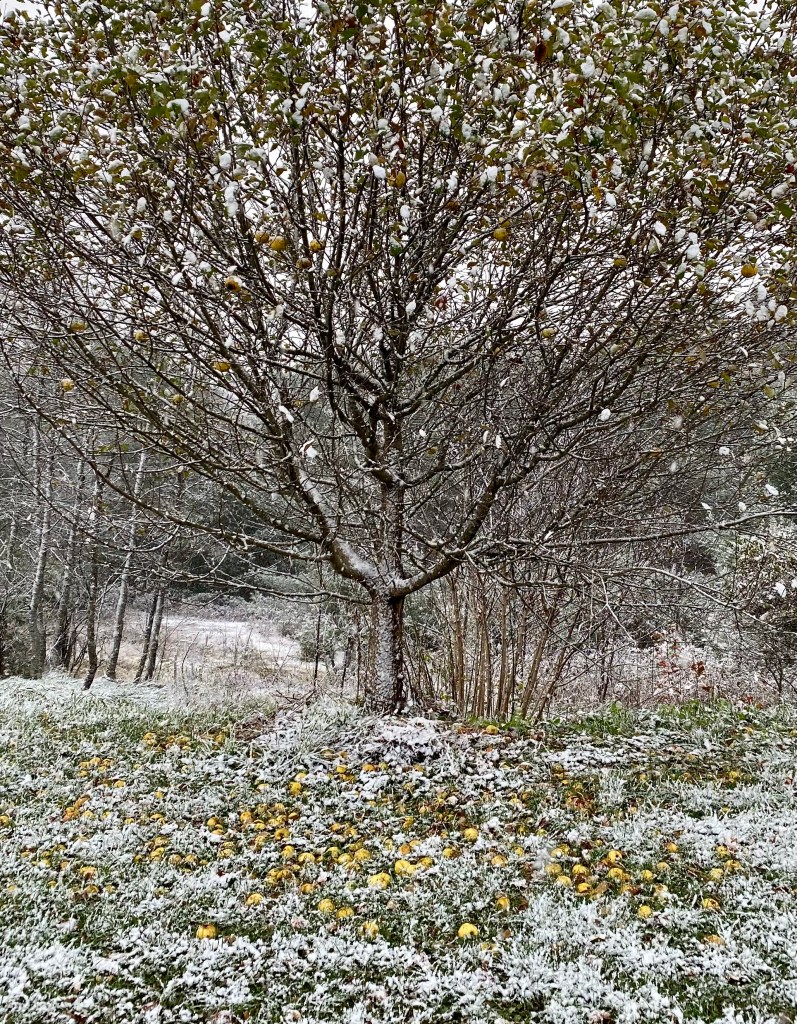
Snowglobe snow falls in the late afternoon. November light: clear and sharp. Not much warmth here, not any season for sleeping rough and roofless, but sparkling as if our world has expanded. In an inexplicable way, the light seems washed full of hope.

The summer folks have fled elsewhere, to Florida condos or back to city jobs. The gardeners and landscapers have put away their rakes and trowels. Around the lake where I walk at midday, only the builders persist in their bulky jackets and gloves. There’s so few of us in town that me wandering by is the chance to stop and remark about stick season. At the lake’s pebbled edge, I dip in my fingers. Before long, ice will rim the bank.

Stick season and the wood stove’s warmth make my cats deliriously joyful. Rumaan Alam (such an amazing novelist!) writes in his intro to Helen Garner’s The Children’s Bach:

Let’s agree to abandon forever the idea that the depiction of family life is the province of women artists, and therefore insubstantial. Let’s refuse to hear a sneer in the term domestic.
The Power of Maples.

This year, my extended world includes widows, including women mentors I looked to when I was a young mother. These women are all somewhat older than me, with long marriages. It wasn’t that long ago I was in the world of the new babies, the swapping of baby clothes, the intent to get the low-down about cloth diapers versus disposable.

There’s a line from one of my most favorite novels, Red Sky at Morning by Richard Bradford, about a woman widowed in World War II. Like a teacup, she would crack, but not break. Same.

Rain’s washed our world last night, and the sun is radiant this morning. While hanging out the laundry, I think of an acquaintance who says he’s still trying to figure out his life. But aren’t we all as grownup now as we’re ever going to get? The birds and squirrels scavenge in my flower garden, gathering for their families.

Here’s “The Power of Maples” by Gerald Stern which seems apt on myriad levels today:

If you want to live in the country
you have to understand the power of maples.
You have to see them sink their teeth
into the roots of the old locusts.
You have to see them force the sycamores to gasp for air.
You have to see them move their thick hairs into the cellar.
And when you cut your great green shad pole
you have to be ready for it to start sprouting in your hands;
you have to stick it in the ground like a piece of willow;
you have to place your table under its leaves and begin eating.

Impossible Zen.

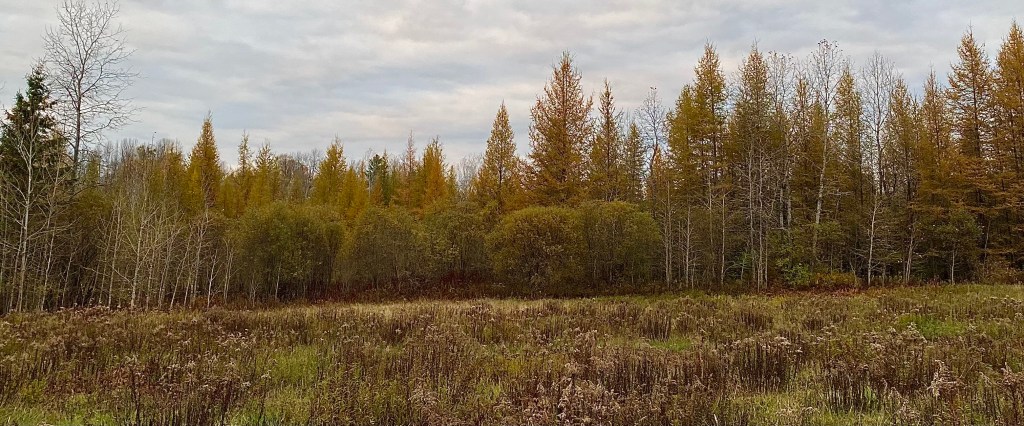
There was a time in my life where I didn’t yet know about the tamaracks. It’s an odd thing to think about: there was a time in my life when I hadn’t yet met my daughters, either, when I hadn’t read a novel, kissed a boy, slept under the constellations.

I head up through the woods to the tamaracks’ marshy place where I’ve never seen anyone else, a swampy patch off a road. In the gray afternoon gloaming, I wander off the path. I’ve forgotten my boots. I trip on a rock and fall on one knee. The twilight settles in silently.

On my way home, I stop in at the co-op. The co-op’s not really a co-op any longer, the handwritten baby announcements and politics scrubbed out in this new business model. In the produce area, an acquaintance is buying peppers. We stand at the wall of produce, kicking around a few thoughts. We agree, this has been a year of unbelievable things; there’s no need to list. I offer my micro philosophy I’ve mulling around, very Zen. As I’m talking, I remember the whole problem with Zen, anyway, is its impossibility.

At the register, the cashier can’t figure out a bag of greens. But what is it? he asks. The man in front of me says he liked the sunflower sprouts, so he’s trying the radish ones now. Micro greens?

Through the wide windows, I realize I’ve been out for much longer than I realized. Darkness is falling quickly now, car headlights sweeping through the village. The man lifts his bag of slender greens, crimson roots, and turns it around and around.

Good luck, I offer.

He nods, and then disappears into the night.

Autumn Mysteries.

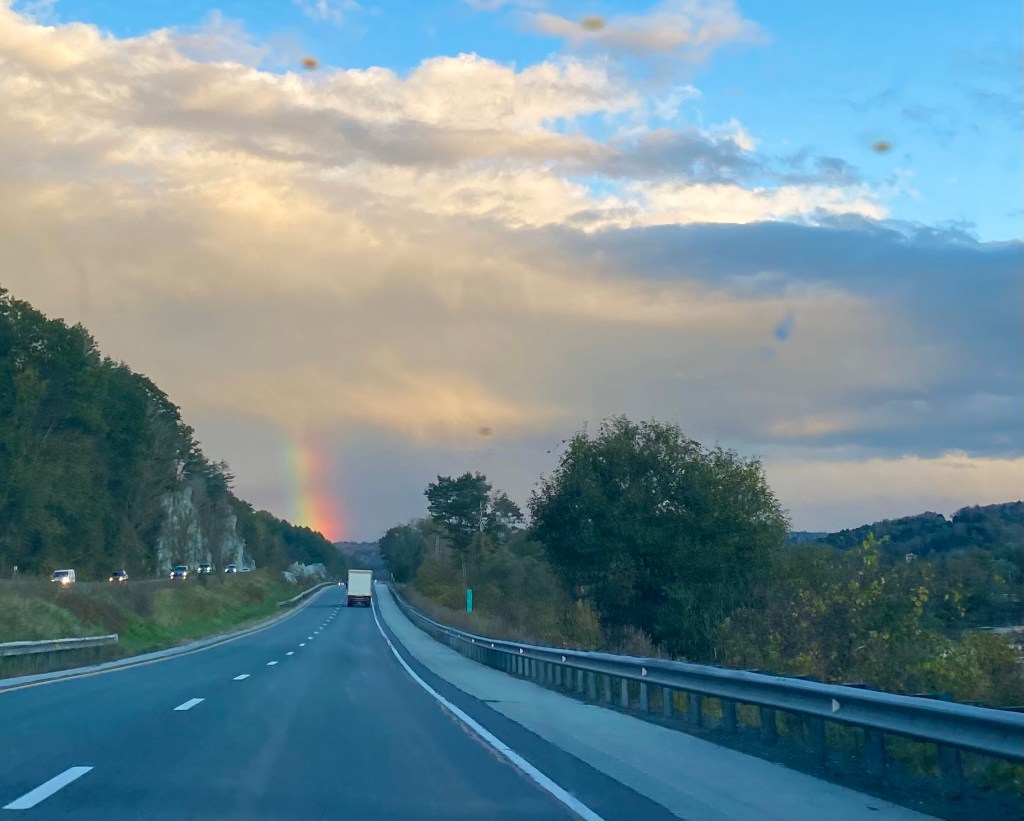
Around a bend in the interstate, a rainbow leg glows. I’ve handed over the keys, and I’m in the passenger seat, knitting forgotten in my lap, as we hurtle along the pavement, rushing over bridges that rise over the Winooski River. Mid-October, dark is not far in the offing. I’m texting my daughter at home who’s feeding the cats and stirring the embers in the wood stove. It’s hopeless to tell my daughters that not so long ago whether someone was home or not was a mystery. Domestic life relied on a vein of faith.

Has the world less mystery now? Surely not. This autumn rainbow beckons us. Around us, an infinity of things we will never understand.

Between us, there’s a bit of discussion about which exit to take, but my driver humors me. There’s those maples before the gold-domed statehouse I want to see, the silver maple beside the library that holds its green longest. By then we’re laughing about a little joke between us — bulk foliage and bulk syrup — tossing those words back and forth for no clear reason at all except for a moment of pleasure.

Autumn: the swinging door between summer’s glory, the myriad folds of winter.

Above the fields,

above the roofs of the village houses,

the brilliance that made all life possible

becomes the cold stars.

Lie still and watch:

they give nothing but ask nothing.

From within the earth’s

bitter disgrace, coldness and barrenness

my friend the moon rises:

she is beautiful tonight, but when is she not beautiful?

— the incomparable Louise Glück, “October”

A Mixed Delight.

All week, we say to each other, This might be the last nice day or Only a few good days left, as if our Shire-ish Vermont realm teeters on the brink of disappearance. Not so, of course.

I leave work early and disappear into the town forest, stepping off the main trails which suddenly seem populated, and hurry down the narrow bike paths, picking up speed and running in my shoes that I’ve meant to replace with their torn toes and worn soles. Add that chore to the list of the mundane: clean the upstairs closet, shake out the living room rug, replace the burned-out lightbulb over the bathroom sink.

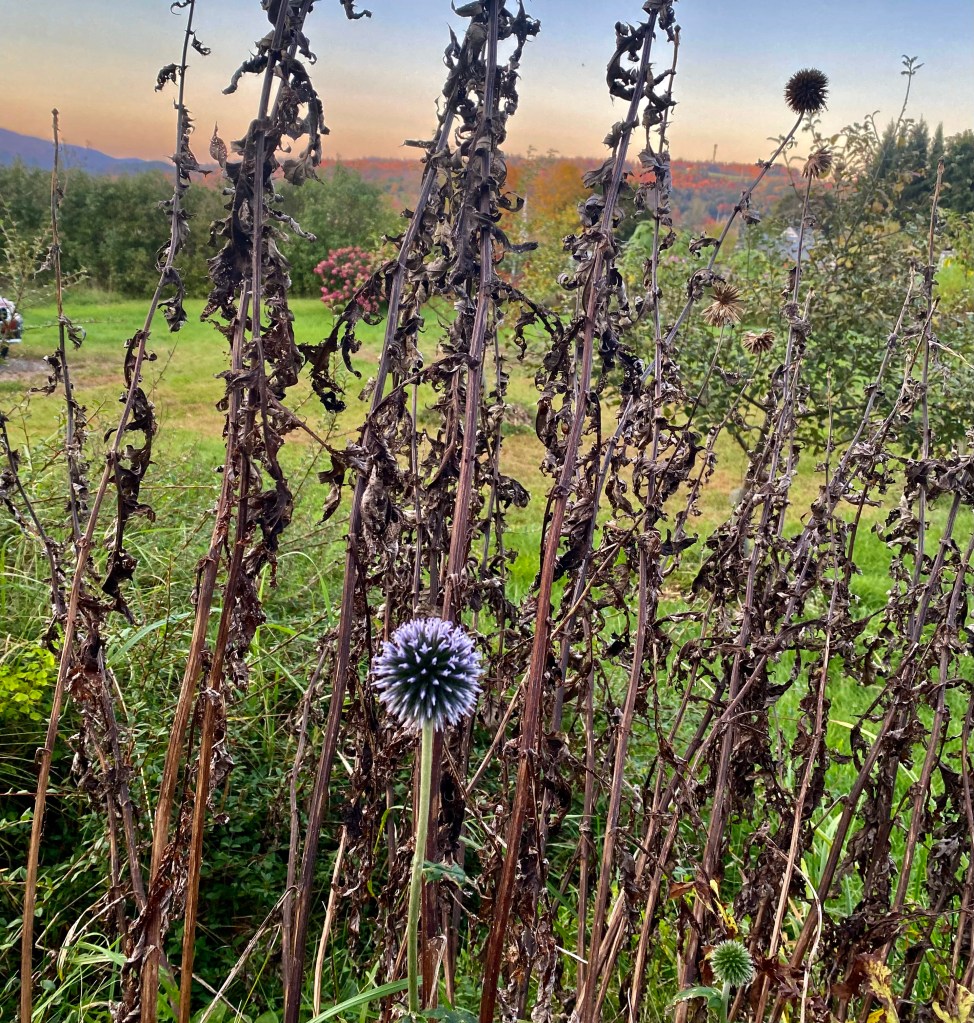
October is a hard reckoning month in Vermont, the sizing up of the summer (not enough swimming, surely not enough sunlight) and the letting go of gardening as winter edges in, steadily, inexorably. I rake leaves, mulch the garden, put away my shovel and hoe.

For years, I canned crazily, hundreds of jars of beans and tomatoes and apples. This year, the mainstay of my garden is flowers. Months ago, the flowers gained the upper hand, and I can scarcely pick my way through the tangle of vine and petal: a patch of succor for pollinators, slow moving now, and birds.

My mother asks what’s new, what’s happening: skeins of geese fly over our house. Like the skeins of yarn I unwind and then rewind into fat balls. Sprawled on the windowsill beside my desk, my cat studies a gray squirrel fattening its cheeks with sunflower seeds. Red, gold, green: autumn.

We must risk delight. We can do without pleasure,
but not delight. Not enjoyment. We must have
the stubbornness to accept our gladness in the ruthless
furnace of this world. 

— Jack Gilbert

Starlight Walking, a Pause, a Choice.

Walking back from a library program after dark, I cut through the cemetery. The cemetery is unlit, and I’m walking slowly, staring at the Milky Way sprawled overhead, the enormous immensity of the cosmos. In the dark, I hear a cough. I haven’t been paying attention. At first, I think the cough has come from the person smoking on the balcony not far from me, in the house chopped into apartments at the dead-end road, or the people coughing might be around the gap in the fence surrounding the cemetery. I’m headed that way; the gap leads to the woodsy path that will lead me home. That particular place in the path often has trash – Little Debbie’s wrappers and empty Twisted Tea cans.

So here’s the thing: I’m not at all afraid. Despite the village around me, the night is deep. I’m well-hidden, so concealed I stand there thinking, staring up and seeing a shooting star.

I’ve written a fair amount about being a single mother, a broken half, the jilted family, the rage of abandonment. But it’s equally true that I’ve been single for so long now in a society that seems so devoted to coupleness, that I rarely speak of my solitary life. I know very few single parents, at all, for whatever reason. So this night, I do what I’ve taught myself all these years: I drink in my fill of starlight, that piercing Ursa Major hung over the black horizon of the mountains, let her drench me with her power. I make my choice and retrace a few steps, see my friend and her partner on the street below driving along in the dark, friends who would have happily given me a ride, had I asked. But these nights are still balmy and the bitter cold hasn’t set in yet.