Stitching, in Friends & Wool.

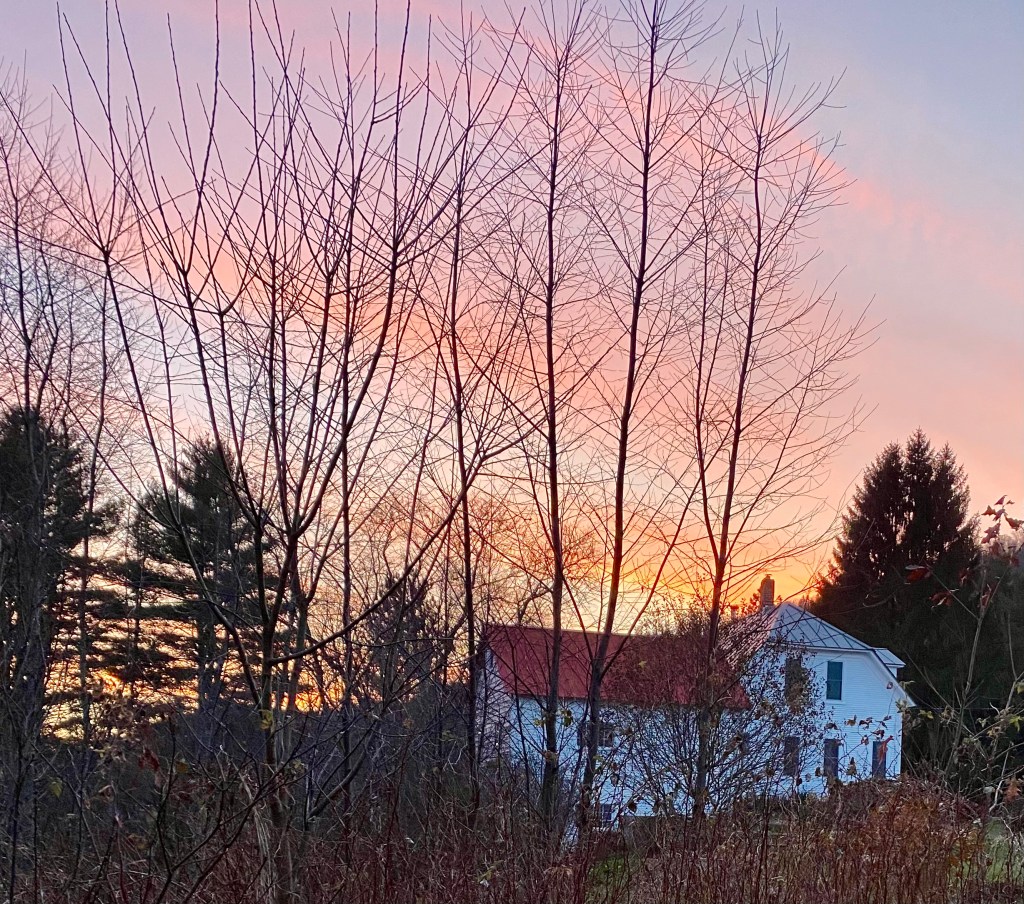
December, and by five o’clock, the dark has hammered in for the night. A friend and I walk to the post office, talking about work and family, laughing as we avoid icy patches glowing beneath the streetlamps. We meet a neighbor walking home with her two children from the afterschool program. The boys have glowing strips wrapped around their wrists, red and green, that draw lines through the darkness as they pinwheel their arms.

We return to my dead-end street where the light glows on my back porch. At the silhouette of mountains across the valley, an immense column of amber light illuminates the night sky. Moonrise. It’s not particularly cold. We linger and watch the stars and planets rub on against the darkness, one by one, and keep talking about those complicated stories of family, of how history bends back upon itself and what this might mean for our children who are in the time of their youth.

Above, stitches of a sweater I knitted for a faraway friend, something I created with pleasure and gratitude, that I’ll box up and mail away. Who knows when I’ll see these friends again. But it’s the only way forward that lends any illumination for me: stitch. When need be, unravel and begin again.

“The products of science and technology may be new, and some of them are quite horrid, but knitting? In knitting there are ancient possibilities; the earth is enriched with the dust of the millions of knitters who have held wool and needles since the beginning of sheep. Seamless sweaters and one-row buttonholes; knitted hems and phoney seams – it is unthinkable that these have, in mankind’s history, remained undiscovered and unknitted. One likes to believe that there is memory in the fingers; memory undeveloped, but still alive.”

Elizabeth Zimmermann

On Not Speaking the Language of Cat.

My cat Acer, above, exemplifies not only feline beauty but a steady reminder that I do not speak Cat, that I live in a world rich with beings going above their own wise lives, despite the lack of an opposable thumb.

For anyone who’s never lived where the days constrict in November and December, here’s a snapshot: I’m home at four and our house is satisfyingly warm as my daughter, home on college break, fed the fire. In the dusk that drifts down, my neighbor and I walk to the town library, which seems a natural destination. When we return, we stand in the light from the windows of her house, remarking about the dark.

We talk about little things that seem irrelevant — our children and Thanksgiving and my asparagus bed gone to weed — these things that stitch our lives whole. The air holds just the right amount of cold, nothing too fierce but sharp enough to whet desire for my warm house, the wood smoke trailing from my chimney. In its wordless language, the half-moon rises through the pines around my neighbor’s house, luminous in the black sky where the stars appear one by one, and then suddenly the Big Dipper glows. The horizon is a thin crimson line, and then that, too, winks down into the night.

“Muddy water is best cleared by leaving it alone.”
― Alan Watts

What’s in the News, What’s Not.

No fooling here — no glossing over — in the past month there’s been two homicide/suicides, neither a domestic, all gunshot wounds, (that’s a total of four souls), right around where I live, then an early morning drug raid a few minutes’ walk from my house. I live in a middle class town, shabby around the edges, a little more spiffed up on some streets. In the evenings, I sometimes walk by the house my daughter’s friend bought. In the dark, he’s often on the roof, hammering or sometimes lying on his back, staring up at the stars. We talk for a bit, and I urge him, be careful.

I write this not out of salaciousness, but more to mark where I am, what’s happening in my state. Malcolm Gladwell wrote that planes never crash because of one reason. Likewise, there’s not one word, one single reason, one sole cause for any of this. These deaths and this raid isn’t my story, but it’s a piece of my story as our lives are all interconnected, the net that holds us together only as reliable as the weakest knots. Yet, as a whole — as a town, a state, a country, as the human story — we keep on.

On this balmy November afternoon, the elementary school kids run on the grass in their t-shirts. Magical insects hover — what my daughters called blue-glass bugs. Later, I stand talking with a friend in the grocery store. I’ve run out of the house, sockless in my Danskos, to replenish the coffee I finished that morning. I met this woman when I was writing Unstitched, so whenever I run into her, we keep talking and talking. What a joy it is to see her glowing and alive, this woman who had a life harder than anyone should ever endure. When I come out, darkness has fallen. The crescent moon hangs over the town, luminous.

The Pleasures of Creation.

An old friend and I walk through the hilly town forest, sharing the tenor of stories that are manna for my soul: which ways our lives have turned and bent, what are the elements that shape us and our families. A little sleet or maybe rain patters down on what remains of the leaves.

On my way home, I stop at the coffee shop and drink espresso in my damp sweater smelling of sheep — a lovely barnyard smell or a repulsive one, depending on the person I suppose. I carry my laptop and my notebook back home to my wood stove and my cats who remind me their needs are few and the most reasonable constant in this house.

By five, it’s dark as the inside of a pocket. Public radio spins in the greater world. In my tiny dining room, I pull a book from shelf and set it on the table, then another and another. In an hour or so, by then listening to This American Life about rats, I’m in the basement searching for the half-full can of Sunshine paint I used in the bathroom last winter.

Three more walls await me. I’m out of paint and decide a lime-lemon will suffice. I’ll need to drive that half-mile to the hardware store, which annoys me as I have brand-new studs on my snow tires, and why waste those on dry pavement?

All this: it’s that old familiar question, that rub between creation and destruction. Espresso and sunshine-yellow paint have never cured the world’s ills, but a slice of pleasure can’t harm.

In my bookshelves, I find a poem I printed out shortly before the pandemic nailed shut Vermont, still utterly relevant today:

Blackbirds
by Julie Cadwallader Staub

I am 52 years old, and have spent
truly the better part
of my life out-of-doors
but yesterday I heard a new sound above my head
a rustling, ruffling quietness in the spring air

and when I turned my face upward
I saw a flock of blackbirds
rounding a curve I didn’t know was there
and the sound was simply all those wings,
all those feathers against air, against gravity
and such a beautiful winning:
the whole flock taking a long, wide turn
as if of one body and one mind.

How do they do that?

If we lived only in human society
what a puny existence that would be

but instead we live and move and have our being
here, in this curving and soaring world
that is not our own
so when mercy and tenderness triumph in our lives
and when, even more rarely, we unite and move together
toward a common good,

we can think to ourselves:

ah yes, this is how it’s meant to be.

How to Reconcile Contradictions?

The November days end in early darkness. Late afternoon, I close my laptop, comfort the cats with a handful of kibble, and pull on my jacket. The village lights glow: the few restaurants, a garage, a laundromat, the library. When I’ve reach the high school, the darkness spreads ubiquitously through the town forest that spreads up the hillside. Nearly all my life I’ve lived in New England, and yet the profoundness of this late autumn darkness always amazes me.

Later, I’m in the neighbors’ house who need some aid. As we stand talking in the well-lit rooms, I feel the house around us, the century-old vessel of wood and nails, a metal roof. Around us, the wind stirs through the evergreens. I walk back in the dark, my head bent against the cold channeling through the valley. All night, wind howls, the inexorable thrust of our world into winter.

While I read on the floor beside the wood stove, the cats keep me company, thinking their feline thoughts. Eventually, I turn off the lamp, and we three beings watch the fire’s flames through the stove’s glass door. Encompassing us, this profound darkness I will never comprehend. In it, our hearts beat on.

Here’s a few lines from David Truer’s “The Americas They Left Me” I read last night, in The Best American Essays, 2023.

This country is a terrible country, and this country is not…. There is a great ugliness on the land and also a great beauty. This country would and will do its worst at the same time it embodies the most nurturing habits our civilization has to offer. There is no reconciling these contradictions; they cannot be reduced or done away with. I must, we must, find a way to contain both.

The Might of Imagination.

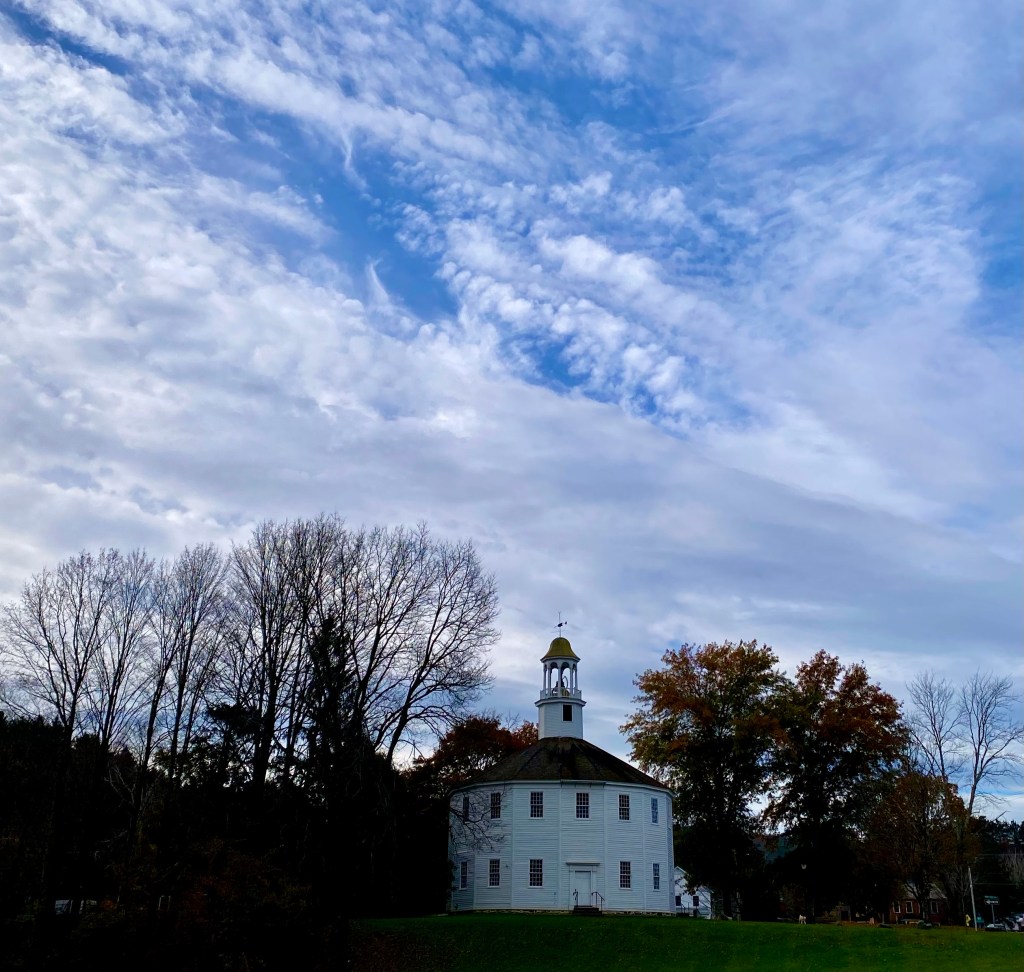
Round Church, Richmond, Vermont

The geese fly overhead in great Vs, chattering in geese-speak as they align themselves, tugging their flock together. In my garden, I rip out the frost-blackened tithonia, the dry fronds of bachelor buttons.

The migratory geese are rhythm, nothing clichéd about their brassy calls. As I steadily work at my annual chores — burying more daffodil bulbs, the candy-like crocuses I’ll happily search for, months from now — I let my body do this work, my boots on the earth, a few spits of rain falling from the clouds, listening, listening.

In the town office where I work, stories surge through, as in any small town. Having lived through scads of my own drama, I know too well how the private seeps into the public, any truth strewn carelessly among chatter. For the most part, I endeavor to do my work and head out; yet, like anyone, I’m always listening, listening, wondering about motive and desire, curious about betrayal and courage, and the ineffable complexities of human behavior. In a conversation with a friend about a couple we jointly know, my friend said, For anyone who’s been following the story, this shouldn’t be a surprise… In a similar vein, I realize I’ve long been quietly following the story of the world where I live.

On my way to visit my daughter, I detour slightly and walk around Richmond’s round barn, shuttered up until dandelion season returns. The afternoon is especially balmy, sunlight bright even in the scarcity of November. I marvel at how mightily humans can create, mixing utility and beauty. How well we can do this.

“Sometimes it seems to me that, in the end, the only thing people have got going for them is imagination. At times of great darkness, everything around us becomes symbolic, poetic, archetypal.”

— Helen Garner