Onset of Pre-Cabin Fever.

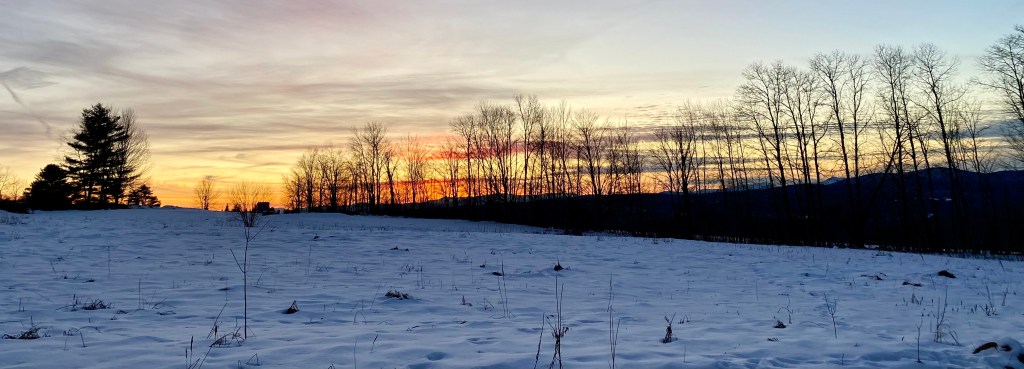
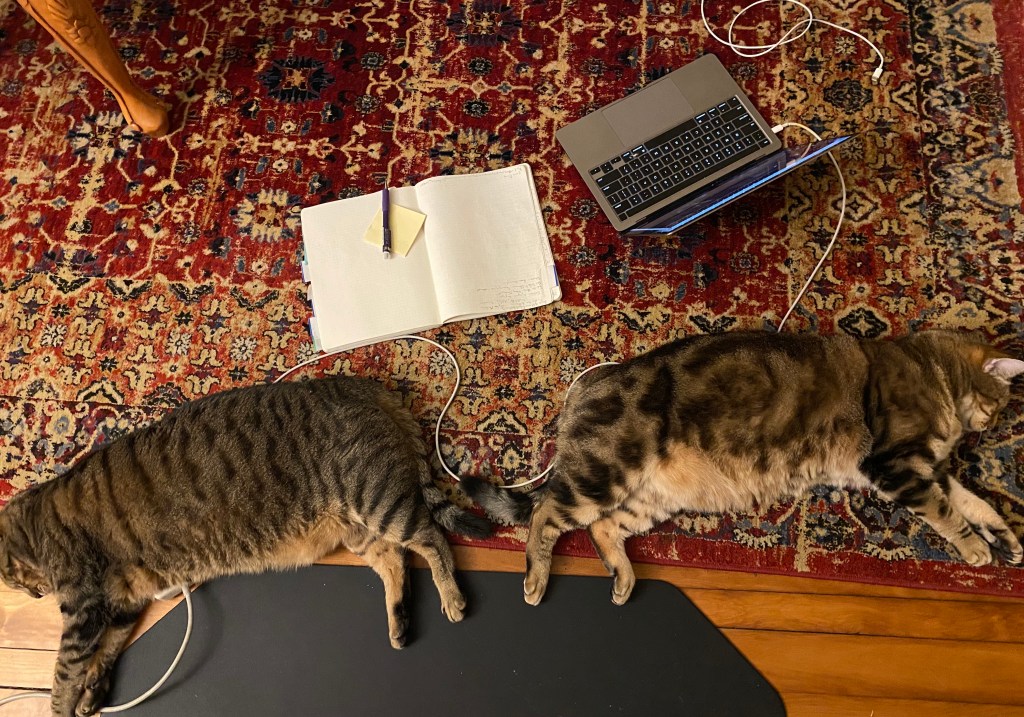
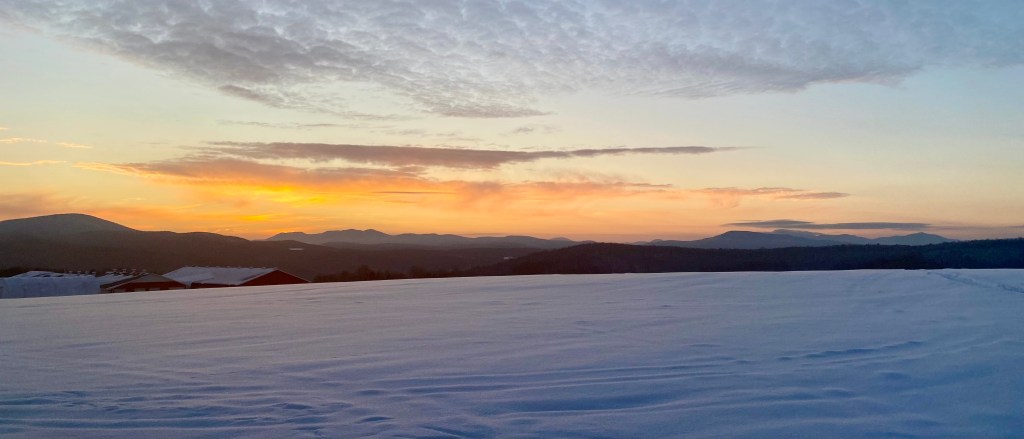
I shake stunningly beautiful snow from my mittens onto my cats. Mid-January. Winter’s loveliness has just arrived. My house is again the three of us, two fluent in Cat and one marginally fluent in Human. The one who speaks Human gets the deciding vote, so we get up very early. The Cat speakers are wholly in favor of this, as the wood fire is fed and the cat kibble rationed into bowls. Eventually, the dawn finds us, and the rest of the world creeps in.

If this keeps us, the prognosis is mad-as-a-hatter by Honest Abe’s birthday. No fear of that. Any hermiting is constrained around here. Two small excerpts from my novel are accepted by journals. The cats and I nestle into our narrative. I let them lick butter from my fingers. Snow silently fluffs around us, concealing the stars, the sunflower stalks, the ash bucket I left by the step.

Household chores and world events.

The last day of 2023, I let the fire in my wood stove extinguish, and I take my stove apart. The stove has been spitting ash and spark through a damper, a chore I’m driven to by sheer necessity.

I unscrew the stovepipe and the back heat shield and plate, and carefully remove the two honeycomb metal filters that are choked with fine ash. It’s a messy job, and I’m a messy woman. My curious cat walks through the cinders and leaves dirty paw prints on my white enamel kitchen sink.

When I’ve put the stove together again, I find the driest kindling I can in my barn and build a small fire and slowly heat the stove again, kneeling before the glass where the flames ripple, listening to public radio hash over the year. I add wood, study the flames, murmur to my cat who is seriously invested in this warmth and the doubtless impending feline nap.

I’d once torn a photograph from a New Yorker issue and thumbtacked it near my desk of Marina Oswald, taken the morning after her husband Lee Harvey Oswald was arrested for assassinating President Kennedy. Her face twisted unhappily, she’s pinning cloth diapers on a line. So it goes: the necessity of domestic life as the great events of the world unfold.

My stove burns merrily. I bake spanakopita and invite a few dear ones who bring chocolate. This morning, January. A drift of snowflakes. The lean winter light.

The snow is melting
and the village is flooded
with children.

— Issa

Solstice Dandelion.

I stopped into a candy shop in Montpelier to buy chocolate Santas for my daughters. We’ve been visiting this store since my daughters were so young I always held their hands downtown. The owner read my book, and we always talk about writing and family and Vermont small town life. Her store had reopened recently after July’s devastating flood. The rain and snowmelt in the forecast hovered around us as I filled a white paper bag with those bright foil-wrapped chocolates. As I listened, I added chocolate pastilles and more Santas, for her or my daughters or me, for the giving or taking, or maybe both.

This week’s rain likely spared this sweet shop, but towns around us were flooded again. In the town where I work, sections of roads carefully repaired after July’s flood broke again.

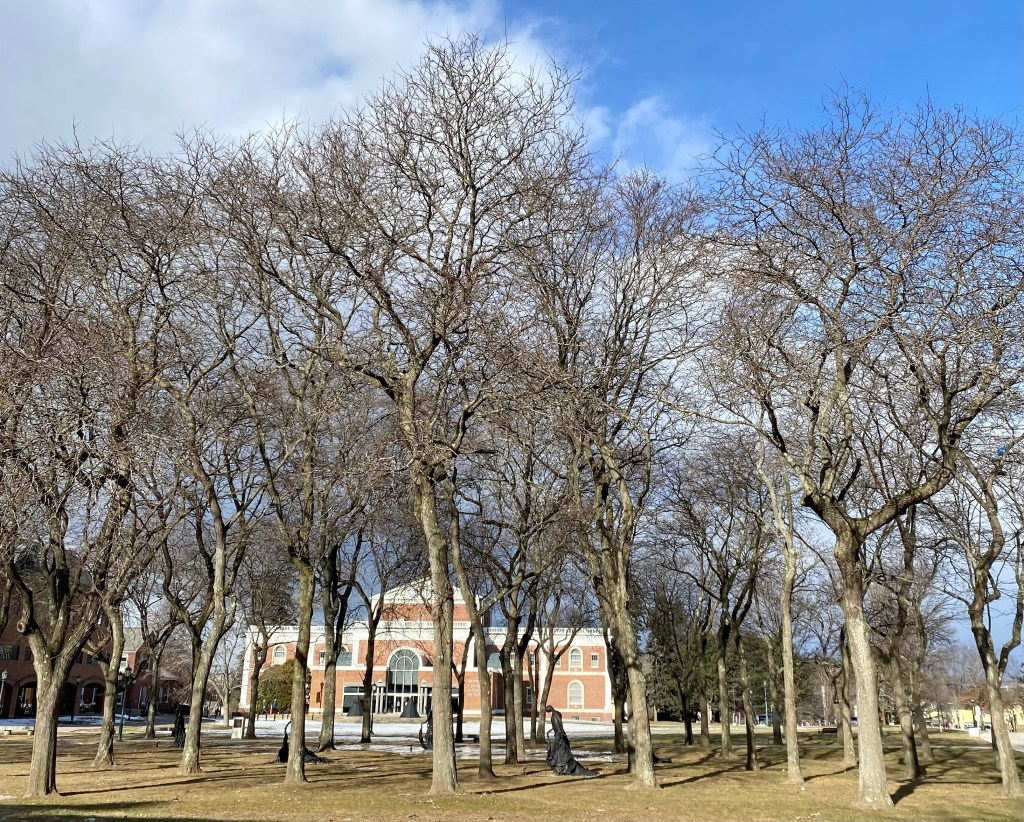
Yesterday, I spied a folded dandelion blossom in the town green. I squatted down and stared, not touching this brilliant gold in its emerald set. Overhead, those bunching clouds. A balmy breeze stirring over the lake that by day’s end will whet a bitter cold.

Solstice: hallelujah on this spinning planet.

Less and less surprises us as odd.

— Tracy K. Smith

Hello, Darkness, my old friend.

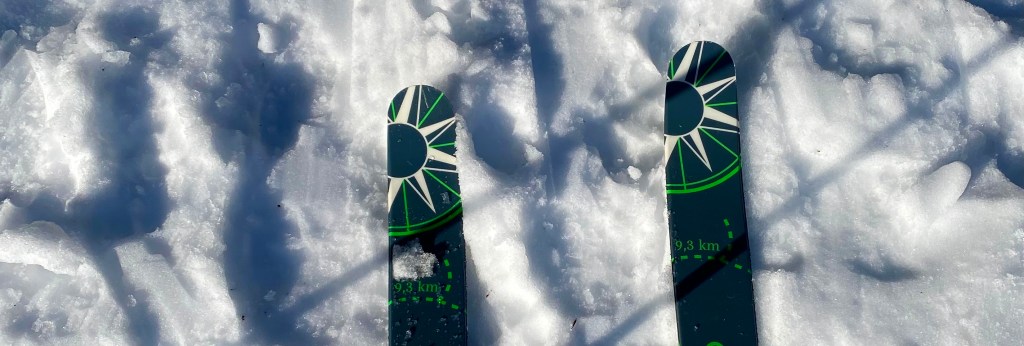
Heading towards the winter solstice, the days are cropped short. I ski in the woods. The next afternoon, after a spurt of warmth, I remove my skis to navigate around patches of tree roots, the exposed carpet of pine needles.

By 4:30, darkness envelopes us, velvety and broken only by our brief human endeavors of a line of twinkling holiday lights, streetlamps, parking lots lit up like precious jewels. Like a wild creature roused by these warm December nights, I prowl through the village and along the river.

Returning home one late afternoon, I pause beside Woodbury Lake. A crescent moon illuminates the blue-black sky, the outline of its orb a faint round: a promise of January’s full wolf moon. Twilight’s but a few moments, molten gold rapidly consumed by the unstoppable night.

I remind myself that December is the time of descent, that the darkness I eyed so warily in October is now my mellifluous friend. I’ve been here before, in so many seasons of my life — dissatisfied and cracked, heart-full, my eyes attuned to starlight. Living into December and the solstice and the winter stretching ahead means stepping into the world’s great vessel, full of so much.

Here’s an article about the world’s first seed bank forwarded to me by a reader.

Your place in the world.

A rare mid-December day of sunlight, and the town seems festive, stirred by the truly false promise of spring. Not true, not true.

December’s a season of reckoning, of that inevitable look back across the months, to a year ago, to five, more. I’m old enough now that the seasons jumble into a Jacob’s Ladder of years: the Christmas of the hoar frost, the year a mouse drank from our Christmas tree stand, the 60 degree Christmas Eve my brother’s dog went swimming and gasped from the cold. The December snow fell every single day. That year, holed in the house with sick children, I wondered if I would go mad; I did not. All past, all somehow yet still with us. Heraclitus reminds us that the single constant in this life is change, and yet it’s still the same molecular stuff arranging and re-arranging, by the force of the universe and our sheer human will.

Oh December: you heartbreaker, you. Sleet and radiant sunlight in the span of a few days. Icicles drip. Chickadees whistle in the white pines. My wood chores finished, the compost bin dug out, I linger in the sun, leaning against the house, reading Paolo Cognetti:

You find your place in the world much less predictably than you’d imagine.

I believe in good gloves.

At the Vermont Almanac‘s celebration of volume four, I talk with people I haven’t seen in years — my daughter’s beloved elementary school teacher, a couple who bought a house down the road from where I once lived. As the staff from the center where the celebration was held clean up, ready to head home themselves, I walk out with my former neighbors. We stand for a few moments by a fire burning in a pit, talking about sugaring and our daughters and Vermont dirt roads. Through the wide windows, I watch people wrapping up the remains of cheese and dried sausage. In my house, I am still eating the remains of Thanksgiving’s cheese, the sharp cheddar I used in my friend’s birthday sandwich.

Overhead, stars strained again the clouds.

I’d been asked to read a poem, “Dear Day in Late September,” for poet Kerrin McCadden, who couldn’t attend. I consider this poem a love letter in the tenor of love letters I admire most — elegantly stripped down, mindful of life’s deep sadness and the beauty of our world fat with bees.

On my way home, I think of the line “I believe in good gloves.” As a former sugar maker, I’ve used up countless gloves. With my small hands, I’ve never had a pair of gloves that fit. At Thanksgiving, in a shop looking for boots, my daughter handed me a pair of petite gloves. I nearly laid them to the side (thrift, thrift), but I bought them. Yesterday, wearing these gloves to bring in wood, I realized the gloves fit me perfectly, downy on the inside. Warm, strong, practical. What do you know.

…. I want to tell you I am

thinking about closing up shop for the winter. I am settling

my accounts. Enclosed, please find a brace of birds,

which I hope you will accept as payment against last winter’s

oil bills. There is much to do. Up in the barn, I have spelled

out the name of the man I love with crabapples. It is one way

to know a man’s heart. I believe in his name, though,

like I believe in good gloves. Oh, how we fight the cold

with everything we have.

Kerrin McCadden