On a day of yet more snow, of wind and cold, I’m reminded that people still keep on with their lives. Living doesn’t wait for convenience.
At the post office, I mail off a copy of my book. The woman who weighs my small package insists this is “sugar snow,” an early spring snowfall that will lengthen the maple syrup season. We sugared for years, and this kind of snow always meant a break in boiling and a chance to wash filthy snowsuits. The upcoming forecast is for as near-perfect sugaring weather as possible. Sugaring is the epitome of day-to-dayness — be smart, keep your eyes open, do the best you can — with no guarantees of a good or even decent season.
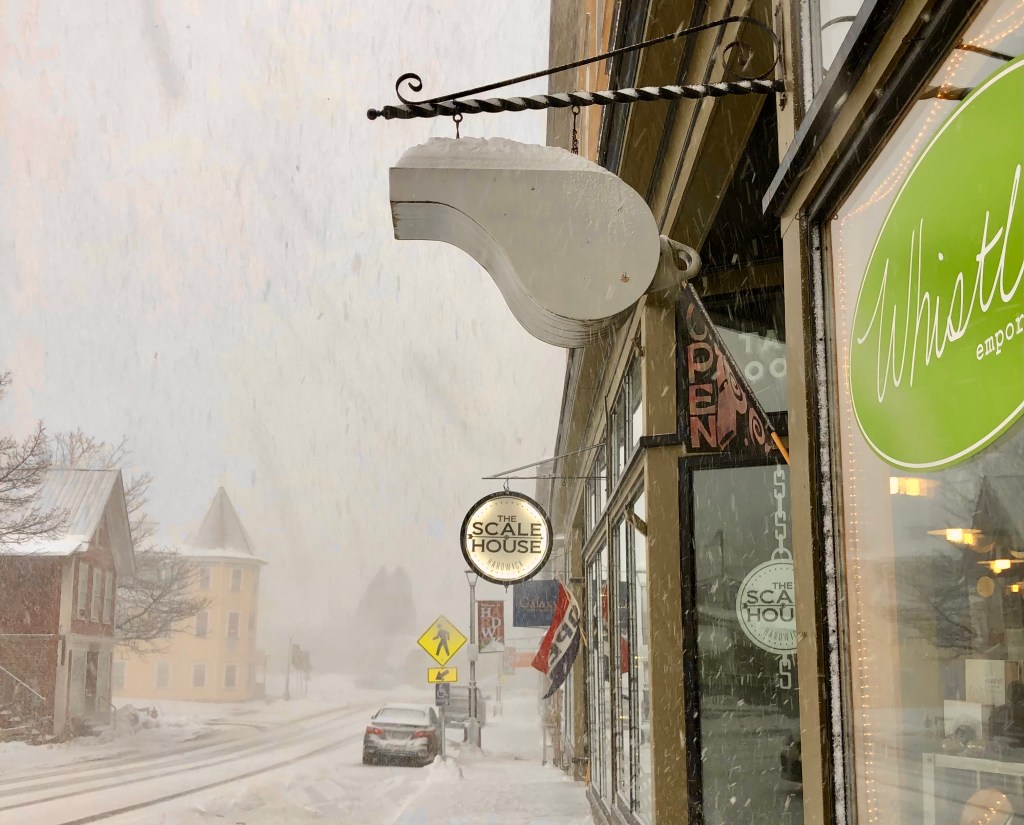
We talk for a few more minutes about shoveling snow, and then I head back out into the town’s Saturday morning. On my walk home, I stop in at the coffee shop and stand in the window drinking an espresso and staring out at the traffic struggling on snowy Main Street. There’s the usual confusion of the three-way intersection so many don’t understand — two stop signs and a blinking yellow light — as if the calculus of two stops and one yield doesn’t make sense. Standing there, I wonder if it makes sense mostly to those who use these streets day after day.
A year ago, the coffee shop’s tables and chairs were closed for seating, and I wondered if I would ever bring my laptop back here, to my favorite table where I once wrote a book. A year later, here I am, drinking coffee, surrounded by maskless people laughing and talking, writing notecards, going on about their lives. On this inclement Saturday morning, that seems nothing shy of a miracle.
“The answer must be, I think, that beauty and grace are performed whether or not we will or sense them. The least we can do is try to be there.”
When my daughter and I return from a walk tonight, we stand for a moment outside our house in the dark. The moon is a bit of a creamy curl over our roof. Mighty Orion stands at his guard in the constellations. Whoever dug this house’s foundation in the sandy soil, carefully set the fieldstones, and built this home has long since passed out of this world. People have lived and fought and loved and died in this house. It’s March and Mud Season hovers over us, freezing, thawing, freezing, and eventually the thaw will win out for the summer. Upstairs, my youngest daughter puts her face to a window. We go in, leaving the stars and the night to their own particular magic.
“It may be important to great thinkers to examine the world, to explain and despise it. But I think it is only important to love the world, not to despise it, not for us to hate each other, but to be able to regard the world and ourselves and all beings with love, admiration and respect.”
This afternoon, I tore through my bookshelves searching for a paperback copy of Hermann Hesse’s Demian, a book I first read in high school. The book above — brand-new, Harley Rustad’s Lost in the Valley of Death — reminds me of Demian. Like so many other people, in some ways reading Hesse as a young woman shaped my life, every one of my years off the well-trod path. Demian has reappeared at certain keys points in my life, always rising with a strangely mysterious power. At the end of a very long winter, that book returns to me like a breath of spring air.
Fittingly, perhaps, I’m unable to find my copy. Maybe that hardly matters. For the first time in months, I take a long hatless walk, listening to the singing birds, remembering the unstoppable power of spring, and that the world wraps around us in ways we understand, and in ways we’ll never comprehend.
On this sunny Sunday in Vermont, here’s a few lines from the incomparable W. H. Auden on the nature of war. For more about this poem, the New York Times has an essay today.
About suffering they were never wrong,
The Old Masters: how well they understood
Its human position; how it takes place
While someone else is eating or opening a window or just
Right before the pandemic shut down the world two years ago, I drove with my youngest daughter to the New Hampshire village when I had spent ten years of my childhood. My family no longer lives there. An old high school flame had contacted me around that time, and I was half-thinking I might look him up some day. My daughter and I parked at the end of the street where I had walked with my siblings countless times, and then past the house where we lived and into the library when I had spent so many hours, dreaming of my life to come.
In a strange, almost sepia-toned kind of way, I felt I had been able to step into that past and see again the sweetness of it — something that seems so often lost in memory.
There’s that famous line from Tom Wolfe that you can’t ever go home again, but these days I’m wondering if that’s because you can’t ever really leave your home. I read that novel in high school, in that beloved library, a great big novel that I devoured with such enthusiasm.
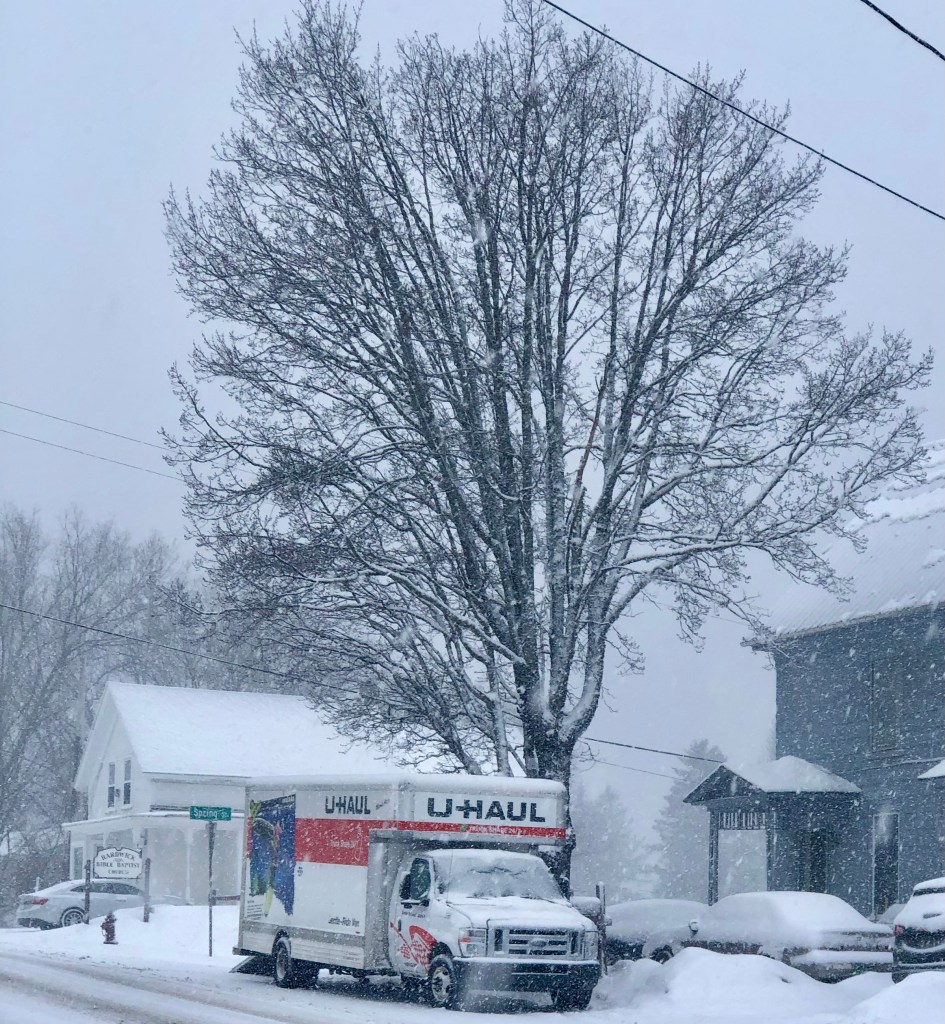
Twenty-five years ago, a young woman driving a Subaru Justy ran into my VW Rabbit in a sudden snow squall, just like the one above. I wasn’t wearing a seatbelt, and somehow miraculously survived wholly intact. The young woman sat in her car, crying, in the middle of the highway, and I stood outside her car, begging her to get out. “I’ve killed you,” she wept. I kept insisting I was fine. I was wearing a blue sweater my mother had knit me, and I spread my arms out wide. “I’m alive.”
Her insurance company gave me three thousand dollars, which my husband and I used to start a sugaring business. Much later, I sold pieces of that business and bought a house in the village. I’m still carrying that squall and that woman with me. I never saw her again. I hope she’s well.
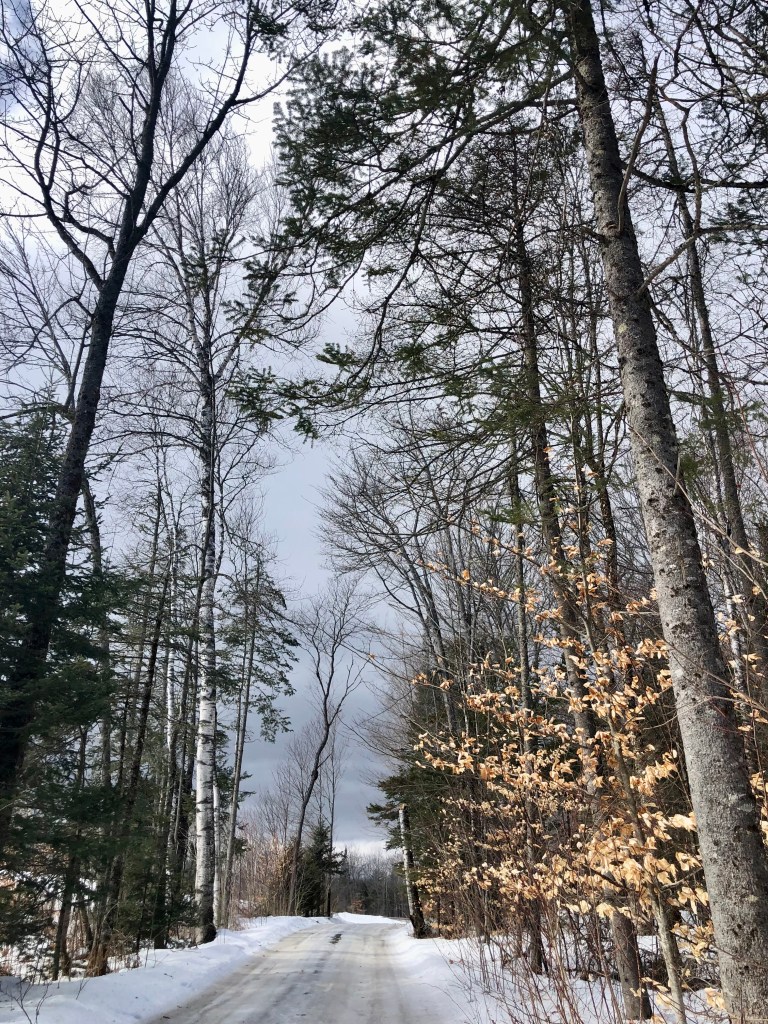
March in February — the fields are beginning to open, at least for this afternoon, for this particular moment. I park by the side of the road and take the long way where I’m going, by foot, my hat off, jacket unzipped, letting the wind pull at my hair.
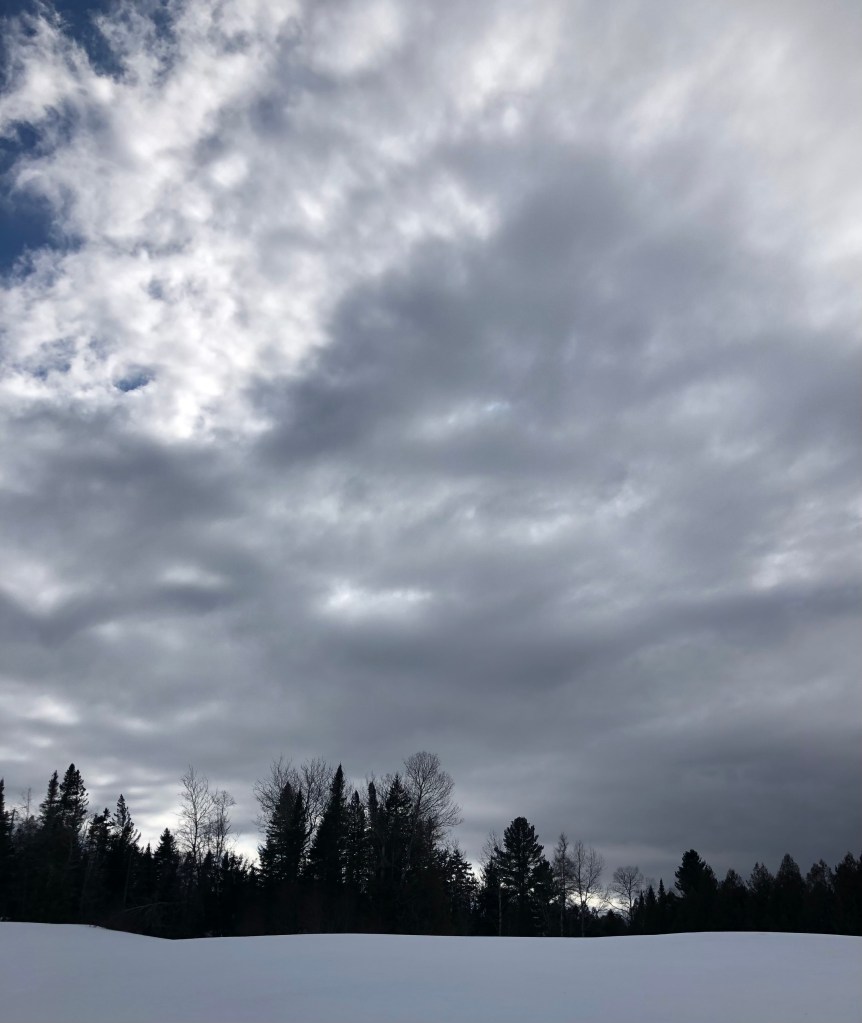
I’m snapping a photo of a field and the sky when a car pulls over at the side of the road. There’s no one else around, and for a moment I wonder if he’s a landowner, angry or just curious what I’m doing. Wednesday afternoon, and no one is around.
He gets out of his mud-splattered white car, laughing, and asks for directions back to a paved road. He was visiting someone and took “the other way.” I laugh back, and we joke about where the other way in Vermont leads someone.
We stand there, joking, the dirt road both melting and already beginning to freeze again as we speak.
When he gets in his car and disappears down the road, I stand for a moment longer. I’d wanted nothing more than wind in my eyes, sunlight on my face. Fait accompli. Then it’s back to civilization for me, too.



 Stony Soil Vermont