Determined to do/the only thing you could do…

When I was six, I dropped a large wooden board on my toe, right where the nail emerges. My mother lifted me up and soaked my foot in the bathroom sink in Epsom salts. I cried fiercely, and my mother said she wished she could take the pain from me. Impossible, of course. Later, I lost the toenail.

The night before my last chemo infusion, I woke thinking of my mother who died nearly a year ago. She never knew I had cancer. Of all my family, only my mother endured chemotherapy, at age 80. Like so many mothers and daughters, we had a tangled and complicated relationship, sometimes fierce, sometimes outright silly and joyous. Not knowing about my cancer was one thing she was spared in her life, at least. No one seeks cancer, but in this long and snowy winter, I was spared the misfortune of being a parent of a sick child. Anything can change in this world, at any moment, but for now….

Recently finished with chemo treatments, how grateful I am to Dartmouth and its staff for their exquisite care. How humbled and thankful I am for the people who wrapped around me – some of whom I’d never met before. To write that cancer changed my life would sound trite. The deeper truth is that this disease will be with me for the remaining days of my life. But my life is in the present tense. I have not changed. I am changing. How blessed I am to be here.

… little by little…
the stars began to burn
through the sheets of clouds,
and there was a new voice
which you slowly
recognized as your own,
that kept you company
as you strode deeper and deeper
into the world,
determined to do
the only thing you could do —
determined to save
the only life you could save.

~ Mary Oliver

Small Soup Bowls. Quarantine. Icicles.

My brother returns home, and I immediately slip up, ignore a morphine dose, am unable to eat. A lesson in my own laziness or foolishness learned: keep to the path.

For days, he sets small bowls of heated soup on my kitchen table – chicken and dumplings, our childhood favorite of pea soup, lentils with savory carrots. One night, my daughter bakes biscuits, opens a gift jar of raspberry jam (July!), and we revel at a nameless soup from a woman we’ve never met. Potatoes with the skins left on, chicken and maybe tarragon, celery, onion. There is nothing we could imagine adding.

Like these soup bowls, my physical life has narrowed to these warm rooms with cats, hours unfurling patiently as I stop counting days and treatments. Each day unfolds. On Saturday, I sit on the couch and return a friend’s call. Sunday, I return another call, listening to my laughter, their laughter, these friends who have been down their own stony journeys.

Quarantined, I’m connected to the world in ways I didn’t anticipate – emails and calls, books, prayers– a rosy swaddling aura. An acquaintance phones me with her cancer story and describes her year so straightforwardly she buoys me with courage. A friend offers to plow our driveway all winter; perpetually on the skimp, I’ve shoveled for years, but it’s a great gift to my people who are anyways busily feeding my wood stove and picking up morphine and antibiotics and driving me to bloodwork and The Good Doctor — not to mention, working their own jobs and walking their dogs and generally going about their lives.

So much kindness has come my way. The night the sainted nurse sat with me for an hour and a half while the final chemo infusion ebbed, ebbed, into my chest beside my heart, she counseled me to cultivate patience, that I will be able to give again, that the world spins and shifts.

In a wind gust, the robins’ nest falls from our porch beam. Icicles hang from the roof, radiant swords of sunlight.

…. A few lines from Louise Dickinson Rich, courtesy of my sister-in-law:

“All ordinary people like us, everywhere, are trying to find the same things. It makes no difference whether they are New Englanders or Texans or Malayans or Finns. They all want to be left alone to conduct their own private search for a personal peace, a reasonable security, a little love, a chance to attain happiness through achievement.”

Necessary Birdsongs.

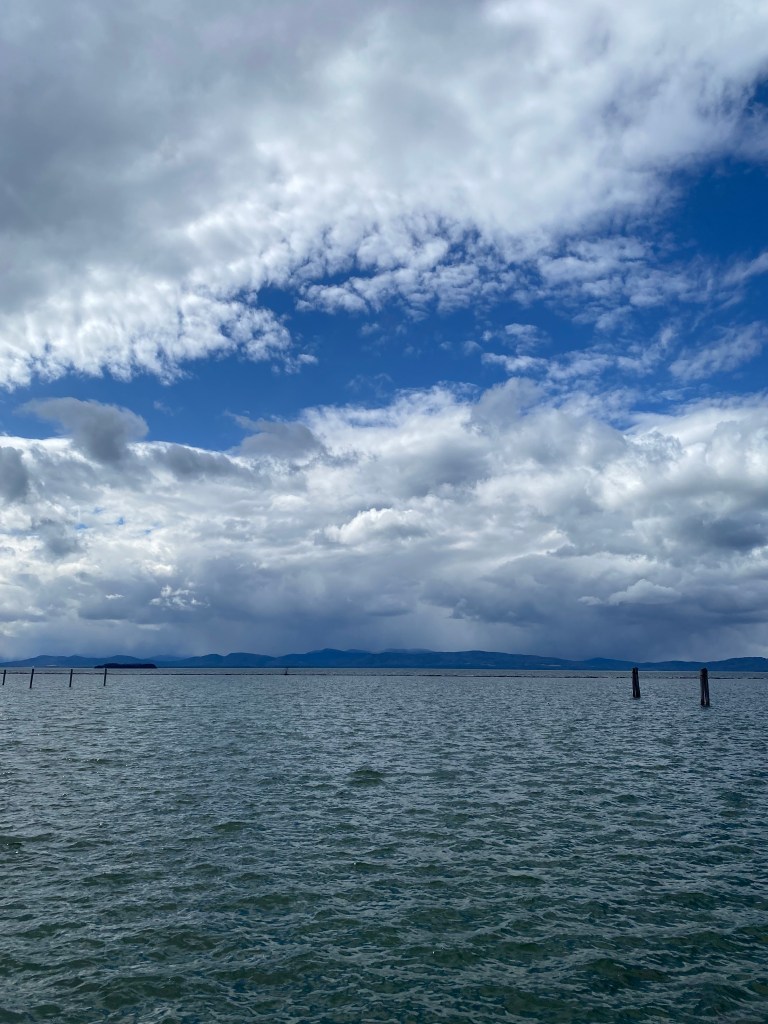
Lake Champlain

Mid-March, the unlovely muddy Vermont: I bend beneath the snarled rose bushes, seeking green nubs pushing through the wet earth. By June, this world will be verdant, lush, those old roses a tangle of green, tiny blossoms each a delicate bouquet of pale pink. These roses, planted by someone doubtlessly long passed over into the other world, ruggedly fence my house, their flowers such a dear sweet fragrance.

In this brown world, I wander to the places where, in springs past, I’ve heard the early songs of redwing blackbirds. Yesterday, I hear these birds, not the full chorus yet, but the warm-up crew. We are well before the yard clean-up and gardening season. The town roads are rutted, hard to travel, and the summer folks have not yet returned. Hidden in this clump of cedars, the blackbirds steadily, without any fuss, go about their blackbird lives. Not so many weeks away, marsh marigolds will blanket these wetlands — dazzling yellow, killer green — but for now, the dun palette of silvery cedar, umber earth, the birdsong melodies yanking us along to spring.

‘I can feel my life start up again…’

We’ve crossed the halfway point of winter and can, again, believe in the possibility of crocuses, the promise of pearly-and-pale-pink apple blossoms. Monday morning, my friend Brad Ferland invites me onto his WDEV radio program Vermont Viewpoint again. I’m lucky enough to ramble on for a bit about writing, and I spoke a little about this blog. For those of you who are new here, I often write about what the seasons in Vermont mean to me. July is the Swimming Season. September the Season of Fat Sunflowers. February, in my mind at least, is the Season of Hope.

The days suddenly widen and grow. A sunshiny stretch like this, and my state’s collective spirit rises. February is still deep in the Woodstove Season, however, which means, as a writer, no need to worry about missing a few fine gardening hours. The clouds will descend again, and surely I’ll complain (again), but for now, with two days of radiance, savor. Savor.

I feel my life start up again, 
like a cutting when it grows
the first pale and tentative
root hair in a glass of water.

— Jane Kenyon

Are you for real?!

The other night, I’m leaving a meeting in the high school library devoted, more or less, to hashing out what community means (nothing to be solved in a few hours). In the parking lot, a woman says Goodbye, Brett — and quicksilver, I shout, Are you for real?!

As the other folks empty out of the school into the spitting snow, she and I talk beneath the ghostly streetlamp. Very quickly, it’s clear to me how utterly wrong I am about this woman. What I believed was true was not. I once ate chocolate covered strawberries in her house with my youngest daughter. The woman packed up a bowl of these delicacies for one sister to give to another.

In ten minutes, we are speaking animatedly of matters of our hearts. We’re both shivering by then in the damp snow. We hug and head to our homes.

I don’t know what’s happening in the rest of the country, and I surely can’t speak for anyone else, but how glad I am that I called out in anger. And how much more grateful I am that she took the time to listen to me, to lend me her shoulder, and I could do the same for her. Indeed: real.

A community… is the knowledge that people have of each other, their concern for each other, their trust in each other, the freedom with which they come and go among themselves.

— Wendell Berry

The sound of one hand clapping, revisited.

This week, I unexpectedly find myself waiting for someone I don’t really know and end up reading a copy of Ken Wilber’s collected writings. Winter has finally come. The purest and loveliest of snowfalls fills up our world. I wait much longer than I had guessed. A woman comes in to sweep the floor, and we talk for a bit. Sunlight pours through enormous windows.

Here’s some Ken Wilber I soaked in:

You know the Zen koan, “What is the sound of one hand clapping?” Usually, of course, we need two hands to clap – and that is the structure of typical experience. We have a sense of ourselves as a subject in here, and the world as an object out there. We have these “two hands” of experience, the subject and the object. And typical experience is a smashing of these two hands together to make a commotion, a sound. The object out there smashes into me as a subject, and I have an experience – the two hands clap together and experience emerges.

And so the typical structure of experience is like a punch in the face. The ordinary self is the battered self – it is utterly battered by the universe “out there.” The ordinary self is a series of bruises, of scars, the results of these two hands of experience smashing together. This bruising is called “dukkha,” suffering. As Krishnamurti used to say, in that gap between the subject and the object lies the entire misery of humankind.

On my way home, I do something I’ve never done in the winter. I park along the edge of an unfamiliar road. I’ve forgotten my hat. The wind is wild, as if I’m on a stormy sea. My hair tangles over my eyes. Oh sun, oh wind, oh endless snow.

Midwinter, here.