Solo.

Every summer for years now, my daughters and I have gone camping on Burton Island in Lake Champlain. We always bring the same friend of my youngest daughter. Sometimes another friend and sometimes my oldest hasn’t come. This year for all kinds of reasons, I went alone for a night.

I stopped first to visit a friend and meet his friendly sheep. Then I raced to the ferry. Rain and clouds had moved out. The island has no cars, so the atmosphere is particularly sweet. Little kids bike everywhere. A group of teenage boys had set up a small army of tents, bikes, and fishing poles.

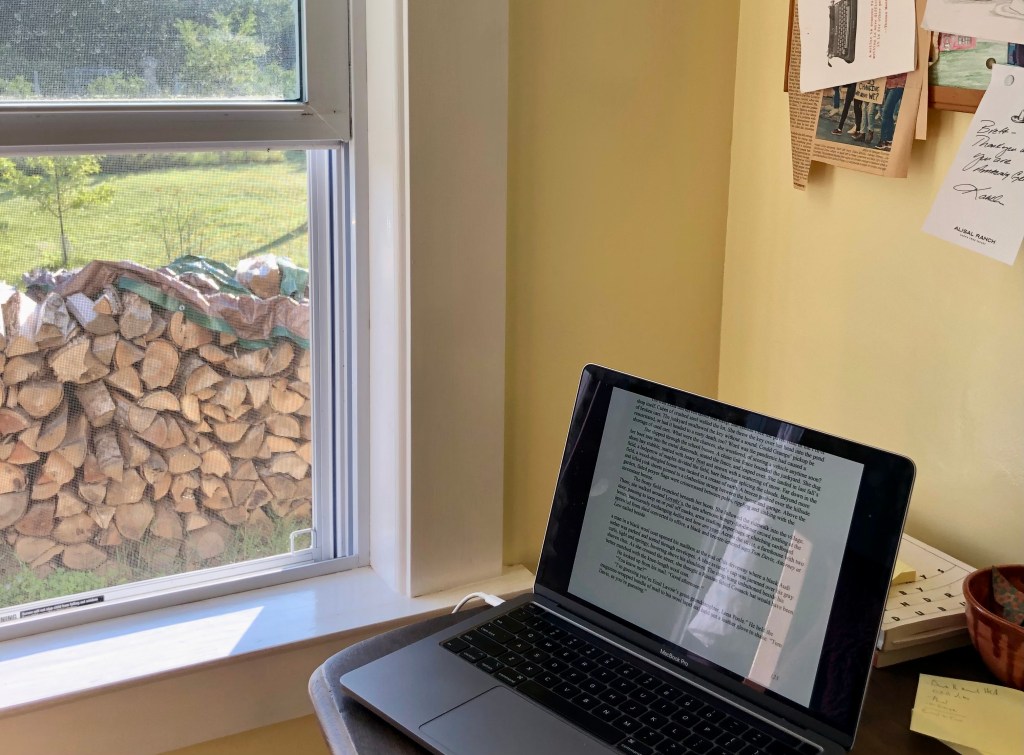
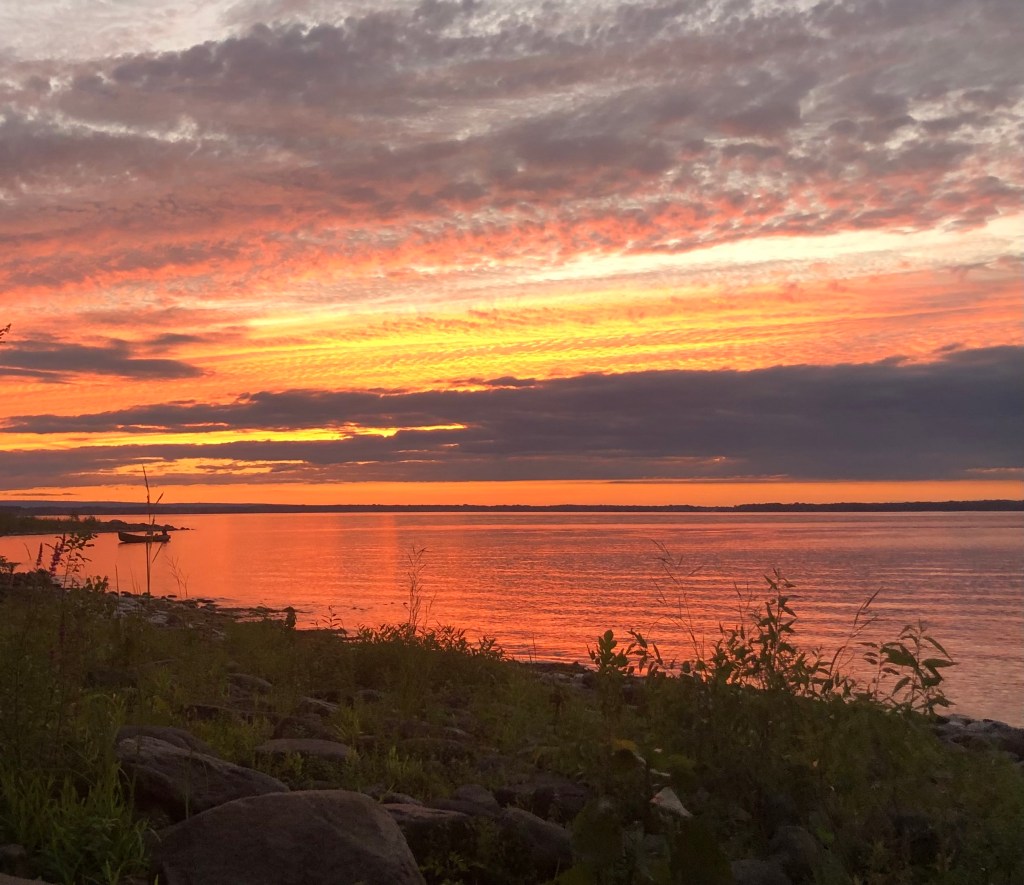
I had brought what I needed for the night: a novel, my knitting, a winter hat, the recently printed out version of my manuscript, and a good pair of walking shoes. If there’s one thing I’ve learned as a single mother, it’s make friends with strangers. Much to my daughters’ annoyance, I often find someone to chat with at soccer games, the co-op, the post office. A kind of survival skill on many levels. But I wasn’t there to chat. I walked around the island on its slate-pebbled shores in the daylight, during the enchanting sunset, and in the dark. As the night fell dark, the tree frogs sang melodiously. I slept dreamlessly under the rising moon. In the morning, I drank coffee and read and read until I packed up my few things and headed back to the ferry.

The island, a state park, is mostly staffed by college kids, who are polite and enthusiastic. The young man on the ferry folded up the wildflower guide he was reading to roll a few bikes on the ferry.

On my way home, I realized next summer I could take my kayak and stay a few nights on Champlain’s islands. I can’t swim to save my life but surely that’s something I could learn.

A few lines from Dan Chaon’s Sleepwalk:

“No doubt, a day of reckoning for mankind is coming, yet even for those of us who accept the inevitability of mass human death, there’s still a cautious hope; we’re waiting to see how Armageddon plays out, keeping an eye open for ways it might turn to our advantage… I’m no evolutionary biologist, but I have faith in our species’ stick-to-it-iveness.”

— Dan Chaon

Rambling Along…

Hot, in the best kind of truly humid summer heat, the heat that brings me back to those endless childhood summers when a summer was endless and not merely a few heartbeats. In a strange kind of way, the heat rejuvenates me. I wake early, work hard, then finish my chores as the day funnels down to swimming.

At a nearby garage, I pick up my car. There’s no one there in the empty building, the side doors rolled all the way up to ceiling. I stand there, listening to traffic and watching shadows from the trees flicker over the cement floor.

Two women come in and tell me they’re limping along a Toyota Rav with a flat tire. One woman wears wool socks and winter boots, and I think, Of course you’re from Maine. They’re both much younger than me, nearly bouncing with excitement, and I ask what brings them here. They’re checking the world out. Their excitement is the brightest thing I’ve seen all day. The woman with the wool socks says with a smile, Could do with some rain.

I answer, It’ll rain. She looks at me as if my assurance is farfetched. I add, Eventually, and then wander behind the garage looking for the man to write a check. The garage is on the riverbank. I look at the shallow water. Get a move on, I think. There’s plenty to do. But I live in Vermont. There aren’t that many days in a year I can wear a sundress and not wish for a sweater.

July 31. Swim.

The dog is a new thing in our lives. My oldest daughter lives nearby with a sweet and curious dog. Yesterday, we brought the dog into our house to meet our two house cats. One cat remained on the kitchen table in his beloved cardboard box (I know, I know who allows things like this? a cat in a box on the kitchen table not for an hour or a day but for months?), paw crooked over the edge of the box, looking at the dog in the cool disdainful way of felines. Our other cat trembled in the doorway, holding his ground. Curious, cautious, verging on endearing and ridiculous. The dog seemed just happy to be there.

We decided to swim and took a giant floatie shaped like a pineapple that I had bought last year for camping. Jammed in the trunk, the floatie hung over the backseat which bothered the dog, who moved into the passenger seat. My daughters sat in the back under the floatie. I drove and talked to the dog. The wind blew in through the windows, muting my daughters’ voices. So many miles I drove with kids in the back, looking over my hands on the steering wheel. For few miles, I was back in the world of young motherhood.

Despite the heat, the lake wasn’t crowded in the least. A woman walked down the sandy path holding a beer can. She and the group at the far end exclaimed that they hadn’t seen each other in thirty years. My oldest whispered, Thirty years? I answered, What’s thirty years, really, forgetting entirely for a moment my daughter is far younger than thirty.

The drive to the lake was a short one. After swimming, we went up the road to the general store and ate pizza on the deck. We chatted with people we saw all the time, and some we hadn’t seen in years. The dog — good creature — waited patiently.

The Ineffable.

About this authenticity question?

I was at a political forum last night where two lead candidates for Peter Welch’s US Rep seat each took their turn answering questions from moderators and the audience. The forum was held at Jenna’s House, an empty church transformed into a community space and recovery center. Naturally, the questions centered on addiction and recovery. The space is beautifully redone, warm and welcoming. I pulled into the parking lot and spoke with a founding family member. He was standing in a warm rain beneath an umbrella, welcoming in guests. He said, I hope you enjoy yourself tonight.

Here’s the thing about the recovery world: all pretense has long ago been stripped away. The recovery world so often is portrayed as the unfortunate, the damaged, the weak, the outsiders. But these people in one way or another have lived through terrible things. Loss is no stranger to anyone here, and that changes the social landscape. I’ve met a generosity and openness and — honestly — kindness here that often seems absent from the take-care-of-your-own-family-first middle class realm.

The church’s inside was well-lit. I sat with a woman I’ve met here and there, and we talked about knitting and cancer and working. All the windows and doors were open. Rain fell. In a little while, a man would speak about the death of his sister when she was 26. I keep returning to this sweet place because I like these people — they’re funny and wry and warm — but I’m also amazed by them. In their own terrible grief, they chose to open their hearts.

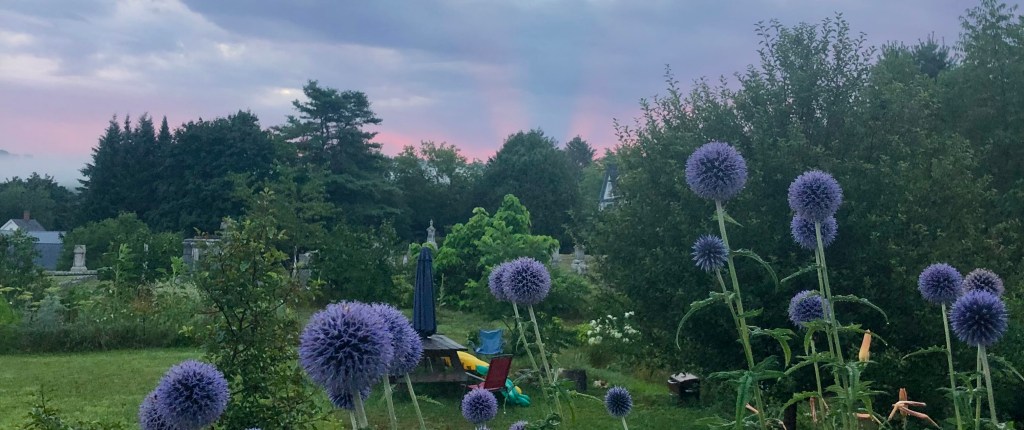
Afterwards, I drove back to Hardwick along the river valley — so green in midsummer — listening to the radio and in no particular rush. The rain had passed by the time I was home, and the world sparkled for a bit before the night set down in earnest. Five years into living at this house, the hydrangeas I planted that first summer have finally blossomed magnificently, profoundly here for the duration.

My teenager was eating blueberries and talking on the phone with her sister. In a year, I’ll expect she’ll be shortly headed into her young woman life. But for this evening, I cleaned up the cat’s lettuce vomit and boiled water for tea. I had about ten things that all seemed important. Instead, I walked barefoot through the wet grass to the mint that escaped my herb garden and plucked a few leaves for tea. Washed with rain, the air smelled ineffably sweet.

“But along with the feeling of ineffability, the conviction that some profound objective truth has been disclosed to you is a hallmark of the mystical experience, regardless of whether it has been occasioned by a drug, meditation, fasting, flagellation, or sensory deprivation. William James gave a name to this conviction: the noetic quality. People feel they have been let in on a deep secret of the universe, and they cannot be shaken from that conviction.” 

— Michael Pollan, How to Change Your Mind

Norma Fox Mazer & Mark Twain.

As a kid, I wanted to grow up and live on a farm. We lived in a New Hampshire village and spent a few summers driving west and camping from Wyoming to southern New Mexico. National Forest camping was cheap in those days — a dollar or two per night — and we cooked over the Coleman stove and slept in tents. My parents were frugal. They didn’t rent motel rooms, hardly ever bought a cup of coffee, and generally operated on the rule of don’t spend (a learned lifeskill I remain grateful for). My father bent that rule in a Boulder, CO, bookstore when the reading material we’d packed in our green Jeep needed an infusion.

The summer I was ten or so I read Huck Finn and Norma Fox Mazer’s I, Trissy over and over. In retrospect, the books were a good pair for a kid.

Last night just after dark, I walked out to the herb patch for a handful of mint to brew tea. After a long day of high heat and the evening’s dew, the world smelled sweet, alive. I had mowed the lawn in the late afternoon, and I breathed in freshly cut grass.

What was it I had wanted when I dreamed of living on a farm? To be outside as much as possible, to put my hands in the dirt, and to see where the sky meet the horizon. Three things I achieved in one Friday, if little else.

That adolescent me, the girl who was, as I remember her, insecure, unsure, dreaming, yearning, longing, that girl who was hard on herself, who was cowardly and brave, who was confused and determined-that girl who was me-still exists. I call on her when I write. I am the me of today-the person who has become a woman, a mother, a writer. Yet I am the me of all those other days as well. I believe in the reality of that past.

— Norma Fox Mazer

A Thousand Things. Summer Moments.

On my way home from work, I stop in to visit a small building just recently finished. Inside, the room smells of freshly cut cedar. The visit is a pleasure, with a building well-designed and completed. Its owners will take joy here, that’s nearly certain.

I’m at the far end of the lake, and so I take the long way home over dirt roads. I make one more stop, where someone I knew years ago has finally begun building a long-planned retirement house. Building is both fast and slow these days — a craze to build and a shortage of materials. There’s no one at this site, and I stand for bit, admiring the view of the Black River valley. I hope this place gives the owners their share of joy, too.

Where I work now is the town where I spent so much of my daughters’ childhood summer days, swimming and hiking. There was plenty of joy in all those things, too. The afternoon is redolent with humidity, exactly as I remember in my childhood.

In this steamy afternoon, I have a little pocket of time before an evening meeting. In my garden, I pick two zucchini, some lettuce that’s gone to sour, and a red coin onion. My garden grows as tall as my shoulders, more wild than not. A light rain patters down. I weed a little.

A thousand things I’ve done today. Or nearly a thousand. In this little moment, I let my own racing mind go. The snails have gotten into the lettuce. I lift one and then, gently, set it back down again.

Let it eat on, I think. I’ve plenty to spare. Don’t be greedy, I admonish myself.