Verbal Valentine.

I’m drinking coffee in an empty corner of a coffee shop when two strangers meet up at the counter and strike up a conversation. They’re kidding the young man behind the counter who’s been sitting on the floor behind the counter, talking to a young woman. It’s a quiet morning, and their chatter has been gently full of laughter and wit.

One stranger buys the other a coffee — “and throw a shot of espresso into it” — and then his card jams and won’t work. The barista turns the card reader upside down (I mean, what else can you do with those things?) and then the other stranger pulls out cash. The men talk songwriting and growing up in North Carolina and the price of a cord of wood.

It’s a kind of Valentine’s bit of goodwill on a snowy morning that soon will turn to sun in Northern Vermont….

When the winter chrysanthemums go,
There’s nothing to write about
But radishes.

— Basho

Today…

All week, people have been dropping in at work, with ideas and needs and so much school board talk. A stranger dropped in yesterday and mentioned she expected to become a grandmother that day, possibly the next. Candlemas, the ancient festival, forty days after Christmas and its official end. February 3 marks my own holy day, the day my oldest joined us in the world and I crossed over into motherhood.

In labor, I walked outside in Birkenstocks and stared at the melting snow that was running in sunny trickles. Just days after she was born, a fierce cold sunk in to stay. The neighbors brought a blueberry pie. As a toddler, I called this child a wildcat. Now, all grown up, she’s still a cat, with a cat’s complexities — half-feral and blissfully domestic, fierce-clawed and loving.

With worry edging her voice, the stranger told me she expected her family’s birth to be healthy. These usually go well, she noted. I agreed, and we walked out together. The wind carried dry snow over the parking lot. She disappeared in her car, but I stood for a moment longer, remembering my daughter was born shortly before midnight. My long labor ended with a surgeon who held my vernix-smeared baby in his gloved hands so I could see her. Her eyes were wide open, and she looked directly at me.

listen,
you a wonder.
you a city
of a woman.
you got a geography
of your own.

— Lucille Clifton

Light Turning.

Walking into town, I pass a house that has been abandoned for the five years I’ve lived here. Last winter, a vehicle skidded off the road and smashed through the front window. Since then, plywood has covered the front.

There’s a few houses like this in that neighborhood, the paint gray, the windows filthy, tiny yards gone over to weeds or dirt. In the pandemic’s craze, people moved back into a few of these, converting abandoned places into homes again. The driver of a fuel truck stood outside this house yesterday with a young couple, the three of them talking seriously, nodding heads. Sheets of foam insulation leaned against the house. On the side wall, someone had ripped off the dirty plastic and exposed a large square window, its top edge red and blue stained glass. Without stopping, I wondered what else was inside the house.

End of January — and suddenly the sunlight returned in full force. Today may be cloudy, tomorrow, too, maybe for days to come, but the earth is tilting. Slow as spring is, we’re leaning that way.

Don’t say my hut has nothing to offer:

come and I will share with you

the cool breeze that fills my window.

— Ryōkan (trans. John Stevens)

Bobcat. Saw-Whet Owl.

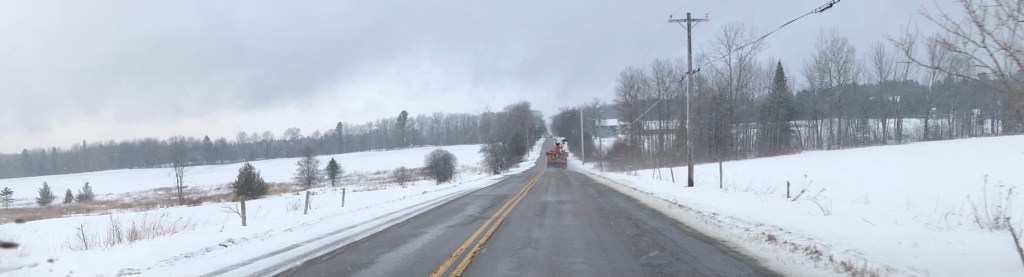
I arrive a few minutes early to meet my friend for coffee and look for a window table to open my notebook. A writer I know just a little is eating a ham and cheese sandwich and asks me to sit down. He’s old enough to be my father if he began fatherhood at a young age, which I know he didn’t. He immediately tells me two things: he’s waiting for his back road to be sanded and he saw a bobcat in a tree behind his house that morning. He describes the cat’s reddish fur, and I ask detailed questions about the wild creature’s size and location and poise. My friend arrives and they keep talking about San Francisco, and then he tells us about studying with Joan Baez at The Institute for the Study of Nonviolence.

The bakery is at a busy intersection in Montpelier. Through the window, I see people in colored winter coats. Until the pandemic, I often brought my laptop to work at this bakery and the one across the street that closed a year or two ago. Two blocks up is the public library where I wrote long sections of my last book. None of these places I’ve returned to work. Like everyone else, my life has changed, my habits recreated.

The bakery is closing. The day moves along. My friend and I walk through Bear Pond Books. She buys me a novel, hugs me goodbye, and heads on her way. I walk the long way back to my car. That night, I dream about the saw-whet owl my daughter and I glimpsed in the woods behind our house. A toddler, she pointed at the hemlock branch where the tiny bird was nestled in the greenery, its eyes wide-open. We stood there for the longest time, wordless, our breath frosty clouds in the winter air.

“… nothing is a promise, but that beauty exists, and must be hunted for and found.”

— Joan Baez

And a Little of This Loveliness…

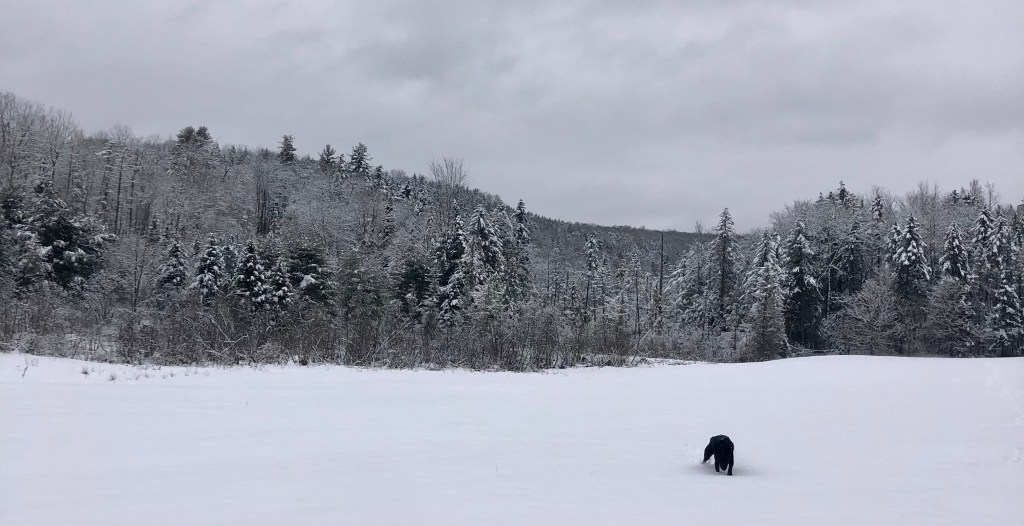
A few streets down from me, a pregnant woman leans on a shovel in a driveway covered with a few inches of dense, soggy snow. It’s late afternoon, and a light snow swirls down as I walk. A pickup truck stops on the road, and I hear the driver offer to plow. There’s a little back and forth, and then she steps back. He sets down his plow and goes to work.

Every snowfall has its own kind of knowledge. As I walk through the streets and then across the former railroad bed and into the woods, I marvel at how much I know about snow, too. How a scattering of snowflakes can remind me of being 10 years old again, and a fourth grade teacher caught snowflakes on her tongue. Delicious, delicious, she said. Or how the three-foot Valentine’s Day storm snowed us in when my daughters had fevers and I wondered if I would ever return to the world of adults.

In the woods, the snow swallows up all sound for a handful of hours.

In these winter months, I’m reading about Claude Monet and his gardens. Here’s a line from the master: “… people must first of all learn to look at nature, and only then may they see and understand what we are trying to do.

The Shape of Things.

In the early 1600s when Samuel de Champlain was bunking around the fire with people who lived on the shores of an enormous and beautiful lake, Champlain remarked in his journal how surprised he was that these strangers discussed their dreams every morning as if their dreams were as real as the waking world. I’ve been thinking about Champlain’s observance and how easily we can narrow our vision, completely discounting or ignoring pieces of our past and present.

A blog reader who sometimes mails me terrific books sent me Jane Alison’s Meander, Spiral, Explode: Design and Pattern in Narrative. As I’m finishing up a draft of my novel, the book has made me look harder at the novel’s structure. As a writer, I can’t help but look at my own tangled story — and those around me — and the way plot lines and patterns, how chance and opportunity, blend and shape our lives.

For Ray Carver fans (and who isn’t a fan, really? if not, you might want to be!), there’s a terrific essay on one of my favorite stories, “Where I’m Calling From.”

So often fictions that experiment formally do so at the expense of feeling. They toy on surfaces or are purely cerebral affairs, don’t explore human complexities. But the mostly unconventional narratives I’ve been discussing have dealt powerfully with core human matters.

— Jane Alison