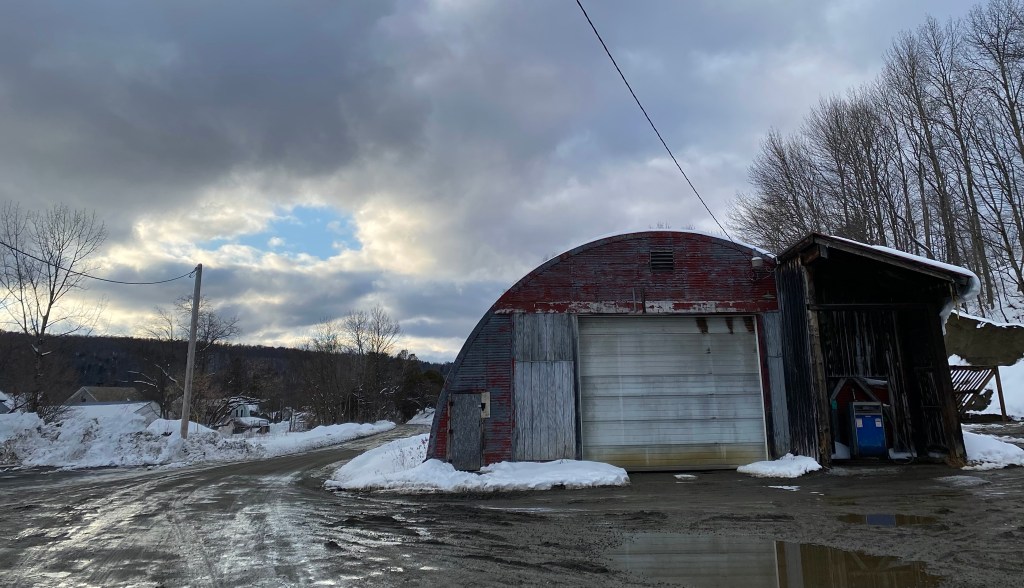
Stone House.

All night, wind howls around our house. I give up the charade of sleeping and pull out my library book. I’m in the final pages of Meredith Hall‘s memoir about growing up in New Hampshire, Without a Map, and I’m in no rush to end her story, close the cover, and return the book.

At my feet, my little cat lies awake, thinking cat thoughts, in a cat circadian rhythm of his own. The Ides of March howl in fiercely. All day, the wet snowstorm has swirled around us. My wet boots lie beneath the wood stove. Our house banked in by white and the ash bucket melting dirtily into the path where I’ve left to cool, its embers to burn out and die.

Somewhere in those hours before dawn, I shake flat the wood stove’s embers with the ash shovel and lay one, two, more pieces of wood on the flickering coals. In the dark house, the little cat follows me downstairs, curious about breakfast but not insistent.

I think of what I’ve read that day, about a stone house built nearby in the 1800s from a single boulder. A curious endeavor. Take this stone, cut it into pieces, and make a home. In the darkness, the wind rakes over our house, hurls over my snow-submerged garden plot, and whirls over the town cemetery.

“The past lies beneath the surface, intransigent truth. Remembered or not, what we say and do remains, always.” 

— Meredith Hall

Small Reckonings.

I’m sitting in the back of the school library on the wall heater when a friend I haven’t seen for years walks in. A large school board meeting has started, and we whisper to each other until I suggest we leave and talk. Early evening, the school is empty, and turn on the lights in a room where my daughters both had classes. I pull out two chairs from the student tables.

Almost immediately, we start in on what should be a simple math problem — March 2023 to March 2020 — which yields an unbelievable three. Before the pandemic we worked together and spent hours talking about literacy and kids, about schools and families, but we also talked about canning tomatoes, about parenting, and being women. We ask how this or that turned out for each other — some decisions, some simply a bend in circumstance.

By the time we leave, the school has completely emptied out for the night. The weather has turned mild, and we walk slowly under the dim lamplight to our cars. A mist rises over the soccer field. I get in my car and drive down the hill and across the river and up the hill to my house. The village lights sparkle in the mist. The moon edges around a break in the clouds. In the darkness I stand there, thinking about the numbers we put together, marking places in our lives, then adding and subtracting our lives—people and jobs and books and houses. The numbers all mesh together, consumed in our shared stories.

Go Without Sight…

On this day of sunlight and chores, I end the afternoon walking through the back areas of town, behind the town garage and around this year’s dwindling sand pit. I turn around in the neighborhood with the scary unleashed dog, backing up slowly and doing, perhaps, exactly what should not be done.

Out of sheer carelessness, I never got the wood stove heated up to temp this morning, early at my desk, so intent, that I carelessly let the stove smolder low. In the day’s heat, I’ve let the stove dwindle further. That chore awaits me. My carelessness annoys my daughter, who’s afraid of burning the house down (what sane Vermonter isn’t at least slightly afraid of that?) and in love with the stove’s fierce heat. Two things at once. Which sums up March. Winter and spring. Breezy clean and ponderous with the thawing earth’s muck.

I pass hardly a soul on my walk and wonder if I should have made friends, or at least a kind of peace, with that snarling dog. As I walk, the air cools. The puddles are luminous with what remains of the day. I remember that beloved line from Wendell Berry — To know the dark, go dark — the line that’s driven so much of life. When I get home, I look it up.

To go in the dark with a light is to know the light.
To know the dark, go dark. Go without sight,
and find that the dark, too, blooms and sings,
and is traveled by dark feet and dark wings.

Flattening the Road.

I drive home in a pouring snow, remembering when we bought a Toyota pickup years ago, and I drove with four-wheel drive, how the road suddenly flattened out. I’m driving my daughter’s car. In Hardwick, I stop at the auto parts store. Her right wiper is torn. I’ve known the person my daughters call The Auto Parts Man for years. He opens the wiper packages on the counter and then puts on his coat and heads out in the snow and replaces my wipers, too.

It’s the last day of February, and he says he’d rather winter just quit. He laughs and shrugs.

Nonetheless, for the moment, my windshield is clear.

This hill
crossed with broken pines and maples
lumpy with the burial mounds of
uprooted hemlocks (hurricane
of ’38) out of their 
rotting hearts generations rise
trying once more to become
the forest

just beyond them  
tall enough to be called trees  
in their youth like aspen a bouquet  
of young beech is gathered

they still wear last summer’s leaves   
the lightest brown almost translucent  
how their stubbornness has decorated   
the winter woods

— Grace Paley

Order.

Dreaming, I untangle my knitting conundrums: rip out one half-finished cardigan and use the yarn for a cabled pullover. Nothing earth-alternating, planet-changing, simply my need for order and creation. Some small measure of satisfaction.

Which is why I understand the volunteer in the Giving Closet, the room in the old school building where I work these days. The Giving Closet holds the community’s castoffs and giveaways, an endless motion of clothes and toys and dishes and not enough artwork that swaps around from household to household.

Late afternoon, low clouds pressing around the wide windows as a storm moves in, I wander into her space and offer hot water for tea. She’s endeavored to straighten and tidy the concatenation of stuff that invariably slides into chaos. Two women are looking for scrubs, holding up shirts and asking each other, This? or This?

Through the windows, snow drifts down. The roads part and V around this old schoolhouse, empty. Across the way, the Ukrainian flag hangs down from the church’s sign.

….. and here’s a few lines from a recent review of Unstitched by Joanna Theiss.

While Unstitched is a valuable and important book for its discussion of opioid addiction, the writing is quietly beautiful, every word appreciative of the Vermont landscape and its seasons, on mothering girls while grieving with a mother who lost her own daughter, on the stark class divides that hinder our efforts to grow past this crisis, and the joy of community, no matter how much mending it requires.

Traveler, There is No Road.

The trail where I ski changes every afternoon. The exposed earth eats away at the snow. The icy patches are harder, or the day has warmed and the snow swooshes mealy beneath my skis. In late afternoon, it’s me and the dog walkers, or two women, always deeply engaged in conversation.

The tech center students have half-tapped the sugarbush. The drop lines hang down in the back section of the sugarbush. The students are gone, too, leaving the tramp of their snowshoes, nothing more. The sunlight comes and goes all day, warm or gloomy. Fresh snow is scant this winter, and the trail’s ice is embedded with a scattering of hemlock and cedar greenery, small things that I fear will snag my skis but don’t.

The streams and rivers are running but the season of frogs is a long way off.

Finished, I clean nubbled ice from my skis with my fingers. A splinter is embedded in my thumb from a piece of firewood, stuck and sore. I press my thumb on the ice, listening for spring birdsong. There’s the sweep of wind, my heartbeat; nothing more.

There’s a reason why King Arthur’s knights were instructed to keep off the trails when searching for the grail, the logic being that if they were on the trail then they were following someone else’s path, so that particular path could not be their true path. Their only hope was to forge their own way through the woods. As Spanish poet Antonio Machado writes: “Caminante, no hay camino/ al andar.” Traveler, there is no road. You make the road as you walk.”

— Stephen Cramer