Reasons…

Rainy afternoon. I wander through the neighborhood where I once considered buying a house. Someone else lives there now. With new paint and two rocking chairs on the front porch, I need a moment to recognize the house, to remember the kitchen door I went through, envisioning in those days how my life might bend.

These years, walking by, I’ve watched the vehicles’ license plates change from Maine to Vermont, a tricycle appear, a front step break, two hydrangeas expand in the front yard.

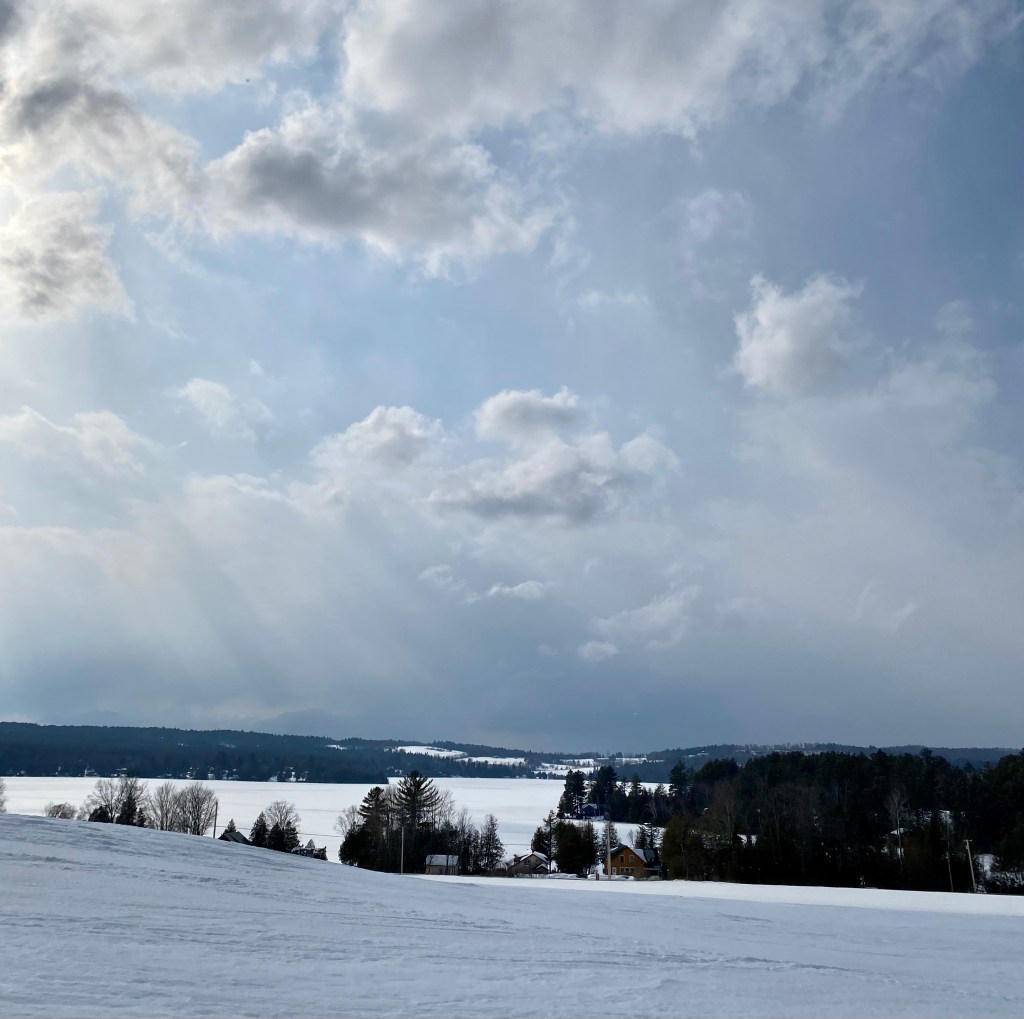
April: season of mud and rain, snow and patience. Some reasons are obvious. Snow vanishes first on south-facing slopes, but other patches around us aren’t so readily knowable. Why does snow cling to some fields and not others? Quickly running water beneath, perhaps, the softening of what our human eyes can’t see, the knowledge gained only by years of our wandering footsteps.

So it goes. April, thaw, brown to pea green.

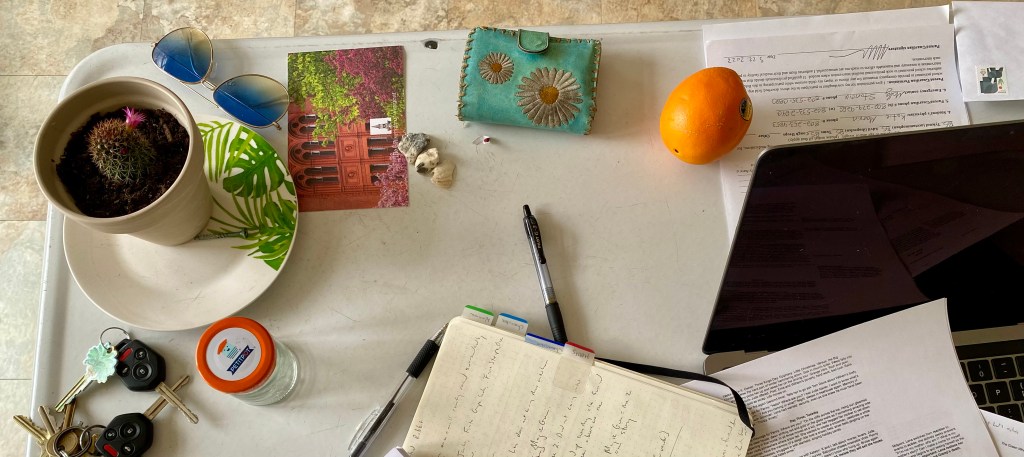
The world begins at a kitchen table. No matter what, we must eat to live.

The gifts of earth are brought and prepared, set on the table. So it has been since creation, and it will go on.

We chase chickens or dogs away from it. Babies teethe at the corners. They scrape their knees under it.

It is here that children are given instructions on what it means to be human. We make men at it, we make women.

At this table we gossip, recall enemies and the ghosts of lovers.

Our dreams drink coffee with us as they put their arms around our children. They laugh with us at our poor falling-down selves and as we put ourselves back together once again at the table.

This table has been a house in the rain, an umbrella in the sun…

From Joy Harjo’s “Perhaps the World Ends Here”

Plot Point, Soul Journey.

My older daughter relays that she stopped for brand-new greasy donuts at 3 a.m. with her sister and a carful of teenagers headed to the airport. She parked beside a car with a man, she says, who must have lived through better moments.

We’re waiting for coffee on a Sunday morning jammed with people getting the Sunday vibe going. I make a vague comment about the soulful journey. Despite the eyerolling of my companion, I’m serious. Maybe the man was simply heading from home to work, or vice versa, but 3 a.m. in rural Vermont often means staring at a lonely emptiness where the way down leads to a few single dismal plot points, and the way up — imagination has plenty of material there. I don’t mean this in any jest, having hit a multitude of my own 3 a.m. moments; there’s a sizable respect between me and 3 a.m. Laughter and donuts, of course, are my preferred side of those moments.

April is the Vermont season of patience, of cold and thaw, and cold and more cold, of rain and the remembrance of November, the splendiferous muscle of crocuses. April is the long haul of spring, of faith in the green that tantalizes. Vonnegut writes, “The primary benefit of practicing any art, whether well or badly, is that it enables one’s soul to grow.”

Might.

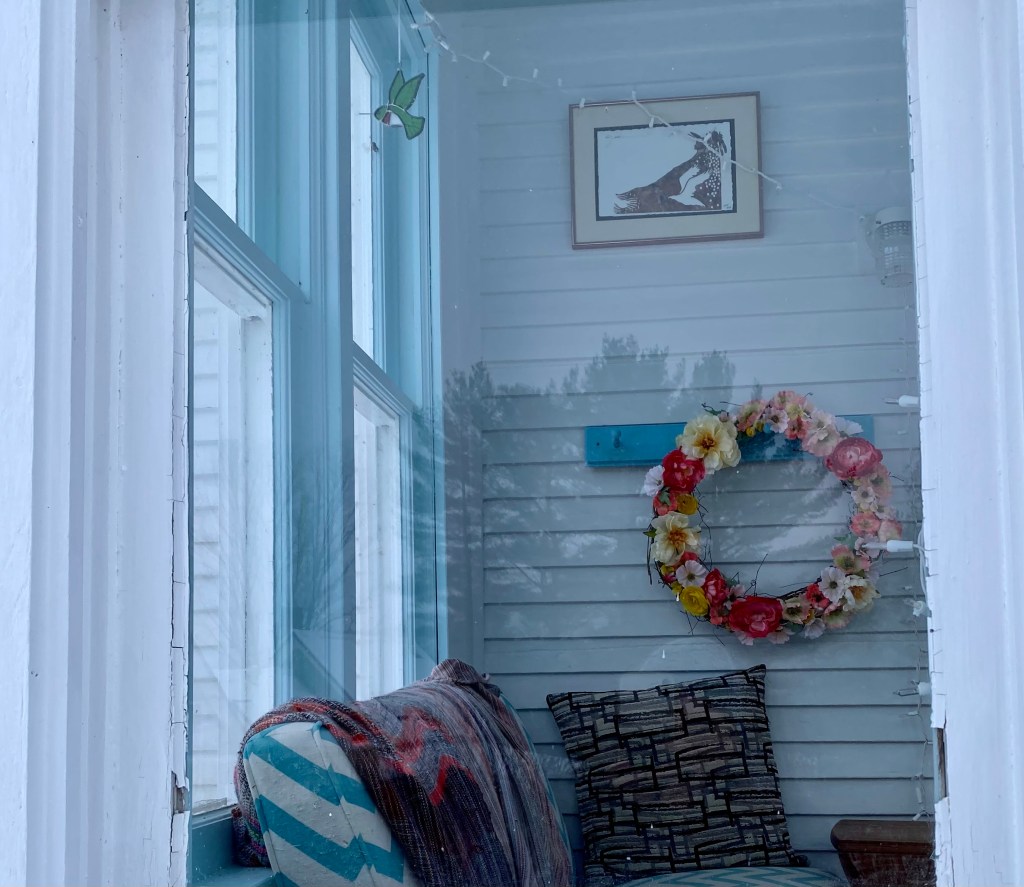
Two years ago, my youngest and I quarantined for whatever the period was then, five days perhaps. I painted the inside window trim on the front and upstairs glassed-in front porches the loveliest pale blue. My daughter recovered quickly, almost instantaneously; I tested negative, over and over, kept painting and listening to the Derek Chauvin trial for the murder of George Floyd, hours and hours and hours.

Soon after, I was vaccinated at the high school on a cold April day. It was snowing lightly, as it was today. I knew some of the volunteers who had come out of retirement to aid the state in vaccinating. Afterwards, I sat in the gym as we had been asked to wait. I sat near a man who I had worked with before the pandemic, before I changed jobs, too. We talked about work and kids and how our lives had changed, and we kept talking even after each of us had been told we could leave. I had plenty to do — oh, how there’s always plenty to do — but I lingered. Each one of us had our story that day that seemed filled with such quiet, such orderliness, so much hope.

My daughter was learning to drive that spring. She drove to spring soccer practice, and we sat in the car before one practice, listening to the Chauvin trial verdict. The geese had returned to the open river. While she played, I stood outside the closed town library. The bulletin board was empty of notices of events, as if time had dwindled to nothingness.

Spring: a mighty season. The earth will do what it will.

“Spring Snow”

Rain of remembering;
late snow turning to rain.
Then in the cold house,
alone in bed,
the soft stutter on the roof,
random phrases; your voice,
only your voice. How can
it be that voice that touched
me everywhere?
And what you said,
if only I could hear it again
in its intensity.
Essence distilled
in the moment of waking,
the delicate mold and odors
of the breaking apart of winter,
in the soft snow that comes
between the past and the chill
distillation, the whisper of air
split between the perfume
of melting crystals; the clasp
and letting go.

— Ruth Stone

No one owns the mud, either.

As the snow melts, the mud comes up. A friend says, But it’s so dirty. I think, Bring on the dirt.

On a sunny afternoon, I disappear early, head out to those secret places where I know the redwing blackbirds sing. There’s nothing I can hold in my hand, nothing I can pocket to bring home and leave on the kitchen table for my daughter, no sign of where I’ve been or what I’ve done, save for the mud that sheds from my boots on the door mat. That, too, is my affair. I sweep it up and empty the dustpan over the back deck.

“Advice from Rock Creek Park”

What will survive us
has already begun
 
Oak galls
Two termites’ curious
self-perpetuating bodies
 
Letting the light through the gaps
 
They lay out their allegiances
under the roots
of an overturned tree
 
Almost always better
to build than to wreck
 
You can build in a wreck
 
Under the roots
of an overturned tree
 
Consider the martin that hefts
herself over traffic cones
 
Consider her shadow
misaligned
over parking-lot cement
Saran Wrap scrap in her beak
 
Nothing lasts
forever not even
the future we want
 
The President has never
owned the rain

— By Stephanie Burt

March. Flowers.

At the co-op, the words are: dirty March. So much snow, rain, the deep ooze of mud, what feels like the very faraway promise of green. Returning home, the teenager has burned herself reading on the back deck. One cat let the other eat his dinner and yowls plaintively, furiously, at household injustice. Stove ash and common dust have invaded the house. Sunlight spills through the windows onto the floor.

March: the season of radiant joy, sullen unhappiness. I lie awake and wonder about my own private death: next week, next month, or four decades from now? I decide the only reasonable course is to bargain for forty more years on this planet, and inevitably take what comes.

Thursday, the day dawns with the scent of loosening mud. The rain slides in. Midday, redwing blackbirds.

A good day for a poem:

Flowers, by Cynthia Zarin

This morning I was walking upstairs
from the kitchen, carrying your
beautiful flowers, the flowers you
 
brought me last night, calla lilies
and something else, I am not
sure what to call them, white flowers,
 
of course you had no way of knowing
it has been years since I bought
white flowers—but now you have
 
and here they are again. I was carrying
your flowers and a coffee cup
and a soft yellow handbag and a book
 
of poems by a Chinese poet, in
which I had just read the words “come
or go but don’t just stand there
 
in the doorway,” as usual I was
carrying too many things, you
would have laughed if you saw me.
 
It seemed especially important
not to spill the coffee as I usually
do, as I turned up the stairs,
 
inside the whorl of the house as if
I were walking up inside the lilies.
I do not know how to hold all
 
the beauty and sorrow of my life.

Layers.

A week of sun ends in scattered raindrops and my hands dirtied with creosote from cleaning out my wood stove. The cats hunker against the wall, glaring at my labors, annoyed at the chill descending into their cat realm. My daughter, fluent in Cat Language, feeds the creatures small pieces of roast chicken. I brew more coffee.

Mid-March, the sudden season of reckoning: what is it I’m doing? This is the week of self-doubt and the week of the kindness of strangers, too. March has long meant the season of sweet maple and cold hands, of leaning hard into work, the season of faith that spring’s crocuses and snowdrops and ephemerals will return—that they always return—to remind myself that the wider world holds us inevitably, for good or ill and sometimes for both.

Cutting into with the ax,

I was surprised at the scent.

The winter trees.

— Buson