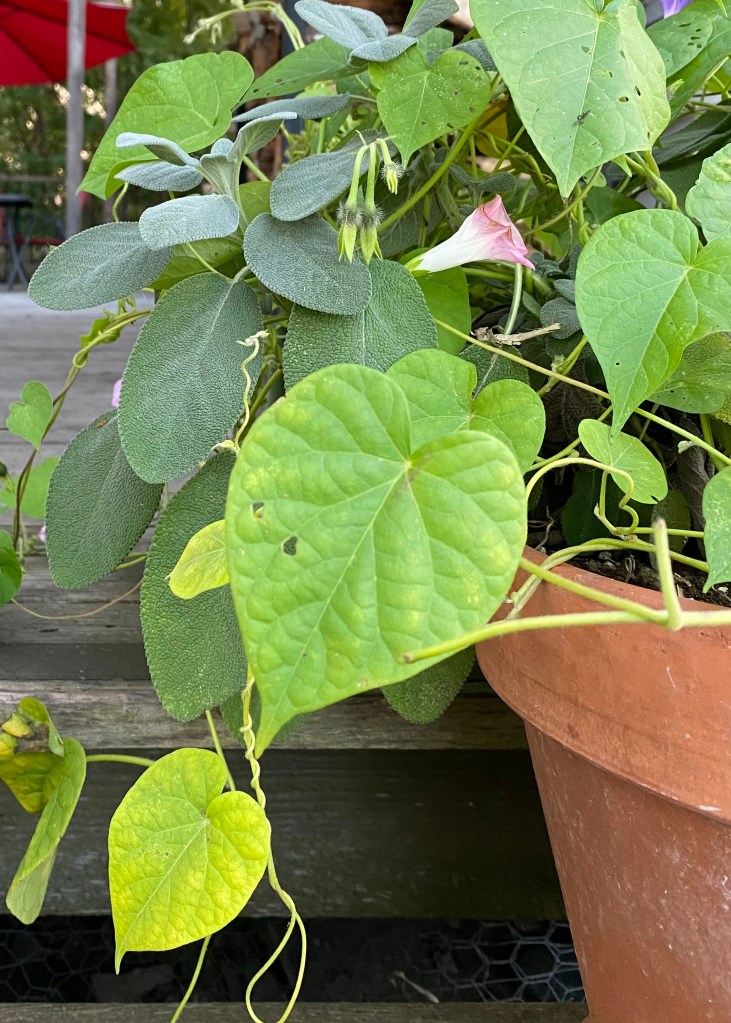
Fresh Lilacs, Late October.

My daughter sends me a photo of an apple blossom she discovered in Montpelier, Vermont, just this weekend, end of October. For anyone not a Vermonter, this is odd news that evokes suspicion and distrust. In New Englanders, distrust is a carefully curated character trait. Good lord, don’t be naïve. Naïve people don’t put on snow tires, and those people drive off roads.

Later that same afternoon, we walk through a pasture and then cut through a town cemetery. There, the lilac bushes are sticks, as you’d expect at this time of year. But at the very top of one bush, lavender flowers bloom. My daughter stands on her tiptoes and gently pulls down a branch. My house is surrounded on three sides by lilacs; late May is a joy. But this year, there were hardly any blossoms. Now: lilacs in late October in northern Vermont? Any sane person would look at this askance.

Nonetheless, I stand on tiptoes, too, and breathe in that ineffable scent of fresh lilacs.

Here’s a few lines from poet Amy Lowell:

Even the iris bends

When a butterfly lights upon it.
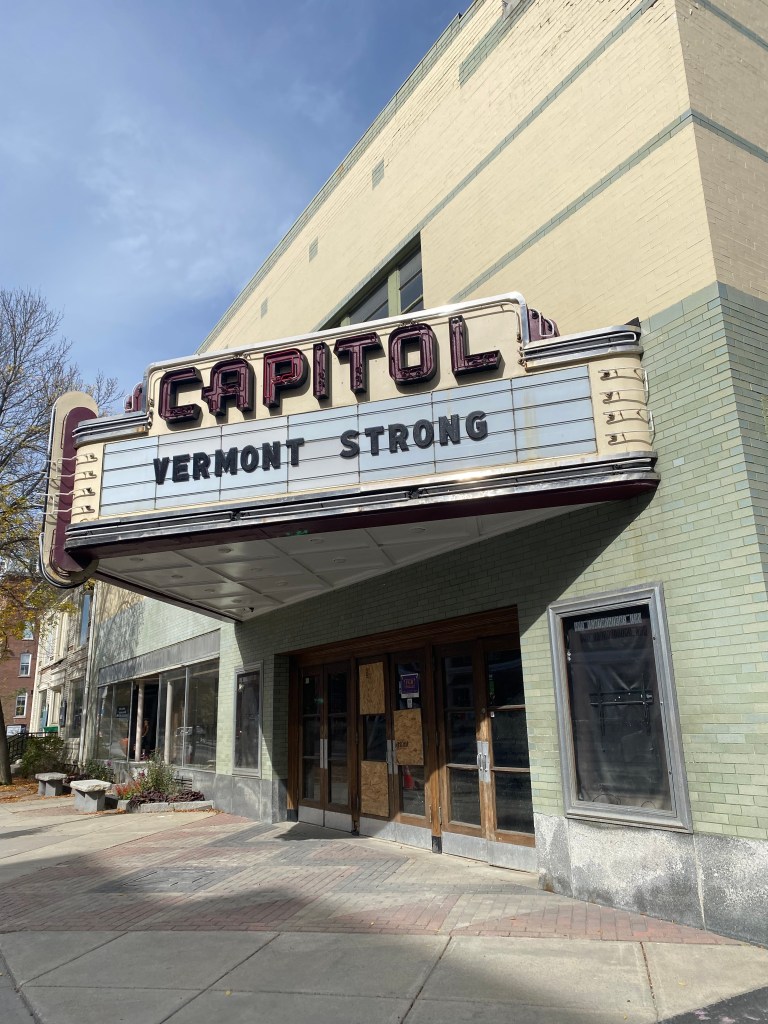
Post-Flood, Montpelier.

As if overnight, the fall foliage has vanished, swept into gray. The secret of Vermont’s autumn is the long lingering twilights, languorous and violet. Branch by branch, the trees are emerging from their summer splendor. Before frost yet, my garden rages on, orange tithonia, candy-colored cosmos, the morning glories that intrepidly vine through sunflowers and tomatoes and borage.

This weekend, I walked through Montpelier. So much of Vermont’s capital remains boarded up after the July flood, in need of money or labor. Other folks have shuttered up and headed elsewhere. It’s impossible to pretend that the world around us isn’t swirling in chaos. Nonetheless, when I come in with my fingers and toes cold, I build a fire. The neighbors string up gold lights. Quickly, quickly, and immensely slowly, the season settles in.

“You must try,
the voice said, to become colder.
I understood at once.
It’s like the bodies of gods: cast in bronze,
braced in stone. Only something heartless
could bear the full weight.” 

— Jane Hirshfield

A Thief Running Away…

Slacker, slacker, I’ve been about a few things in my life, the laundry folded and left in piles on tables, my blog idling, the emptied cans of cat food needing to be recycled.

These mornings, I’m up so early my glossy housecats are yet sleeping, curled in their cat balls, not yet grousing and purring for their breakfasts. A year ago, I believed I had finished a book; I had that draft in my hands. But a year later, here I am, drilling down, writing maniacally, to get all the way down to the end, in and out of chapters, between words, cutting and creating.

Walking to meet a friend after work, I suddenly see the whole shape — the beginning, the messy middle, the end — in the tangible image I’ve been searching for. That image is all through the book: now, some stitching together, a few crumbs for the reader’s delight.

Some of you have read clumsy drafts of this novel, and thank you, thank you. What a fool’s venture writing a book might seem. There’s never a guarantee of anything — of good work, of any money, of satisfaction. A year later, though, and I know this book inside out. I could recite sections, perhaps, if you and I spent time in a lock-up, although that, I hope, is unlikely.

Here’s what I learned this past year: worry about the few things that matter. Write as well and as hard as I can. Getting there, I think.

Here’s an article about human civilizations in Vermont that I’ve been thinking about all day, too.

A thief running away like mad from a ferocious watch-dog may be a splendid example of Zen.

— R. H. Blyth

Good Weight of Firewood.

The wood man delivers me green firewood, wood I plan to burn next year, God willing. He brings bees, too, or maybe the creatures simply appear magically from my gardens or trees, hovering on this sweet-smelling-of-sap pile. The day’s flawlessly sunny, and we stand beside the wood and butterfly bush my daughter bought me, talking. His truck is 40 years old, older than him, and he yarns on from there, telling me about his sugarbush and the taps he leases and how much syrup he made last year and the year before. A former sugar maker myself, we talk the talk about reverse osmosis and arches and how he nearly but not quite burned his front pans last year. We talk ropy sap. We talk how long it takes to fill a 40 gallon drum.

I write him a check for a week’s worth of my wages. He heads out, still laughing, leaning out his window, telling me his wife expects him home for lunch.

When he’s gone, I lift a piece of maple, heft its weight, breathe in its smell. This wood man’s given me good weight.

Stealing Flowers Gone Wild.

Bear Pond Books in Montpelier reopened yesterday, nearly two months after the July flood, beloved bookstore in Vermont’s capital city. “The flood” sounds Biblical, and I’ll note that the Old Testament has never been known as a Hallmark read.

Last fall, I often parked my car behind the town garage so I could run on the rail-trail. On a heap of gravelly slag, a variety of yellow asters blossomed. At the fall’s end, shortly before frost, I brought a bucket and shovel and dug up a clump of stalks. I buried that clump in my garden. The leaves emerged this spring. By then, I had forgotten that re-homing of the yellow aster. Now, the green buds are on the verge of opening.

There’s a submerged theme between the three things in this post that I imagine only I can see— the bookstore and the flood, my stolen flowers, Mary Ruefle’s lines about clouds: the unstoppable force of our planet, immense, immense. Meanwhile, our toiling: the bookstore folks carrying out mud bucket by bucket, me with my shovel and a small handful of what might appears to be merely weeds.

Mary Ruefle:

All that summer there were so many clouds we

didn’t know what to do with them. They overflowed the

sky – they were on our streets, in our homes, in our draw-

ers, and in our cabinets. They were in our cars and on our

buses, I even saw them in taxis. No one had ever seen so

many clouds, to the extent that, as often happens with a

glut, no one could remember a time without them…

From My Private Property

… two million naturally occurring sweet things…

On this last Wednesday in this August… a few lines from Ross Gay:

Sorrow Is Not My Name

—after Gwendolyn Brooks

No matter the pull toward brink. No

matter the florid, deep sleep awaits.

There is a time for everything. Look,

just this morning a vulture

nodded his red, grizzled head at me,

and I looked at him, admiring

the sickle of his beak.

Then the wind kicked up, and,

after arranging that good suit of feathers

he up and took off.

Just like that. And to boot,

there are, on this planet alone, something like two

million naturally occurring sweet things,

some with names so generous as to kick

the steel from my knees: agave, persimmon,

stick ball, the purple okra I bought for two bucks

at the market…

      —for Walter Aikens