The Revenge Business.

Washing dishes this morning, I catch a little of NPR’s Morning Edition. Mandy Patinkin who starred in The Princess Bride says his famous line about avenging his father’s death. As I’m scrubbing out the coffee pot, Patinkin says the more important line is about how revenge never got anyone what they wanted. Ever.

For February, this Saturday is crazy warm. I hang the laundry outside to dry and open the windows. I finish up some work at the coffee shop and talk with a school board member from the board I quit, abruptly, last spring. A few raindrops are falling as we step outside on the sidewalk.

In the little rain, I walk home, thinking about that revenge line. Families, nations, epochs, have run on revenge. And the math always works out in its own calculation. Check out the NPR segment.

The true religion, the religion of snow…

I stand at my kitchen’s glass door devouring blood oranges and watching the sifting snow. Blood oranges — could I choose a less local delight? I open the door and cast out the peels for the birds.

The cat Acer sits on my feet, listening to the morning radio news, too. Just over the river, my home state New Hampshire revels in the Presidential primary. Meanwhile, Vermont prepares for its March Town Meeting Day, with the calculations and passion of budgets and petitions. Close an elementary school? Pledge to become a pollinator-friendly town? So much of January in my state is devoted to public meetings and discussion/debate, to a reckoning of the way forward, a jostling for who’s running for what seat — and what seats might remain empty.

Meanwhile, snowy winter has finally arrived, spare and elegant. Fearsome and enchanting. As the days deepen in cold, the light hours increase: no stasis in this world.

A fan of local chicken, bacon, milk, my cat stares at my orange-sticky fingers with disdain. I crunch the orange seeds, too, devouring this sunlight sweet.

Here’s Billy Collins’ poem about shoveling snow with the Buddha:

[Shoveling snow] is so much better than a sermon in church,
I say out loud, but Buddha keeps on shoveling.
This is the true religion, the religion of snow,
and sunlight and winter geese barking in the sky,
I say, but he is too busy to hear me.

Myself, the Householder.

Furious, long before four this morning I’m at my desk with coffee and manuscript and my needy cat who must have his nose rubbed. A few months ago I asked a neighbor to knock off his cash carpentry payments to my ex-husband, a father who’s never made a child support payment. The neighbor brusquely told me I didn’t understand the complexity of the situation and walked out.

Now, he’s sent word that I made him and his wife feel unsafe. Oh Lord…. me and my 4’9″ stature and my insistence that I do know the complexity of my story and my uncomfortable female rage. I’ve doubtlessly repeated this, but his is a Kafka-esque flip of the word unsafe. And since when are other people’s children negligible?

I’ve been here before — like too many others, as this is hardly my unique problem — and I do what seems sensible to me. I tell no one where I’m headed and hike through the forest and up along a ridgeline. The hike cools my head. I discover white trilliums and wash my face in a low-running stream. The woods are hurting for rain, thirsty, thirsty.

I left with a question — what will I do? — and returned with my answer. Out of chaos, always, springs the pulsing might of creativity. At home, I hole up with Joanna Biggs’ A Life of One’s Own: Nine Women Writers Begin Again, and Biggs points me to Toni Morrison. In the evening, I pull a few weeds from the lily-of-the-valley that guard my house’s foundation. Such a delicate, pure, tiny flower.

 Q. You don’t feel that these girls (of teenage mothers) will never know whether they could have been teachers, or whatever?

A: They can be teachers. They can be brain surgeons. We have to help them become brain surgeons. That’s my job. I want to take them all in my arms and say, “Your baby is beautiful and so are you and, honey, you can do it. And when you want to be a brain surgeon, call me — I will take care of your baby.” That’s the attitude you have to have about human life.

— Toni Morrison, Time Magazine

Plot Point, Soul Journey.

My older daughter relays that she stopped for brand-new greasy donuts at 3 a.m. with her sister and a carful of teenagers headed to the airport. She parked beside a car with a man, she says, who must have lived through better moments.

We’re waiting for coffee on a Sunday morning jammed with people getting the Sunday vibe going. I make a vague comment about the soulful journey. Despite the eyerolling of my companion, I’m serious. Maybe the man was simply heading from home to work, or vice versa, but 3 a.m. in rural Vermont often means staring at a lonely emptiness where the way down leads to a few single dismal plot points, and the way up — imagination has plenty of material there. I don’t mean this in any jest, having hit a multitude of my own 3 a.m. moments; there’s a sizable respect between me and 3 a.m. Laughter and donuts, of course, are my preferred side of those moments.

April is the Vermont season of patience, of cold and thaw, and cold and more cold, of rain and the remembrance of November, the splendiferous muscle of crocuses. April is the long haul of spring, of faith in the green that tantalizes. Vonnegut writes, “The primary benefit of practicing any art, whether well or badly, is that it enables one’s soul to grow.”

A Whole Person.

Everyone has their own familiar paths and places. This empty stretch of interstate in the Netherlands between Vermont and New Hampshire my daughters and I have traveled countless times now, in all varieties of weather and moods. Now, so many years into this, one daughter is grown, the other on the cusp. My daughters look at my brother and me with a mixture of so many things — what, precisely, neither he nor I need to speculate. Laughing, he suggest to them that he and I equal a full person, our meager strengths and copious broken places complementary. I suggest, Maybe even a little more than one person….

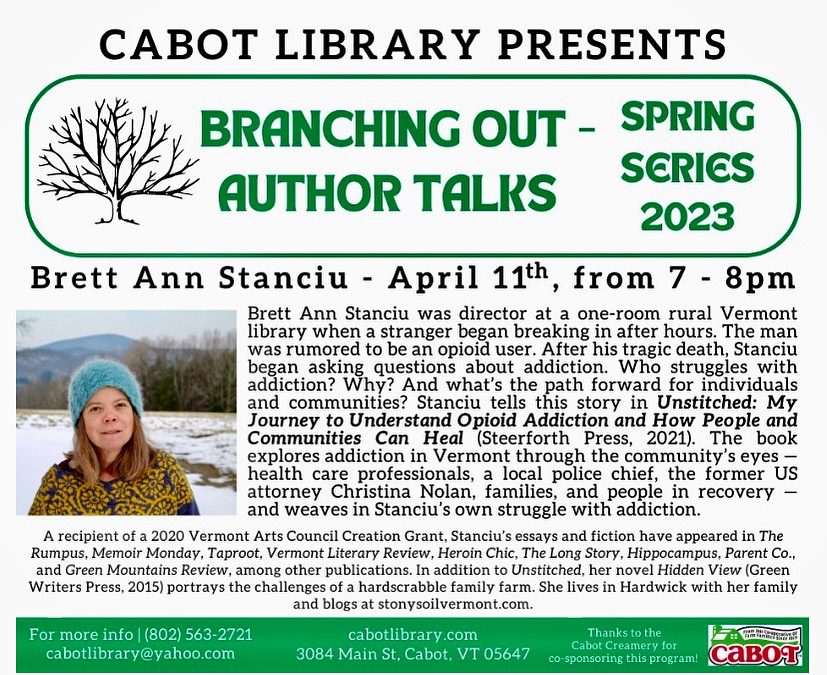
I’m grateful to be invited to read and speak at the Cabot Public Library Tuesday, April 11, 7 p.m. in a real-life deal. Come if you can.

And — definitely worth a read — Matthew Desmond’s Poverty, By America.

Poverty was a relationship, I thought, involving poor and rich people alike. To understand poverty, I needed to understand that relationship. This sent me searching for a process that bound poor and rich people together in mutual dependence and struggle. Eviction was such a process.

Saturday, Snow, River.

A snow-globe snow flakes down all afternoon. In a meeting, I sit near the window and look over the river. Plenty of listening. Plenty of talking. Ice clings in chunks to the shoreline, but the current runs swiftly. This March day is just at that brink where snow piles on last year’s dead grass, melts on the pavement.

As sometimes happens in this group, the conversation winds around to the world’s wider themes — the pandemic and literacy, disparity of wealth — very big picture things — how the world is broken in places and how these pieces may or may not fit together. There’s plenty of coffee, and sandwiches, too, that someone has brought from somewhere, and I keep drinking the coffee and studying those currents, how the water crashes up over rocks and flows on again, heading that long way to Lake Champlain and north through rivers heading towards the North Atlantic. Someone beside me remarks that he’s not convinced our world can be put back together.

In the very big picture, however, things are always going together, breaking apart, heading together again. I keep watching that dark river and the foamy curls of waves. The coffee is lukewarm and lousy at best. Nonetheless, I keep drinking it and drinking it. We keep talking and listening.

“That’s religion in America, under constant revision.” 

Jeff Sharlet