Mending Myself.

Mid-morning, abruptly the weight of my mother’s recent death lies on me, a physical presence, as if she’s leaning on my shoulders. It’s 21 days since she passed, days and nights crammed full. Like most mother and daughters, my mother and I had a relationship filled with 10,000 things and more. Again, today, on the eve of a short journey, I pack my laptop and books. I vacuum and mop and talk and talk and talk with my daughter.

Rain falls all day, so chilly I light a fire to the intense pleasure of my two cats. A year ago, my youngest and I flew home from Europe, my heart filled with our trip’s happiness. So, too, again, my life unfurls forward with an offer of good writing news. Spring in all her exuberance sings — such sweet joy for us in a northern sphere.

I wander outside. My shoes fill with rain. I stop in at a friend’s house. In her well-lit living room, with her purring cats, we talk about travels and love. Later, as I leave, she leans out the door, and we keep talking about honeybees and blossoms. The rain falls steadily, streaming down the collar of my coat. I have that walk home and more work, but I linger in the billowing fog, the gleaming green, our conversation gently pulling me back into this world, stitching me.

The dark blossomings of chaos…

Again, this metaphor lens (how is it possible not to see the world in metaphors?) Paul and John’s Long and Winding Road, Dante’s gloomy forest, Sylvia Plath’s bees and beekeepers…

I lead a friend into a forest, a piece of Nature Conservancy land on a dirt road. We’re talking, talking, my eyes searching the forest floor for ephemerals (the trilliums folded shut, trout lilies still only leafy, no blossoms yet). I take one wrong turn, a second wrong turn. I backtrack, looking for the narrow stone steps. Our walking and talking — and my eventual smartening up to pay attention — takes us to Chickering Bog. In this pristine place, it’s just us and frog eggs, fat tadpoles, crimson pitcher plants — the confluence of ancient and freshly brand-new.

The strange thing is, I’ve walked to this bog half a dozen times, easily. Yet never in April when the sunlight drops down through the trees’ bare branches, when the winter-fall of broken branches strews over the paths. Or maybe I’ve never been here with this conversation about things tiny and great. The glassy water shimmers so clear the bog’s mucky bottom tantalizes, unreachable, so many centuries of so much life.

At the journey’s end, at the dirt road’s edge, the sprinkled gold coins of coltsfoot, a purple sprig of flowering Daphne.

On the reading front…..

“We must therefore be willing to get shaken up, to submit ourselves to the dark blossomings of chaos, in order to reap the blessings of growth.” — Gregg Levoy, Callings

Stop all the clocks.

Santa Fe, many years ago

In this space, I’ve stepped between the mossy threads of my own life. For many years, my mother who lived far from me kept up with my life through my blog. I’d started writing stonysoilvermont the summer my then-husband and I split up. I was about to publish my first book. Although I’ve considered quitting, I’ve kept on, the disciplined scraps of this writing feeding into my creative life.

So it seems right to acknowledge my mother’s passing over into the next realm. A woman of nearly indomitable strength, she was ill for many years and surmounted multiple surgeries and illnesses. But none of us are mortal. My mother, who was a nurse for decades, knew this more keenly than most people. When I was a girl, she returned every morning at breakfast with stories from the hospital, some funny and some heart-wrenching — a child with leukemia, a cab driver shot point-blank in his head. One July morning, she carried home an orange kitten. We named him Oliver, and he lived a long full cat life.

Same, too, with my mother, a woman whose strength and passion shaped my own. In her later years, disease made her wander back and forth in time, into places where none of us could follow. My mother would have wanted us to grieve the end of her life, but not to fall dramatically on our knees. Raised a Lutheran, she was imminently practical. Nonetheless, I remember when I was 21, and my mother grieved her own mother. She stopped all the clocks.

Dazzling light.

Here’s the weird thing about this March: cabin fever is not a thing. March has always marked the time of year when snow and cold has piled unrelentingly on us for veritable months. Not so, this warm year. But climate change does squat for the dearth of light, and certainly nothing for the dissatisfaction that’s creeping into our social consciousness. I am a woman who craves the planetary might of blooming crocuses, the radiant headiness of a forest strewn with spring beauties, the serene hover of a bee tucked into a downy apple blossom. Patience, patience.

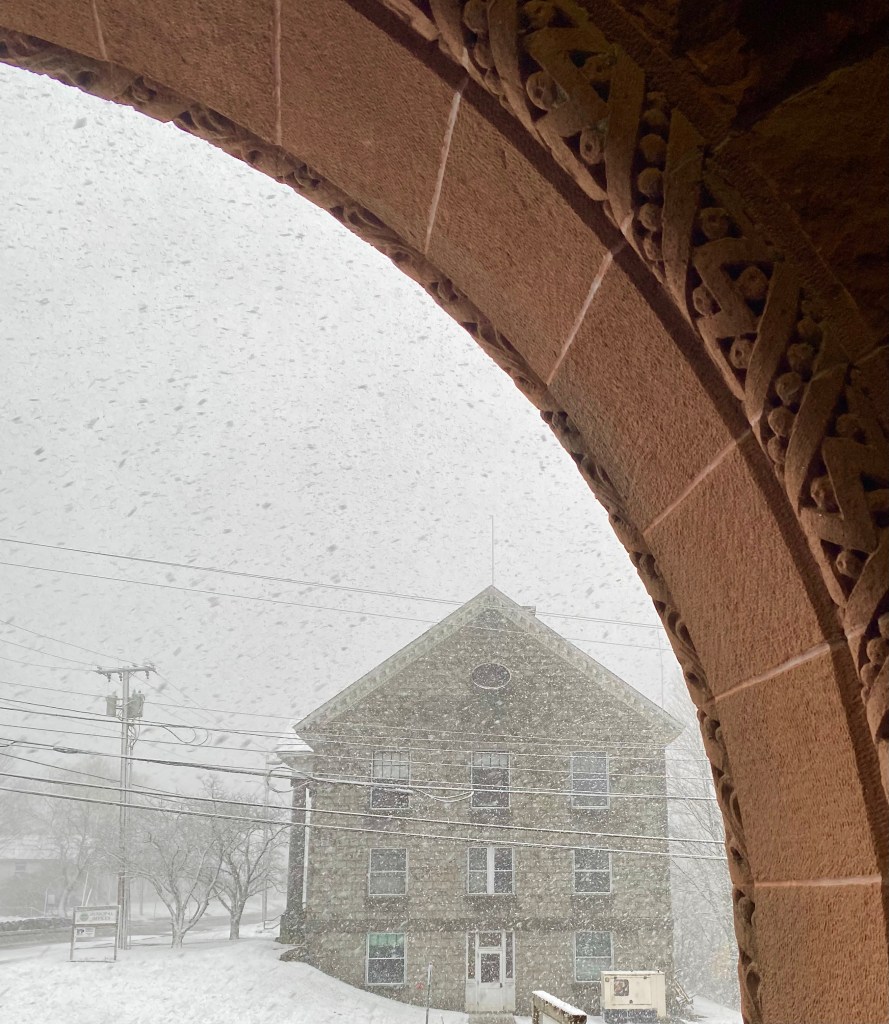
Walking home from the library, a sudden snowfall drenches my eyelashes.

On this early morning, poetry:

Strewn

It’d been a long winter, rags of snow hanging on; then, at the end

of April, an icy nor’easter, powerful as a hurricane. But now

I’ve landed on the coast of Maine, visiting a friend who lives

two blocks from the ocean, and I can’t believe my luck,

out this mild morning, race-walking along the strand.

Every dog within fifty miles is off-leash, running

for the sheer dopey joy of it. No one’s in the water,

but walkers and shellers leave their tracks on the hardpack.

The flat sand shines as if varnished in a painting. Underfoot,

strewn, are broken bits and pieces, deep indigo mussels, whorls

of whelk, chips of purple and white wampum, hinges of quahog,

fragments of sand dollars. Nothing whole, everything

broken, washed up here, stranded. The light pours down, a rinse

of lemon on a cold plate. All of us, broken, some way

or other. All of us dazzling in the brilliant slanting light.

— Barbara Crocker

Song against Reductionism.

A pretty wet snow covers our muddy world — temporarily, for sure, a grace of sugar snow in a long mud season. Early March, and I’m already hanging the laundry out to dry, the pale green nubs of perennial bulbs pushing up through matted debris of last year’s leaves, broken twigs.

On a warm afternoon, I put the snow shovel away — my usual blind enthusiasm about spring! I’m the woman who rails against reduction, that the world can be defined as this or that. This world is nothing but gray, an unending smear of thaw and freeze. And yet, I’m wrong about that, too. Daily, the bird chorus gains, the winged creatures flocking in the box elders in the ravine behind my house, feasting at the feeder in the mock orange.

A poem from the late David Budbill:

“What Issa Heard”

Two hundred years ago Issa heard the morning birds

singing sutras to this suffering world.

I heard them too, this morning, which must mean,

since we will always have a suffering world,

we must also always have a song.

‘Soon it will be the sky of early spring…’

Wild February!

At noon, I stand talking to the road crew in a sparkling snowfall. I wax on about the prettiness of snow on the emerging earth. The crew, who’s endured the strange vagaries of mud season in December, the fickleness of Vermont’s winter weather made weirder by climate change, humor me with a nod.

Fifty degrees and rain forecasted for today, followed by more, followed by bitter cold, then rain and wind, the sun I lean towards…. Late winter, again, and I remember when I could distinguish the years: the spring we boiled sap from March 1 to the 31st. The year we made 540 hard-earned gallons, two of us and a five-year-old, and I wore through three pairs of gloves carrying in wood and feeding the arch.

Walking around my snow-scattered garden, I envision where I will plant the bare root Japanese lilac I’ve ordered, for me or someone else to admire and love. The path down to my compost is both icy and soft mud, the conundrum of winter reluctantly losing its teeth to spring. The true joy is the inevitability, the earth’s order to proceed from twinkling snowflake to downy crocus, the planet’s sheer opinionlessness regarding skunks and black flies.

The road crew and I kick around a few more pithy remarks about government corruption, and then we head along….

From my one of my favorite Louise Glück poems, March:

The sea doesn’t change as the earth changes;
it doesn’t lie.
You ask the sea, what can you promise me
and it speaks the truth; it says erasure.

Finally the dog goes in.
We watch the crescent moon,
very faint at first, then clearer and clearer
as the night grows dark.
Soon it will be the sky of early spring, stretching above the stubborn ferns and
violets.