The repair of the world might, indeed, be impossible…

In a gray drizzle/not quite drizzle, I stop outside the co-op to talk, my hands full with peaches, mozzarella, and Clif bars for my daughter’s hike the next day. The prediction is for temps at high elevation in the thirties.

My conversation companion is a woman I run into randomly, usually on the sidewalk, and inevitably we jump right into talking. It’s August and dreary with wildfire smoke and a sudden cold rain. My hands are full with those peaches and sweets, so I’m blinking in the misting rain. I’m laughing a little, because why not? but I sharpened up quickly as she’s not laughing at all. The strange thing is she’s listing some things that have been rattling around in my mind for months now – the collective frustration that bends dialogue to anger or sarcasm, the way the town’s Center Road is so unkempt grass grows through its middle, and the recent property tax bills that are are you kidding me?

And even though my daughter is at home waiting for the cheese for that pizza we’ll make from onions and basil and tomatoes I’ll snag from the garden, I leave my few groceries in my Subaru and follow my companion through the damp woody patch behind the co-op. We stand at the river’s edge. She leans far out over the water. Look, she says.

It’s drizzling, and even though I’d gone running just before stopping in for what I thought would be a few minutes’ worth of shopping I’m starting to shiver a little. But I have this sudden vision of what’s happening with this town where I live, how the river threatens to wash away this downtown of brick and granite and asphalt, trees and roses. Years ago I realized that brokenness is never one thing; all these unfixable things – climate swings and decades (centuries?) of ill-use and reliance on the Feds to fund these fixes, when that amorphous federal government… well, why say more there?

A few years back, I interviewed a well-known writer who advised me that a writer should always acknowledge her time and place. The rain’s fattening. The repair of the world might, indeed, be impossible. At home, our kitchen is warm and bright, and the cats are half-sleeping as cats do on the rug before the kitchen sink. I’ve always believed in domesticity as the antidote to the world’s inevitable callousness. Later, I wander over to the neighbor’s house and lean in her doorway for a bit. We talk randomly about nothing much at all, catbirds and rose thorns, no repair, but a strengthening of heart, surely.

Late August, given heavy rain and sun
For a full week, the blackberries would ripen.
At first, just one, a glossy purple clot
Among others, red, green, hard as a knot.
You ate that first one and its flesh was sweet
Like thickened wine: summer’s blood was in it….

“Blackberry-Picking” by Seamus Heaney

Messy democracy.

So this whole democracy thing? Since we’re in an election year and all?

I work in a small town for a Selectboard. Monday morning, I pull into work (late, again), and a Selectboard member is eating a blueberry muffin as fast as he can in the parking lot, a muffin I’m certain the town clerk made. I get out and make some comment roughly along the lines of it’s a good thing I don’t do drugs anymore because Your Town….

He counters with, Let’s get serious. What’s your cucumber and zucchini situation? I’m coming back at noon with four full boxes.

Monday morning, it’s revealed that people have stolen signs. People have written letters to the Selectboard and newspapers and the Sheriff about the theft. People arrive in the office with dogs and laptops and questions, eat muffins and disappear. I walk outside with the phone. It’s possible that the thief arrives. It’s also possible there’s some laughter. Or maybe I’m making all this up.

Democracy is messy, chaotic, often brutal. People arrive who look as though they’ve slept in ditches for their entire adult lives and complain about the flood. People complain about their neighbors. People run for election. In all of this, I take off my shoes and walk around barefoot. I do all the things I’m supposed to do and I keep wondering if I’m doing any of these right. I give an old woman a bottle of water. I am always trying to leave, disappearing into the asters around the lake, into the rooms upstairs where it’s just me and the wasps and the open windows. I am always trying to sew the pieces of my life together. Sometimes I crumple paper and throw it at my coworkers, which is not really at all charming or funny.

As a writer, I learned from reading. I learned so much from sugaring — the majesty of the world, the inarguableness of cause and consequence. I learned joy and love as a parent. I learned grief as a broken wife. Working for a small town, I’ve learned the peculiar American craziness of little towns and politics, of gossip. How to spy cowardice and when to lean against the courageous.

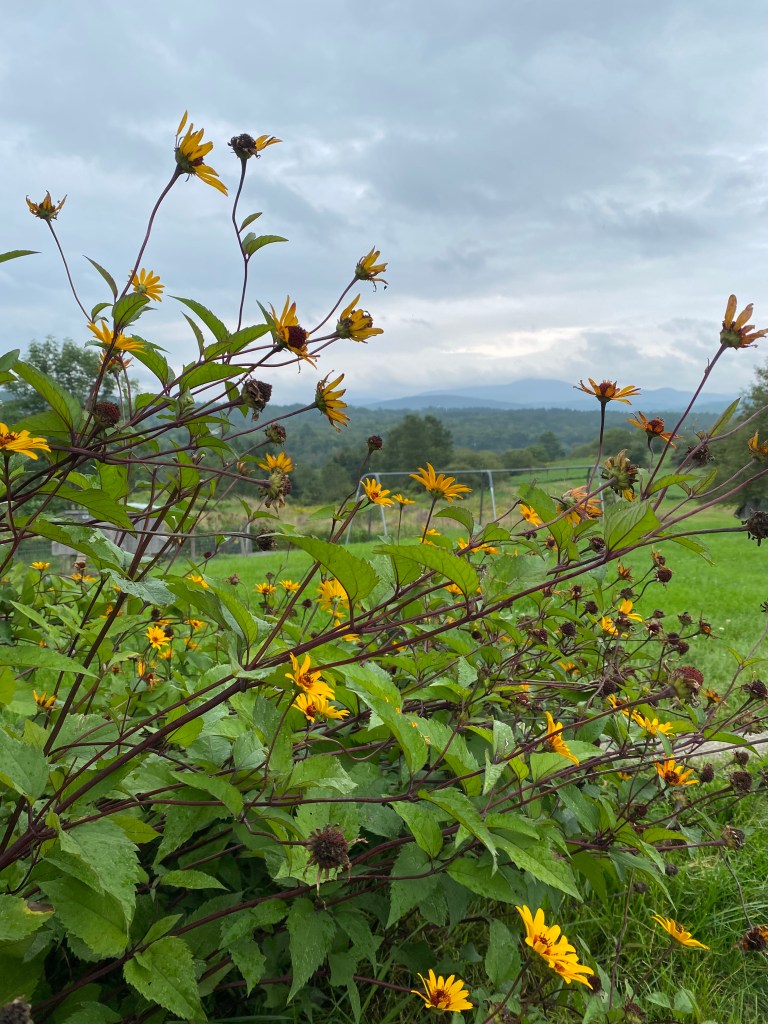
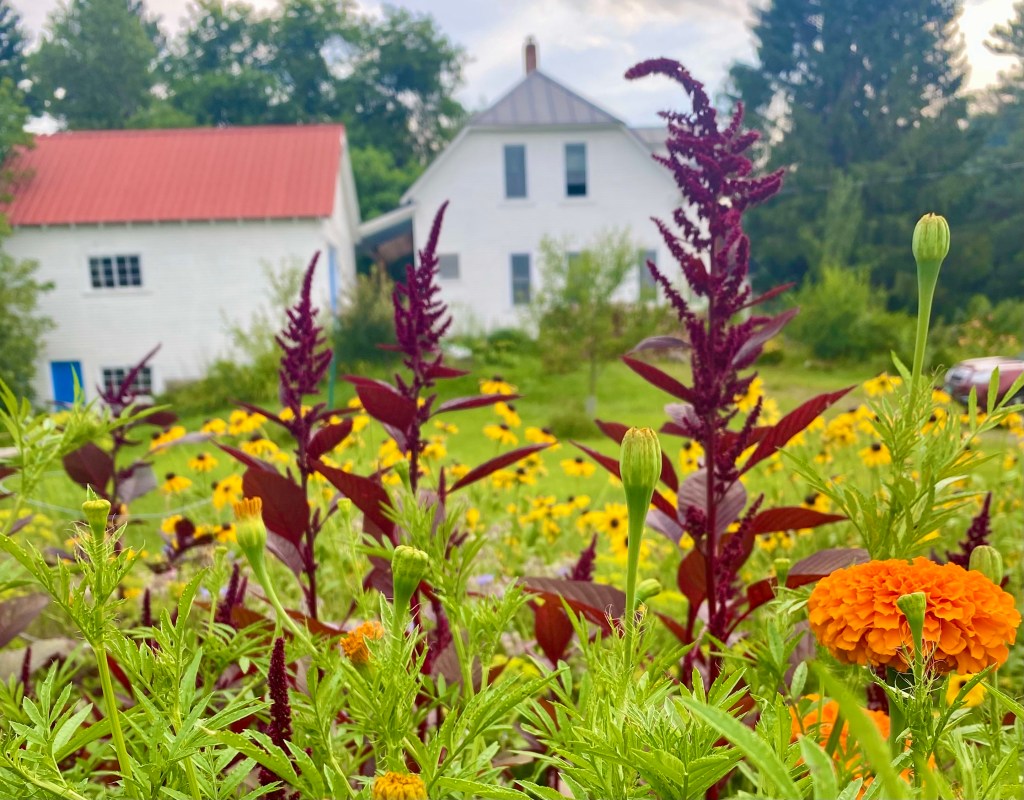
There’s not one damn thing perfect about any of this. Here I am as usual, half in, my head and heart filled with my garden gone rampart with rudbeckia and coneflowers. But we’re all that way…. July is the season of joy, January the season of despondence and loneliness. In the heart of midwinter, I leap from the snowy shore to the frozen lake. Far out, I sometimes lie down in the middle of the day, the ice a bed between my bones and the sludgy lightless waters. Overhead, the infinity of the heavens.

But today it’s Good Old July. In the afternoon, I walk with a woman along the forest trails she’s cut. She’s eased white quartz from the soil. The rocks gleam, as if freshly scrubbed with rain.

“The apparition of these faces in the crowd…”

In the Albuquerque airport, I’ve tucked myself into a corner, editing a manuscript and drinking coffee, when suddenly I see the small airport is jammed. I pack up my things. In search of my gate, I ask a man if he’s headed to Chicago. “Houston. We’ve been deplaned from the tarmac, twice, and I’m pretty sure everyone here is about to have a nuclear meltdown.” Edging away, I hear a woman cajole her child to “let daddy figure this out.” The ruddy-faced daddy glares at a monitor.

At the terminal’s far end, I join an elderly couple (retired psychiatrists), a pediatric oncologist, and a mechanic who’s hoping to visit his mother before her open heart surgery. They tell me the news of Biden’s withdrawal.

Our plane has not arrived, and we step to one side of the swirling crowd. The oncologist shares that he’s been a fan of Biden. Such suffering in that family, he says; it changed him. The psychiatrists nod, listening. He tells us that his experimental research department received a flood of funding, but that’s all ceased now, with staff layoffs in anticipation of the election. He plans to retire in a few years and return to Botswana to volunteer. I don’t want to be dismal, he says, but the need for help won’t end.

We spy two pilots, admire their youth — but not too young — and gladly note they disappear through a door towards the tarmac. The loudspeaker voice informs us the pilots will have a short meeting with the cabin crew and then we’ll board. We’re not quite sure what that huddle is about — go team? keep the plane in the air? — and the oncologist muses that airports are one of the few places he’s experienced where strangers keep the social fabric together. No one, he tells us, says anything to strangers on D.C. public transportation.

That does not bode well, I think.

Just before we board, we shake hands and wish each other well. All these matryoshka doll layers in us: I walk down the ramp with the sign maker, who confesses his worries about his mother. Like a kind of magic, then, we’re in the air. Hours later, I land in Burlington, Vermont. Under a crimson full moon, I cross the street. The night sprinklers are watering a swathe of grass. All those dark miles of driving ahead of me. At home, the hydrangeas shine in the moonlight, boughs weighted with blossoms touching the ground.

IN A STATION OF THE METRO

The apparition of these faces in the crowd:
Petals on a wet, black bough.

— Ezra Pound

Hand-me-down mud boots.

These few days I’ve spent in New Mexico, my mother is a constant presence and absence. She’s powerfully here, in her sunny kitchen or in the stacks of empty flower pots in the garage. Yet, she’s vanished, too. All night, the desert breathes into this house, sage-sweet wind and coyotes barking and the robin songs here, too, like in my Vermont world. These days, the skies have been layered with lightening and sooty storms, golden sun, the blowing gritty sand that scours my skin to softness.

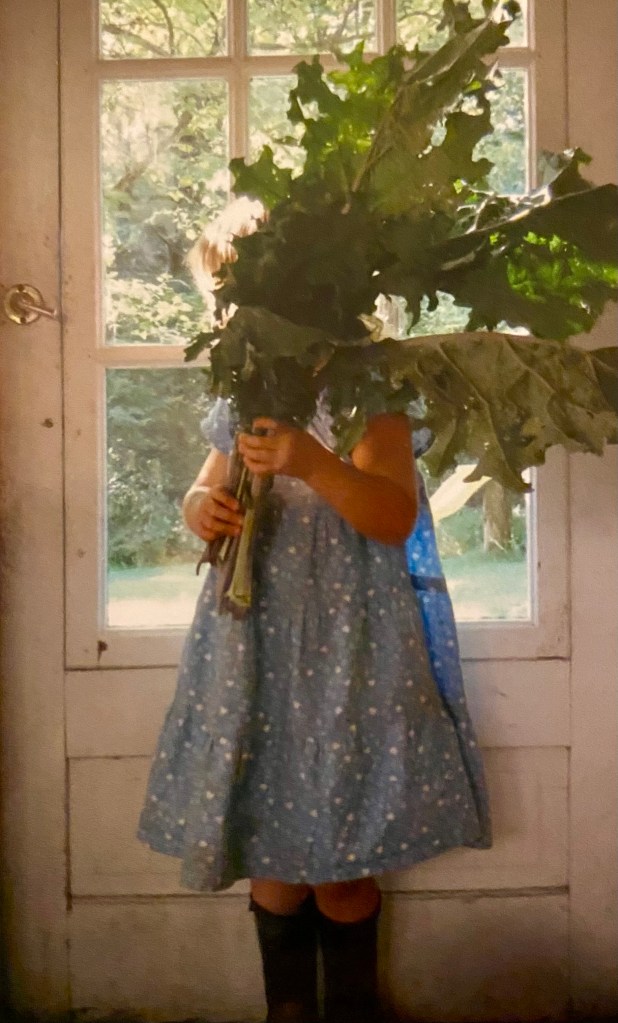
The world far beyond my small family’s sorrows teeters towards deceit and collapse. There’s no inoculation against any spiritual ailment, really. Measles, sure, but never the terrifying largeness of grief or rage, or losing safety or love. Which leads me back to the photo above, my little daughter as she was at our kitchen door, in her hand-me-down mud boots and a handmade cotton dress, carrying stalks of garden-cut kale. A reminder never to sentimentalize or diminish the rugged and real lives we live.

A Pretty Song

From the complications of loving you
I think there is no end or return.
No answer, no coming out of it.

Which is the only way to love, isn’t it?
This isn’t a playground, this is
earth, our heaven, for a while.

Therefore I have given precedence
to all my sudden, sullen, dark moods
that hold you in the center of my world.

And I say to my body: grow thinner still.
And I say to my fingers, type me a pretty song.
And I say to my heart: rave on.

— Mary Oliver

In the edge…

Midafternoon as a storm threatens in, I’m at a stretch of lakeshore where I’ve never swum, and I push in. I’m on the prowl for an eagle, which I never find, and the day has grown muggier than I imagined.

What a month of May this has been. My mother’s death ripples through the amazing forsythia and lilac season, through writing and the steady complexity of work I do for the local Selectboard. At a nearby farm, I buy hothouse basil and tomato starts. A woman I know slightly strikes up a conversation. In the past, our lives ran on weirdly similar tracks, involving divorce, sudden visits from the FBI, the miasma of disorientation. Now, we swap mother stories beneath an enormous lilac. I breathe in the blossoms’ scent.

A few years back, I volunteered in my youngest’s elementary school classroom to assist with a nature program that the kids loved. Naturalist and artist, the teacher kept using the phrase “in the edge.” She pointed out that life thrives at the crossing borders of field and forest, of riverbank, the edges of a homogenous world.

I’m in the edge these days. May’s heat notwithstanding, the water is bitterly cold. I swim out with my lousy swimming skills, my garden’s dirt washing away, the storm clouds hammering together over the glassine water, some of the day yet to come. On the shoreline again, sharp stones gouge my soles.

Where I Am.

For a week, I’m lucky to be staying at the Vermont Studio Center for the Arts, tucked in Johnson, Vermont, with writers and visual artists. A word, first: like anyone in this culture driven to create art, I’ve been swimming upstream (clumsily) for what seems like most of my life. But this magical place offers notsomuch an antidote but an alternative possibility.

In one way, I feel like I’m a college student at tiny rural Marlboro College again, eating communal meals with the same cohort, attending presentations, talking and so much talking. How’s your book going? What are you doing with copper? So many interesting people writing and sculpting and painting. But, like everyone else here, I’m far beyond college age, using my studio hours fiercely.

In my studio building, a former resident wrote in a communal notebook about arriving worn down from the grind of capitalism, and how rejuvenated she left after her stay here. I’ve long realized that our capitalist model often draws out the mean and petty strands of us, like a competitive gardening streak that weirdly surfaced in a long-ago baby group I attended. Which serves, of course, exactly no one at all. For this bit of time and space, I’m savoring this dear space, where my back is watched, and I can do my work.

… Last, thank you all for your notes and emails since my mother’s death. My father recently uploaded his memoir, 87 years of his indisputably distinct life.