Spiritual Crisis

Tanned and wearing overalls, a woman comes into my library and gathers a stack of library books for her children. For this moment, it’s just the two of us. She’s a woman who doesn’t usually check out books for herself, but she asks for a recommendation. I ask her what she wants — fiction or nonfiction? Something easy?

She pauses and then tells me, I need something good. I’m having a spiritual crisis. I’m turning forty and raising two kids and….

I add, And the world’s falling apart?

She laughs. Yes. That might be it.

I pull Maggie O’Farrell’s book off the shelf, and she doesn’t look at it, simply adds it to her pile while we keep talking. She’s a woman who seems, to me, to have been fortunate with finances, surrounded by family. We talk for a bit more, and then I offer that change is opportunity — painful as that might appear.

We step outside, take off our masks, and walk around the gardens, talking about cucumbers.

The things in life which don’t go to plan are usually more important, more formative, in the long run, than the things that do.

Maggie O’Farrell, I Am, I Am, I Am: Seventeen Brushes With Death
IMG_7865

This Offering

After a day of high school kids reciting poetry, I hold up in the Barre public library. Not far from me, a man unscrews a plastic bottle of sweet tea and mutters to himself. Abruptly, I pause my frantic emailing and wonder if I’m speaking to myself, too.

It’s March and sunny, and the snow has melted — not entirely, but a noticeable amount — since this morning. I’ve left my jacket in the car, as if daring myself to complain about this breeziness-with-a-promise-of-spring in my thin dress.

My head is still filled with poetry, and with the people I’ve met today who, in one way or another, bend their lives around writing and art — people who fashion meaning from the sometimes jagged stuff of this world.

Like libraries, poetry has always been a home to me, filled with the things of the world that both amuse and enchant me — like the man laughing at some secret only he might understand, and myself, staring out the window at a little girl in muddy black boots, digging through the soggy snow with a snapped-off stick, searching for treasure.

I am offering this poem to you,
since I have nothing else to give.
Keep it like a warm coat
when winter comes to cover you,
or like a pair of thick socks
the cold cannot bite through,
I love you…

— Jimmy Santiago Baca

IMG_7271

Barre, Vermont

Vermont Commune Story

Writing about summer camp — in February — makes me pause over photographs. How green and gorgeous is Vermont’s summer. The profusion of hydrangeas. The luxury of lying in green grass.

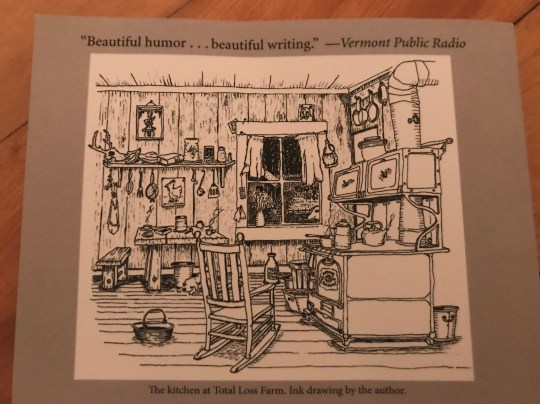
I spent a few hours last week speaking with Peter Gould of Shakespeare Camp fame. But Shakespeare Camp is just an iceberg tip of his fame. A few years back, I heard him read the title story from his collection Horse-Drawn Yogurt at the Galaxy Bookshop in Hardwick. The bookstore was packed. The evening may or may not have been snowing, but I remember the night as snowy, because the story, set in winter, is so evocative.

I’ve shared a few lines from this story below. The story is one of the very best stories I’ve read about the countercultural life in Vermont — the energy and enthusiasm and love of Vermont and the sadness, too.

The farm would remain. People would leave. Some would stay, working in town but making their home there, connected to the mythic past but not to the daily work of a farm. New folks would come, with new goals. Soon no one would remember most of what had already been tried, what this antique tool was for, what dream that pile of rotting lumber in the lower pasture represented. We would always plant a little organic garden, but that would not be our excuse for being. We could live off the economy better than we could live off the land.

— Peter Gould, Horse-Drawn Yogurt: Stories from Total Loss Farm

IMG_7148

My Daughter, My (Former) Younger Self

My daughters dropped me off for a dentist appointment — worse, an oral surgeon — appointment and disappeared to check out a mural in town.

I wait. I wait a little more. The appointment’s at the end of the day, and, as I’m waiting, darkness wraps around the little building. Later, my 14-year-old tells me she was outside in the dark, jumping up and down and waving her arms at me, watching me read.

Who sits in the dentist chair and just reads? she asks.

It’s an odd feeling — myself in a brilliantly lit chair, while my daughter’s outside in the dark, trying to get my attention.

As for the tooth, he looks at it and says, What a shame. The rest of your teeth are so good. I explained I injured the tooth many years ago, but I see he’s not really listening. He’s looking at that tooth. He’s thinking. I say, what’s the least bad way forward?

Then, alone in the room again, I wait and wait, no longer reading, thinking of the story of the tooth, that slender bit of enamel.

It’s nearly 6 p.m. when he returns with an insurance option. I agree, of course. When I walk out, my daughters roll down the windows in the car, laughing, teasing about taking forever….

Here’s my ode to silver maples in State 14.

IMG_6796.jpg

Armistice Day

This is the gray time in New England, when even the daylight is dull. Gone are the spring days of blue squill, the early morning birdsong.

After dinner, we walk in the dark.

My daughter and I read for hours. Later, she disappears for a run, while I proceed with my persistent thread of work. In all this, Marlboro College, where I was an undergraduate, appears (truly, this time) on the precipice of closing. All weekend, I follow the alumni FB thread — grief, anger, plotting — while I keep thinking of Marlboro and how much this tiny college gave me. I’m not alone in that, I see, listening to alumni after alumni.

November. Our house is warm. I open the curtains and let in the daylight. At 4 p.m., the noisy cat comes and yowls over my book, demanding his dinner. My daughter puts on her ski boots and walks around the house, listening to snow in the forecast. November: life churns on.

The rain had been falling with a pounding meanness, without ceasing for two days, and then the water rose all at once in the middle of the night, a brutal rush so fast Asher thought at first a dam might have broken somewhere upstream. The ground had simply become so saturated it could not hold any more water.

(The opening lines of Southernmost, by Silas House)

IMG_6779.jpg

Neither Wolf Nor Dog

My daughter looked up from her geometry homework and asked why I was laughing. I shared with her a few lines about soup and dogs from my library book — a book one of my blog readers and commenters had recommended —Kent Nerburn’s Neither Wolf Nor Dog: On Forgotten Roads with an American Elder.

I’m lucky enough to scavenge time to read — and I read fairly quickly — but this particular book I wasn’t in any particular rush to finish. So much of our world is talk, talk and words, words. This book is filled with silence, too. Sometimes in life, too, you’re fortunate to read a book at precisely the time in your life you need to meet that book.

Many thanks for the recommendation. I’m dropping this book in the library return box this morning, passing it along to another friend.

Everything happens for a reason. You’re here for a reason. It’s time you stopped worrying about some damn truck and got figuring out what that reason is.

IMG_6669.jpg