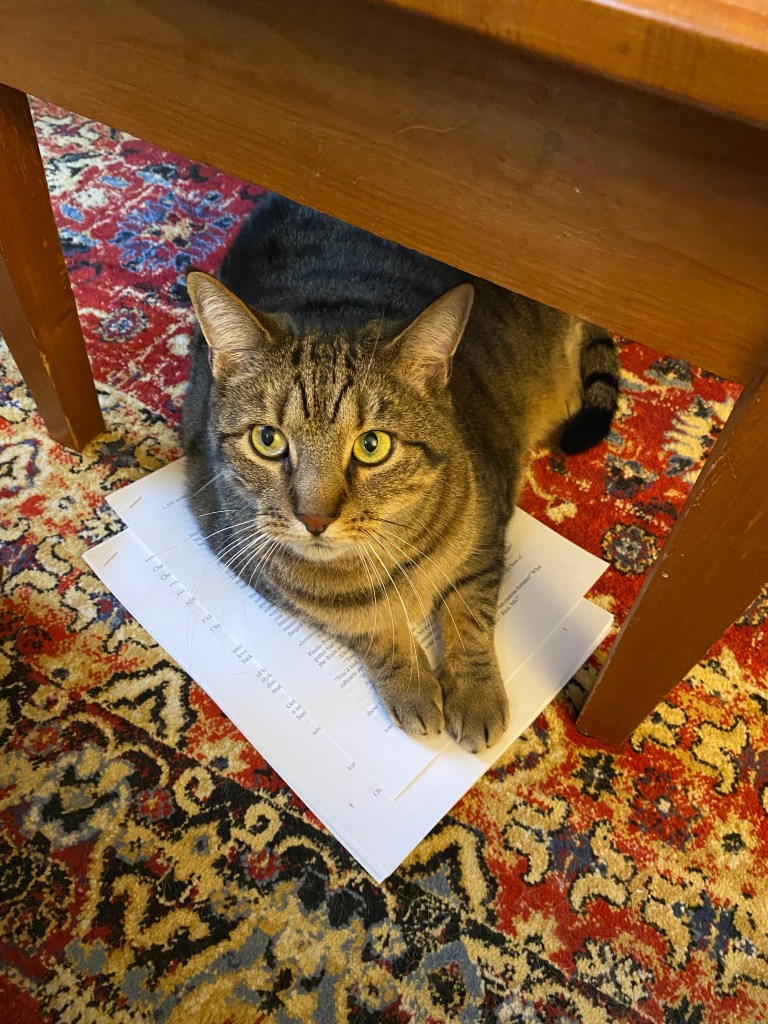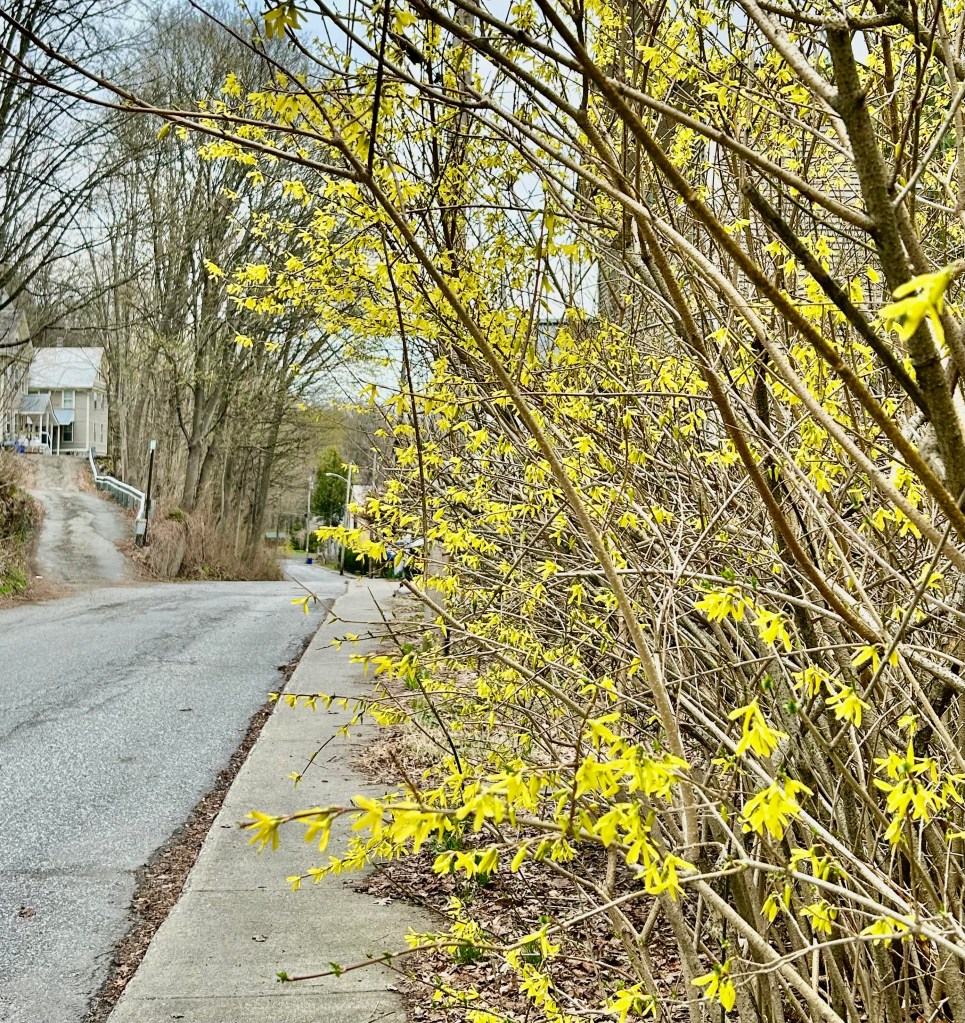
Hell-bent robins.

I arrive home from the local arts center, get out of my car, and a robin nearly flies into my head. Winged creatures are swooping from the apple trees to the hedge of lilacs that is just beginning to bud. My god, what a lovely day.

In my bag, I have an empty pint jar of water I’ve been drinking, and a ball of purple linen I’m knitting into a summer shift, and the books of the two authors whose reading I just attended — Helen Whybrow of The Salt Stones and Jody Gladding’s translation of Jean Giono’s The Serpent of Stars. I have a new book, too, a collection of stories by a Turkish author I’ve never read. Sitting with my book world friend, her publisher friend hands me a book, too. The afternoon and evening has gone this joyous way, like that hell-bent robin — strangers and friends and people I haven’t seen in ages — exuberant about literature and art and the unstoppable profusion of spring.

I like this art center so much I imagine curling up on a cushiony bench and sleeping beside the wide windows, the starlight on my face. An acquaintance I met at a Vermont Studio Center residency works here, too, and we plot some amusing possibilities. We’re beside the table heaped in lush mounds of delicacies, and I graze on stuffed mushrooms and empanadas and fresh tomatoes. I wrap lemon squares in napkins and hold these in my hands away from my books and knitting.

Outside on the stone patio, the wind is lifting over the meadow, the sun sinking and the cold creeping in. All around me looms that chilly darkness, the nearness of sunset, the hole in the night where dawn seems impossible. So much of my life I’ve teased and poked at this, and, conversely, pushed the vast cold away — through distraction and once-upon-a-time through drinking and work. Now, as the twilight drains away and night stakes in for its duration, I wander among the yet leafless apple trees, the garden with its green garlic nubs, drinking tea and listening to the birds settle down to sleep. My god, the myriad lessons of cancer. Note this, too: clench joy and fear in the same fist. See what happens.
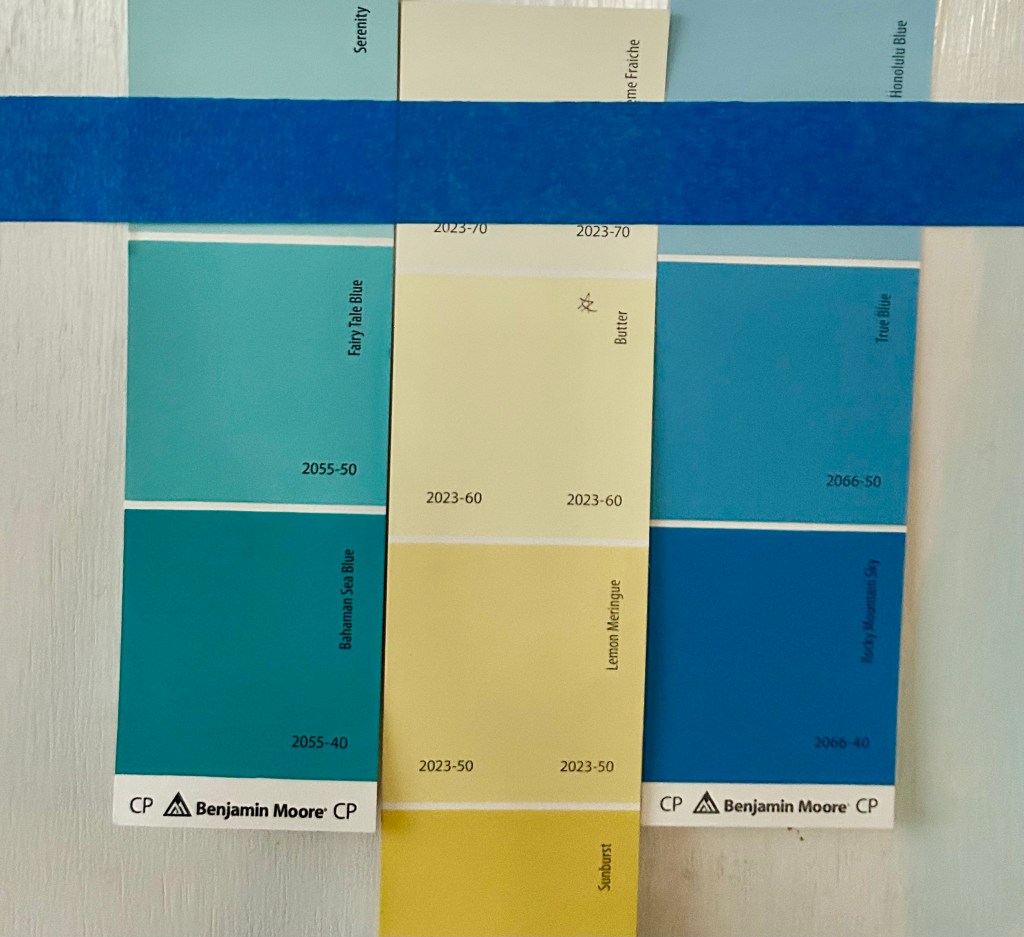
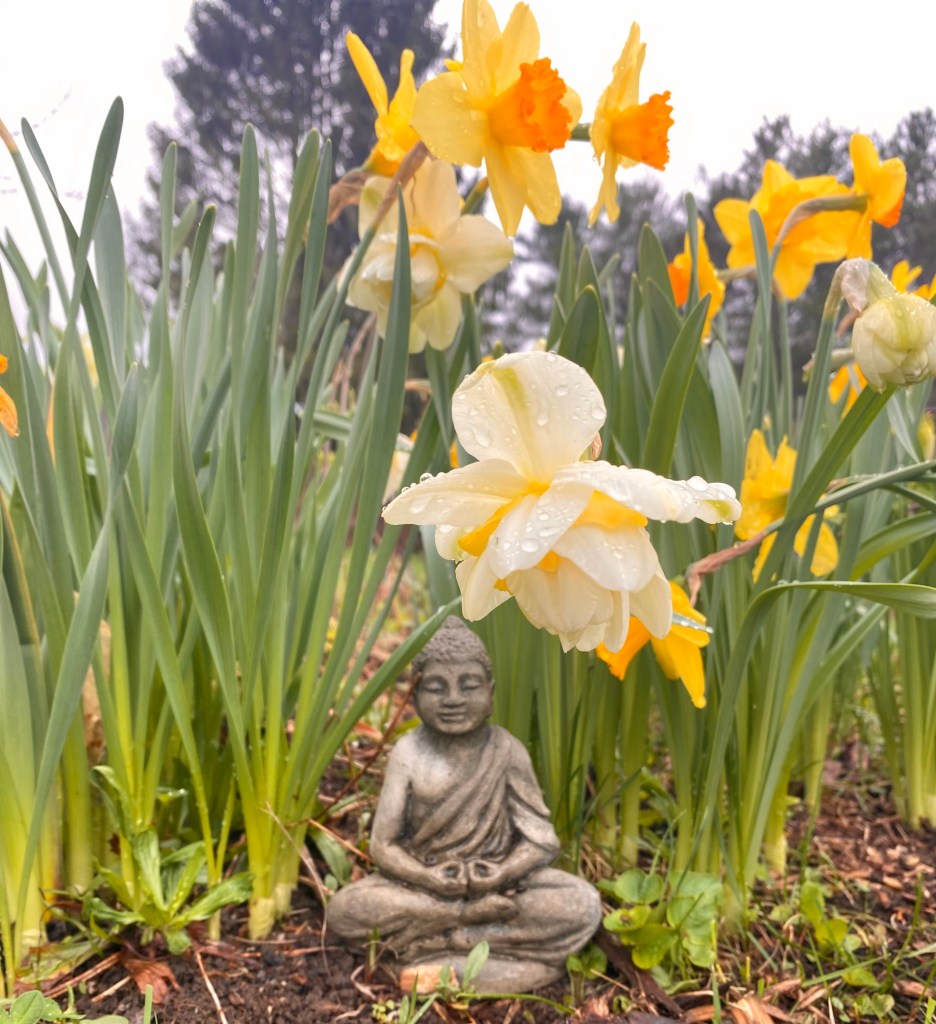
Kitchen renovation paint considerations….

Nurses.

If you don’t know nurses, you will, or someone you love will. In my past year of cancer-and-chemo appointments, of those dozen hospital stays, in variations of days to weeks, the nurses were my very best friends. Nurses cajoled me to eat chicken soup and drink water (even a sip, just try); they were kind to me and looked out for my daughters. They taught us the ropes of the hospital ship: the habits of doctors and surgeons, how to adjust a bed and order food, find the light switches, turn up the room’s heat, find warm blankets. They offered orange juice and sandwiches to my daughters and hotel vouchers. The nurses told me I would live.

Nurses taught me about IVs, how not to bend my arm, what downstream occlusion meant, and when I must absolutely ring immediately for a nurse. They helped me to shower when I couldn’t stand, and never laughed when I said I forgot I had no hair. But they did tell funny stories and made me laugh. When I had a terrifying reaction to a chemo drug that was absolutely necessary for me to endure, a nurse sat with me for hours.

There was that terrible ED visit when I couldn’t stop throwing up from pain, and I was too weak to talk, and the nurse stayed long after his shift ended, holding my hand while I cried. There was yet another awful stay in the ED, those three nights in the room with the beige metal walls and the heat that wouldn’t turn off, and the nurse and the MD together figured out a pain med plan that brought me back to my body, that made the cancer bearable again.

Another nurse helped me get discharged on a spring day when I pleaded to go outside and see the apple blossoms, to have sunlight and wind on my face; she arranged for my daughter to sit with me on a bench and sip hibiscus tea, and she arranged for the hotel room where I slept all afternoon and then traveled in the morning across the road again, back to the cancer center for more chemo. She did this to help me heal. The chemo nurses tend the frail and the hopeful, the recovering and the dying. I had no port, so my arms were bruised and scabbed from months of sticking, and these fine nurses turned my forearms over and over and never failed me. Who in your life never fails you? They took such care.

I could write on and on. The nurse that first visit to the ED, who knew from a scan that I had metastatic cancer before I did. He walked in my room and looked at my daughters with such compassion. We did not know, but he did. He knew the hardship that lay ahead of my dear daughters.

The nurses, unfailingly, cared me as one of their own. I have notes in my journals, names and stories of strangers who cared so tenderly for me and my daughters, but really what I have is gratitude, admiration, and such sorrow for the unnecessary murder of one of our tribe.

The Essentialness of Beauty.

A numberless day in my hospital stay…. I’ve noted the passing days by the perennial garden below my window. Each of these gauzy rainy days, the greenery brushes out further. The crabapples bloom. On the hillside, emerald stretches over branches, a multifaceted palette of leaves.

As for me — survived this surgery (hurray, yes) — and I’m now cared for by family who cycle in and out, messages and emails and gifts from friends, kind and competent hospital staff. My great thanks to readers to have reached out to me, or simply read my words. Surgery, indeed, for a laywomen like myself, is an oddity. Scalpel to flesh cannot be an everyday occurrence in a life. I relied on the surgeon’s precision. Grateful, grateful, I am for these skills. Soon, I’ll be home again, in the everyday world of my bright kitchen, our cozy front porch, garden. The lilacs will bloom.

One of our house’s great gems is the lilac bushes that span three sides, in varying lengths. The first spring we lived here, I invited friends for dinner. They got out of their car and stood in the driveway, reveling in the lilacs’ perfume.

While here, I picked up a copy of Loving Frank, Nancy Horan’s fictionalized love story of Frank Lloyd Wright and Mameh Borthwick, which ended in a horrific tragedy. Here’s a line from the incomparable Wright worth thinking over: “The longer I live the more beautiful life becomes. If you foolishly ignore beauty, you will soon find yourself without it. Your life will be impoverished. But if you invest in beauty, it will remain with you all the days of your life.”

Finding Jesus with the star sunglasses…

Home again and somewhat shocked to see an ice floe leering off my back roof, not exactly the size of A23a Iceberg, but approximating it….

I’m under strict orders to drink broth, eat saltines, lie on the couch and read — the last two I’ve been perfecting for months now. As for the rest of the order (this is the only thing you should be doing, Brett), I’ve been quietly breaking rules for years. Now, intimate with cancer and my mortality, I push myself to obey the orders, stick with the plan, follow the course precisely.

The winter thaws. The iceberg chips, shifts. I step outside and lean against my house in my down jacket that is now limp and beaten down, a sad thing that, this quarantined winter, I’ve used so little. How will my thousand words a day fit into these orders? A grant deadline looms. When will I put on my clean shoes and that linen sweater I knitted and return to work? A cardinal perches on the railing.

In those 48 hours I spent in the Dartmouth ER, in a beige isolation room, an upbeat nurse with amazing eyelashes occasionally stopped in to cheer me and whoever of my daughters was there. On the TV, which we never turned on, she pointed out a tiny orange plastic duck, and told us someone had placed small figurines all over the hospital. “I found Jesus,” she said. “I know that’s weird, to go around a hospital saying I’ve found the Man, but really…” She reached in her pocket and pulled out an inch-high plastic Jesus in a long robe, black curls, gold star sunglasses. He smiled so widely his teeth gleamed.

In that same room, I spied a second duck, brought the ducks home with me and lined them up on the bathroom mirror beside the wooden blue elephant from the Metropolitan Museum my daughter gave me. Two tiny things that arrived in my pocket, after a week of manifold things, after months of many manifold more. All day, it will rain, the warmth softening that iceberg on my roof, falling on the deck and breaking the wood, or not. If it’s broken, we’ll repair it this summer. If not, we’ll move on to the next thing.

And utterly seasonally inappropriate, here’s a Galway Kinnell poem I’ve been loving:

Blackberry Eating

I love to go out in late September
among the fat, overripe, icy, black blackberries
to eat blackberries for breakfast,
the stalks very prickly, a penalty
they earn for knowing the black art
of blackberry-making; and as I stand among them
lifting the stalks to my mouth, the ripest berries
fall almost unbidden to my tongue,
as words sometimes do, certain peculiar words
like strengths or squinched,
many-lettered, one-syllabled lumps,
which I squeeze, squinch open, and splurge well
in the silent, startled, icy, black language
of blackberry-eating in late September.

Picking at the salty remains of roast beef…

Shortly before the November election, I’d heard word of a friend’s illness, and I determined to fly West and see this couple. At that time, I thought I was poisoned by mold and struggling myself, but I really wanted to visit. I decided to hold off buying the ticket for a few days until just after the election, because, well, what if? What if the grid crashed or something? I’ve lost money on airline tickets before.

What happened, instead, is I ended up in the ER the night before the election and discovered the mold was a red herring. I had cancer — although I hold, yet, that the mold was an element of a complicated equation that may, or may not, have added to turning on that cancer gene. By then, flying was impossible for me. Now, news comes to me of her final passage from this life. My friend has lived a long, loving — a good, very good — life, and yet…

All afternoon, another friend and I text back and forth. Remember the nights we ate in their dining room where the walls were painted light blue above a cream headboard? On the wall thermometer, we watched the January temps dip to 20, 21, 25 below zero, laughing at what would be a cold drive home. We never wanted to leave early. Instead, we kept drinking wine, eating chocolate cake, picking at the salty remains of roast beef.

Sorrowful, indeed. We are all now far enough along in life to know that no one dodges the Reaper, that the cut of illness or injury might fall swiftly at any moment. That, in the end, we leave as we entered. While my daughter drove me home the other twilight, I watched the stars ignite in the burnished blue along the horizon, one by one, these ancient untouchable illuminations. She followed the highway home; my eyes fastened on those seed pearls, the slender thread that thickened just the merest width as the night flushed in.

Here’s a line from Niall Williams that, by stroke of coincidence, I read today.

“… you could stop at, not all, but most of the moments of your life, stop for one heartbeat and, no matter what the state of your head or heart, say This is happiness, because of the simple truth that you were alive to say it.”

Mirth in the mirthless. A great mercy.

Mirth in messiness… another night drive to the ER, so cold, what were we leaning into? Five degrees, maybe six? The stars above the river ice a mockery of light. Kindness and Dilaudid, another scan, a hurry-up-and-wait, the three of us talking about nothing in particular save for a hike we once took in a thunderstorm and an orange water bottle confiscated (gone, forever) at the Albuquerque airport.

It’s the small hospital not far from our house, not the cancer complex with its soaring blue-green glass. On this zero-degree night, my daughter presses her feet against the room’s wall heater. There’s hardly any patients, save for a man we never see who insists that he must be heard. In the night of dim small lamps, I sleep and wake, talk with a woman from the high plateau country of the upper midwest. She remarks wistfully that Vermont is too tiny and cramped for the sweep of the midwestern sky. Maybe it’s just the Dilaudid, but when sleep folds over me, I dream of those childhood summers my siblings and cousins and I chased fireflies while the grownups drank bourbon and ate our leftover birthday cake and kept at their two-week conversation. The dew washed our bare feet.

The hospital morning flicks on before the sun has dulled the night’s darkness. Mirthless, indeed, I become, crabby with human lack and inhuman fate. Words, words, mine and others’, in a repeating loop. I text my nurse friend. On her lunch break, she appears, and then there’s laughter from nurses in my room. People come and go. I sign for more billing. (How much is this going to cost me, anyway?) The chaplain appears who’s read my book and wants to talk Flannery O’Connor and death. I’m not about to be funeral planning for myself anytime soon, but I plunge right into that death question. Indeed, this wretched cancer, my uninvited guest, perhaps the truest teacher of my life.

He asks, To know to savor every day?

Oh sure. But the disease has whittled me down to a glittering core, to ignore the petty fluff that not so long ago stung my eyes, and certainly my heart, too. What remains is real, both beautiful as those fireflies winking in the sultry midwest night, and ineffably, unbearably sorrowful.

I intend to live a long life; I’ll at least go on for some while, which is all any of us can say. In the meantime, this rarefied illness journey? Not lacking for writing material.

From Flannery O’Connor, The Habit of Being (1988):

In a sense sickness is a place, more instructive than a long trip to Europe, and it’s always a place where there’s no company, where nobody can follow. Sickness before death is a very appropriate thing and I think those who don’t have it miss one of God’s mercies.