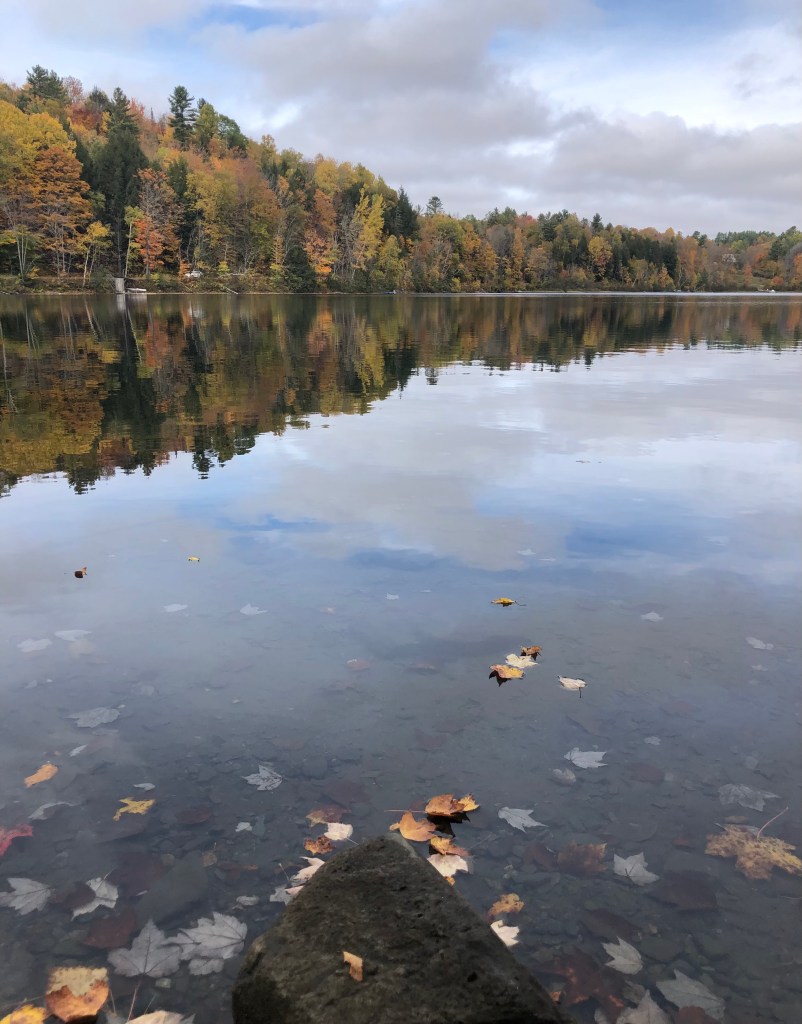
Kicking Up Leaves.

My daughter and I are standing on a street corner in Montpelier, Vermont, talking about some little thing — maybe the mighty silver maple on the library’s lawn and how those leaves are always the last to turn gold. How I remember this every year at the same annual mark, and then forget this for the rest of the year.

While we’re talking, I keep thinking of this lovely library, and how I took my daughters there as little girls. Later, I often worked all day in the upstairs reading rooms with views of the trees. Not so, anymore, in our pandemic world.

Across the street, a couple kicks fallen leaves at each other. I stop talking, thinking, Oh, no, what fresh hell is this? when the couple begins laughing. They’re each holding white paper cup, and he has a paper bag that might be full of sweet delicious things from a nearby bakery.

That moment — that tiny joyful moment — opens up our day. Sweet normalcy. Oh, yes. Bring that on.

One of my most favorite autumn poems:

on a withered branch
sits a crow
autumn nightfall

—Basho

Driving Dream. Daughter.

In a dream, my daughter drives along an interstate and rounds a curve. A semi spreads across the road, its back-end across our lane. In a fraction of a moment, I predict we’ll hit the truck. Before I can speak, my daughter steers to the right, and I have a sickening foreboding that she’ll hit the truck and I, on the right, will emerge unscathed. I’m not afraid really; it’s grief that nails me.

She steers us around the truck, over the grass, back onto the road, and keeps driving. My heart hammers.

In the dark, I lay awake. There’s a lesson here, I counsel myself.

On this rainy October morning, here’s a few lines about parenting from Anne Lamott and an excerpt of my book in The Fix.

…one of the worst things about being a parent, for me, is the self-discovery, the being face to face with one’s secret insanity and brokenness and rage.” 

― Anne Lamott, Operating Instructions: A Journal of My Son’s First Year
Greensboro, Vermont

Book Recs. Messy Democracy.

I’ve been on a reading binge on the Anthony Swofford/Christa Parravani husband and wife author duo, jumping around their memoirs. I picked up Parravani’s most recent book, Loved and Wanted, and then interlibrary-loaned others. Swofford wrote Jarhead — the marine memoir that just about everyone was reading a number of years ago, and I never did.

Yesterday morning, my oldest daughter got up at three to make her flights to visit my parents in New Mexico. In those murky depths of the night, I got up at three, too. When she left, a cat and I lay on the couch, reading Hotels, Hospitals and Jails. Ending with a father and son RV journey, the book’s ending did that miraculous thing, spinning not just that book but how I look at literature in a wider, more powerful light.

Hotels ends with the beginning of the couple’s marriage. Parravani’s Loved and Wanted takes place years into marriage and baby-raising. That, perhaps, is about all I’ll say about that.

My papers and notebooks were scattered around the couch from the virtual select board meeting I attended the night before. Nearly four hours long, the Selectboard discussed darn near everything in town, from federal Covid money to the sheriff’s update regarding a shooting to whether the board should consider moving a road. While democracy may be struggling in much of the country, in rural Vermont, messy democracy still rules.

Autumn is nearly over

that person dressed in fine silk

has borrowed everything.

— Buson

#10 Pond, Calais, Vermont

A House You Can See Through

On my way home from work last night, I stop by a house in town to drop off a borrowed survey (another long strange story…)

I’d never been to the end of that narrow one-lane road built on a ridge over a lake. The owner’s car is a Subaru the color of mine, but years older. As I walk towards the house, I realize I can see right through the house. The walls from driveway to lake are all nearly all windows.

A breeze moves through the trees. Down the hillside, the lake washes against the rocky shore. He invites me into the open house, where everything is wood and glass, not at all slick and polished, but clean and well-used. The house was built just after World War II by his family, and it’s been loved dearly. He’s on his way back to Europe, and I wish him safe travels.

When I leave, I keep thinking of this house where the sunlight washes right through. I can’t help but wonder if that’s perhaps why he’s so calm. Maybe it’s nothing more than coincidence. But living in a house of wood built by your grandfather, where the sunlight streams in all day, surely would round off anyone’s corners. It’s a good, bright spot — this quiet place.

Hardwick, Vermont

Sunday Morning Reading.

On my drive a few weeks ago to New Hampshire, I listened to Donald Antrim’s essay in The New Yorker about his hospitalization shortly before he published a memoir about his mother’s death. He was eventually treated with electroconvulsive therapy, partly at the urging of David Foster Wallace.

In this sticky August weekend, I’m reading that memoir, The Afterlife.

Here’s a line from this fiercely written book:

People are fond of saying that the truth will make you free. But what happens when the truth is not one simple, brutal thing?”

— Donald Antrim
Greensboro, Vermont

‘This is what you shall do…’

Planting rudbeckia this afternoon, my shovel hits something hard in the sandy soil. I scrape and unearth a brick and then several pieces, all in surprisingly good shape. How useful, I think.

I dig harder, wondering, who buries bricks? and then discover a drill bit, too.

With my fingers, I unearth that and ponder. I know a carpenter who worked here a number of years ago, and I wonder if the tool is his.

For a moment, my eyes sweep the perennials in the front yard — forsythia and roses and lilies and peonies — and wonder what else lies buried in all that soil.

I plant the rudbeckia, stack the bricks in the barn, and hide the drill bit in a secret place.

Oh, sweet July and all your forty shades of green. Keep on surprising me.

This is what you shall do; Love the earth and sun and the animals, despise riches, give alms to every one that asks, stand up for the stupid and crazy, devote your income and labor to others, hate tyrants, argue not concerning God, have patience and indulgence toward the people, take off your hat to nothing known or unknown or to any man or number of men, go freely with powerful uneducated persons and with the young and with the mothers of families…”

— Walt Whitman