Among Lilacs-Gone-to-Sticks…

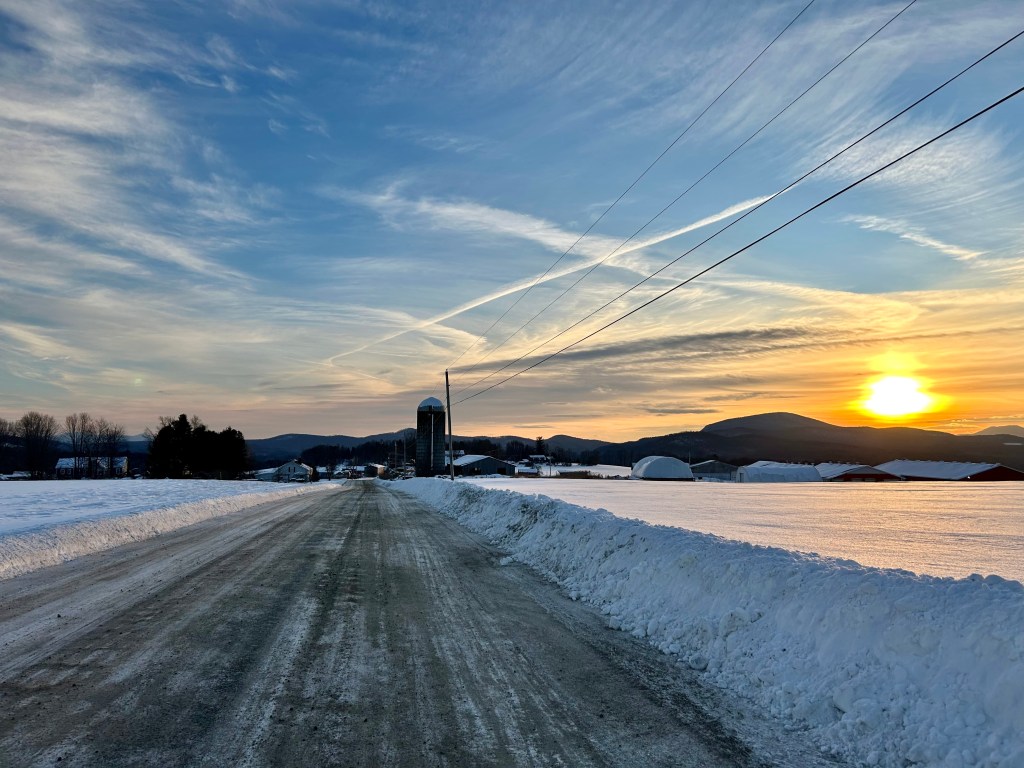
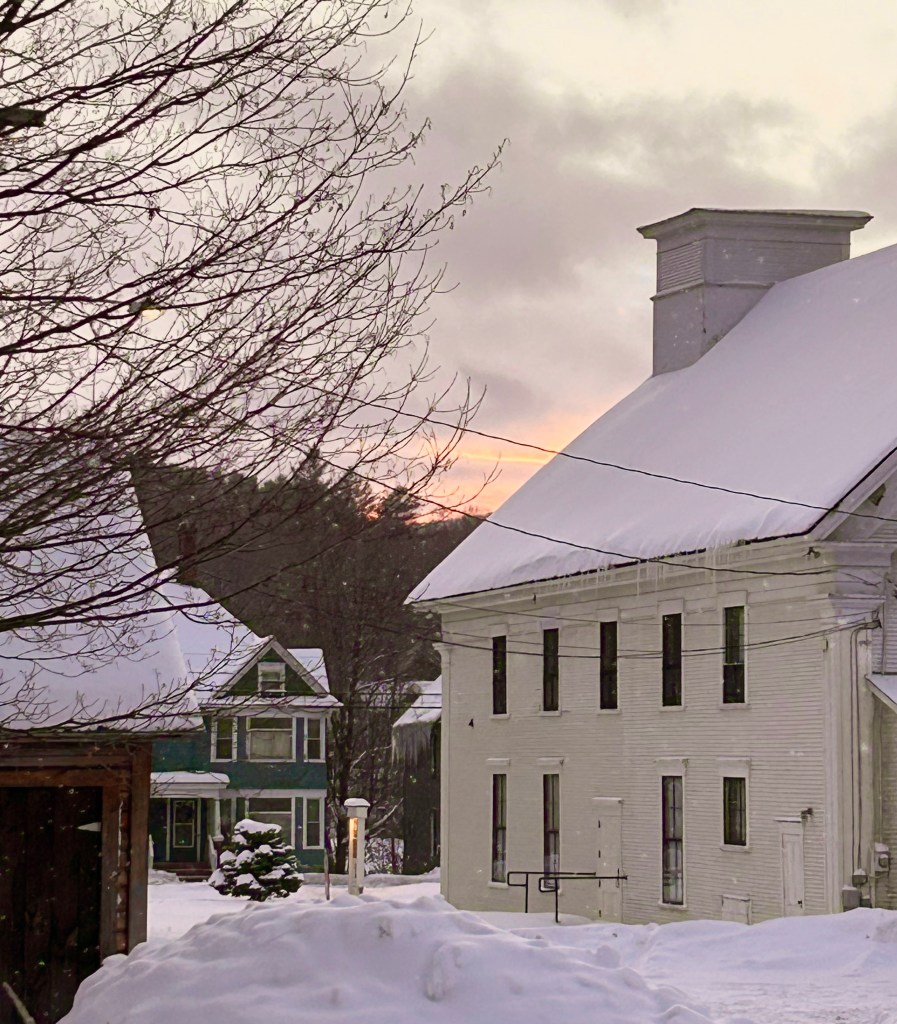
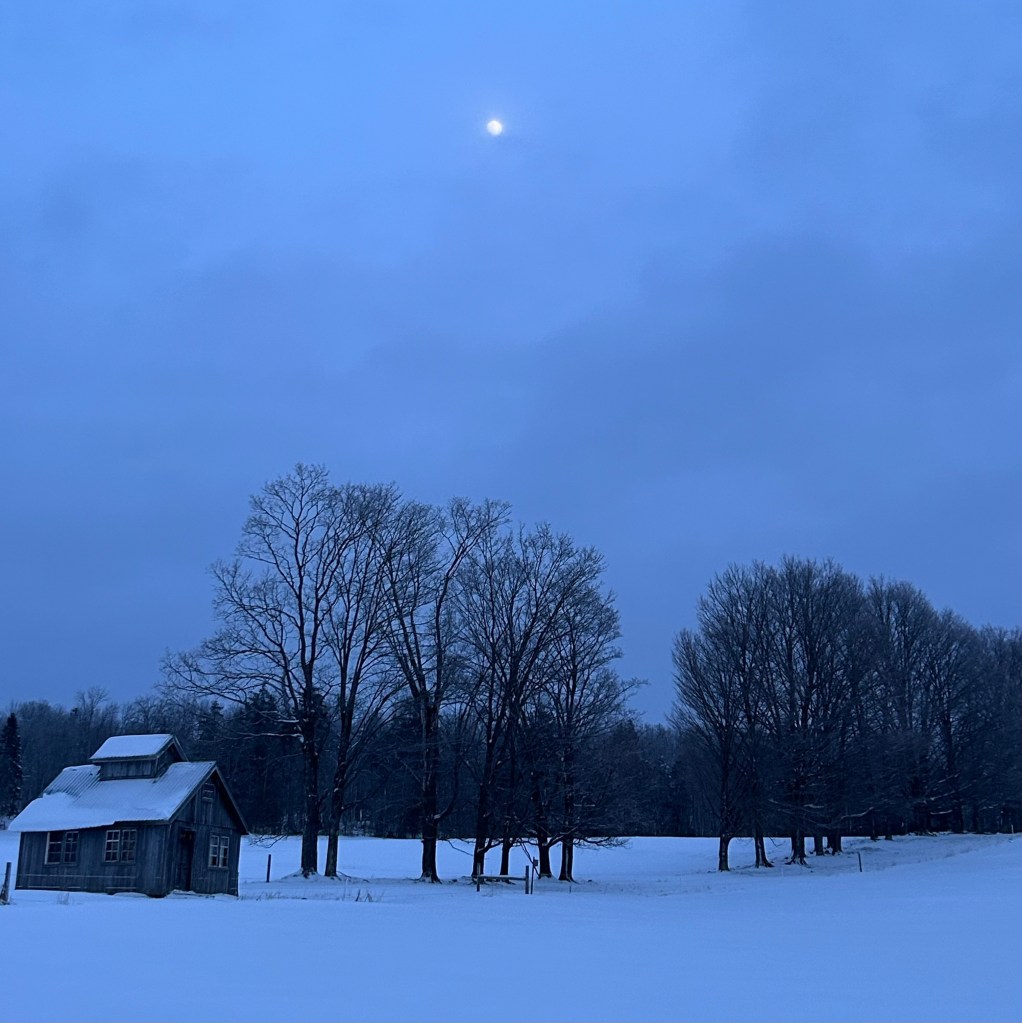
Late afternoon in Vermont December is twilight; I’m hustling along my road, a glass container of hot soup wrapped in a pink cloth in my hands, and I stop for a moment and talk to the neighbor boys who are sledding. The light is dim enough that I squint to count the three children, shadowy figures in snowsuits. The cold is fierce on my face. This day has been sprint from one thing to another, more yet to come, but I pause, that glass steaming in my mittens, the sunset sprawling over the great sky, the stars already emerging in the east’s darkness. A small moment, a tiny exchange of hellos. Such luck to be in this ordinary afternoon.

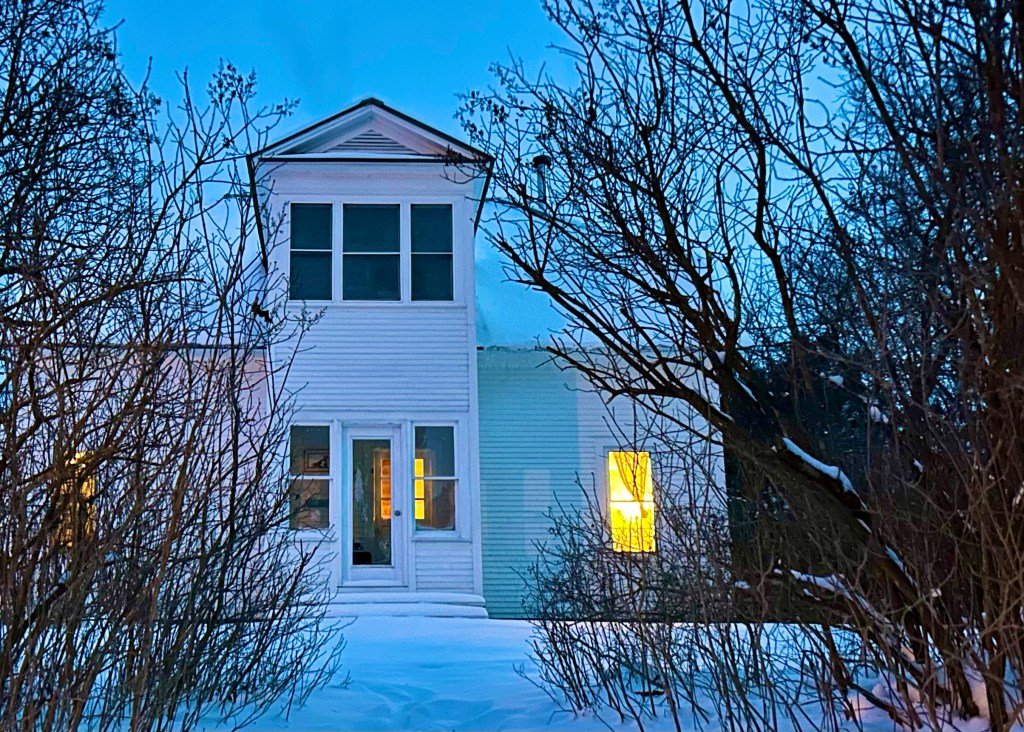
I walk through the parting in the lilacs-gone-to-sticks for the winter, study the bird feeder hung in the mock orange, the seeds sprinkled in the new snow. Behind me, the boys call to each other. In their lit kitchen window, I see the boys’ parents. Dinnertime nears. The cold is so mighty a body without shelter could and would perish. In the snow that gleams with the last of the day’s light, my boot prints lead to me, my lit window and cat, the upstairs bedroom dark where I stood a year ago and wondered if I would die. Wrong question. Not if but when. For this moment, however (a great big however), I remain in this simple-not-simple equation of laughing children, hot soup, the night swooping in. I study my bootprints with satisfaction and then head towards my own kitchen door.

“The Way It Is”

There’s a thread you follow. It goes among
things that change. But it doesn’t change.
People wonder about what you are pursuing.
You have to explain about the thread.
But it is hard for others to see.
While you hold it you can’t get lost.
Tragedies happen; people get hurt
or die; and you suffer and get old.
Nothing you do can stop time’s unfolding.
You don’t ever let go of the thread. ~ William Stafford

The Scythe, the Past.

Twilight, 25 degrees yesterday, the temperature dropping, I’m walking back and forth by the town garage, a tumbling-down quonset hut beside the town’s towering sand pile. Such much winter yet to come. On the snowy road, I pace back and forth, watching the sky turn from blue towards black, the stars hidden behind the clouds, talking with my friend about family and politics. Listening, I remember the Christmas manicotti she brought me last year. My daughter and I ate that delicious meal at the kitchen table; through our glass doors, I watched the snow fall, wondering if I would live another year.

Another year is not a guarantee for a single one of us. Another lymphoma lesson. I’d woken that morning with that now-familiar fatigue, as though sandbags were tied to every bone in my bone, pulling me earthward. I fed the wood stove, drank coffee, rallied and did my writing, rallied again and pulled on my coat and boots and left the house.

Later, by chance, at an outdoor fair I see a woman I’ve known for many years, who was part of a trying time in my life when my daughters were young. She offers me a particular kindness, and I thank her, wondering what I’m supposed to say. She does not seem to expect the standard answer of all’s well, that’s over and done because of course any fool knows, once cancer has rooted profoundly in a body, the reaper’s scythe does not hide. By now, it’s not so much the scythe that frightens me, it’s the suffering to get there.

On my way home from the fair, I pull over and get out of my car. The sun shines brightly, but it’s freezing, and I’m shivering. I walk back down the dirt road that’s empty of everyone, not even a crow perched in a bare-branch maple. Far up the valley I see enormous white wind towers, the Lowell Mountain Project. To my left is a house where one of the leaders of a group that protested the towers now lives. When the tower project began, my then-husband joined that protest group. The experience broke my naive love affair with Vermont and my blind faith in that too-hard-used word community. Not so long after, the husband and I divorced. My life went on, and I became intimately familiar with my own fallibility, my own deep pockets of untrustworthiness. I devoted two years of my life to writing and publishing a book in atonement for my own callous actions. Which never changed the consequences but widened the story. Then, cancer — the plot turn.

Robert Frost, no stranger to suffering, famously wrote that everything he knew about life could be summed up in three words: it goes on. Standing alone on that roadside, I imagine myself as the mangiest cur, footsore, half-starved, near mad. Disease may yet be rising within me. If not now, perhaps soon, perhaps never. This hillside above the Black River valley will endure long beyond my bones and flesh, long beyond yours, too. The sun and wind cut into my eyes. Why do I refuse to remember my mittens? Rather than letting all this go, I stuff these stories back into my heart and trek back to the village. I’m not finished with any of this. I’m still following the strands of all these stories.

…. and last, Rick Agran of Bon Mot has kindly invited me to his radio show at 5 p.m. EST tonight…

Stopping in the Snowy Forest.

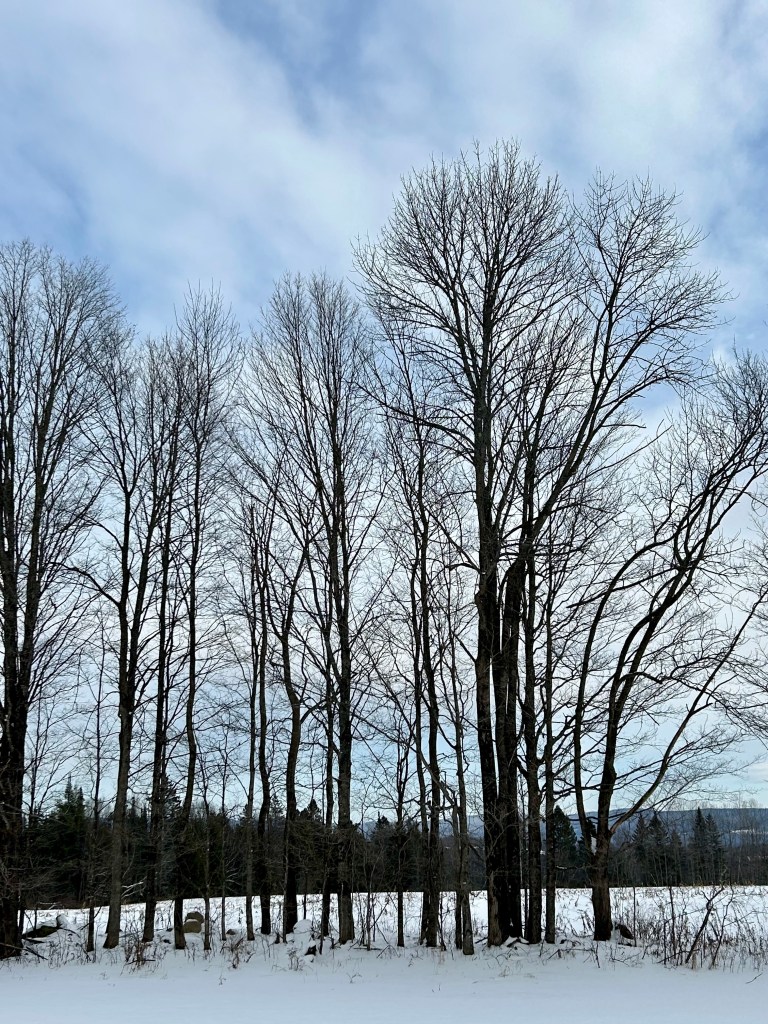
In the woods, I hear voices and pause, thinking a cluster of children might emerge over the hill. Instead, a flock of clangorous geese wings low overhead, then a second V, a third. Town traffic sounds filter into the woods. I am not in the deep wilderness, not so far from high school and road and village, but for this hour, it’s just me and the sweep of wind and drifting snow and the human and dog prints of whoever walked here before me.

As a kid, my father was never one to be daunted by adversity. Evenings, he often set down his coffee cup and took us on walks to the library or around the block, and around the block often meant across a thin-grass soccer field to the woods. Who owned those woods, I never knew. We jumped across the stream and along worn logging roads, past the piles of New Hampshire boulders and stone walls in the forest where fields had dominated not so many years ago. The woods were alive with rabbits and deer, birds and ferns. We wondered about the Natives who lived here and the colonists who cut down the trees, and then the trees grew up again.

On this twilight Monday, I lean against a hemlock, snow in my eyelashes, remembering when my daughters filled their snowsuit pockets with tiny hemlock cones. Intentionally or not, my father instilled love and not fear of the forest in his kids, the understanding that our feet could carry us to unexpected and miraculous places.

Here’s that classic New Hampshire poem threading through my childhood, my daughters’, and so many others:

Stopping by Woods on a Snowy Evening

By Robert Frost

Whose woods these are I think I know.   

His house is in the village though;   

He will not see me stopping here   

To watch his woods fill up with snow.   

My little horse must think it queer   

To stop without a farmhouse near   

Between the woods and frozen lake   

The darkest evening of the year.   

He gives his harness bells a shake   

To ask if there is some mistake.   

The only other sound’s the sweep   

Of easy wind and downy flake.   

The woods are lovely, dark and deep,   

But I have promises to keep,   

And miles to go before I sleep,   

And miles to go before I sleep.

100 Daffodils.

In this balmy late autumn, I walk with new acquaintances in an oak forest where I’ve never wandered. Oaks are sparse in the woods where I generally walk, these lovely-leaved beauties, the ground beneath them strewn with acorns, some broken, their centers chewed out.

I’m with other women who are unwillingly on a journey similar to mine — cancer and chemo, the shock of our worlds slashed apart. Our conversation drifts to the kindness of friends and strangers, and the flip side of kindness — a kind of harshness: why can’t you get on with your life since the chemo is finished? (a raw impossibility) and didn’t you eat enough kale? For the record, when my daughters were young, I grew three kinds of kale in my garden, fifty plants to carry us through the winter, fenced from the foraging deer. All that kale, so carefully tended, and yet, here’s the luck of your draw: cancer.

It’s a rare kind of privilege to walk with these women, listening, offering snippets of my own story. On this cloudy afternoon, these woods are light-filled through the barren branches, the poplars and beeches still shimmering patches of gold. One woman ventures, “All nature has scars.”

Every year, I dread this season of dwindling light, the creeping-in edgy cold, the giant fist of winter readying. And yet every late autumn, the falling leaves enchant, the wood stove’s warmth soothes, the moon gleams its crescent cut-out in the starry sky.

Writing this book about cancer has pushed me to read and gather facts and history, the scientific low-down. And yet, simultaneously, I appreciate more and more the great mystery of this universe. A friend counsels me that I can hold two things in one hand: knowledge and uncertainty. But these, too, are beyond numbers; this world’s mysteries are multitudes. My sister once remarked that cancer is the great leveler: it’s humbling. On a recent chilly morning, I planted one hundred daffodil bulbs: a meager offering to this sweet place where I live. The story behind these spring beauties will surely sink down and vanish into the sandy soil.

Auto Mirror

In the rear-view mirror suddenly
I saw the bulk of the Beauvais Cathedral;
great things dwell in small ones
for a moment.

Adam Zagajewski, translated from the Polish by Czeslaw Milosz and Robert Hass

Gifts at the Back Door.

I arrive home in the dark and find one of my red deck chairs at my kitchen door, a white container set on its seat. It’s not late but dark already. On my way home from work, I’d walked along the river and walked further than usual. When I’d returned to my car, darkness had fallen.

I’ve been living in or nearby this village for thirty years. I’ve seen a share of miserable things — from addiction and homicides to petty cattiness — and its goodness, too. How, in times of trouble, folks appear with aid. No questions, often very few words. My god, the grace of this.

Scorched earth is how I consider myself these days, not so many days post-chemo, post-surgery, leering up on a year’s anniversary since I learned I had cancer. See how I write this? Past tense. And yet, transmogrified is a word I used with a friend. How this disease has transmogrified my being.

In the dark, I unlock my door, set down my backpack, a pile of library books, a bag of apples. My cats mewl for their cat supper. The container has soup, barley and beef and spinach. The woodstove has gone cold, my jacket drips rain on the floor and my cats’ dense fur, darkness presses against the windows. And yet, serendipitous soup. I take a spoon from the drawer. As for figuring out the rest of my life, or this week, or even this evening — I let that go.

From my library book stash, Sally Mann:

“As for me, I see both beauty and the dark side of the things; the loveliness of cornfields and full sails, but the ruin as the well…. The Japanese have a phrase for this dual perception: mono no aware. It means “beauty tinged with sadness,” for there cannot be any real beauty without the indolic whiff of decay. For me, living is the same thing as dying, and loving is the same thing as losing, and this does not make me a madwoman; I believe it can make me better at living, and better at loving, and, just possibly, better at seeing.”

“…music despite everything…”

A woman stops me on the sidewalk and offers me a chair. I discover it’s a fine reading chair and bring it home, much to my cat’s delight. Friends track me the hermitess down in the coffee shop where I’ve spread the pieces of my manuscript over a table. We drink cappuccinos and eat jam bars and talk shop. I’m hurtling through the book I’ve called a cancer atlas — how to endure the intertwined suffering of cancer-and-chemo and then what? I tease, write the ending for me, will you? although I’m already there, stitching together mosquito bites and spring ephemerals and sleeping alone in a cold tent while the rain soaks through the tent fly and floor. We share kale soup recipes and marvel at this long dry autumn, the poplars yet holding their gold leaves.

Ever present in my mind is the question I asked the oncologist when I’d finished chemo, endured the surgery, limped my way back to his office. “What now?” And his answer, “Go and live your life,” the old existential question. A koan, a place of delight to be able to ask this question.

On this No Kings Day, while my cats sprawl contentedly before my woodstove, I’m reminded of the dearness of living a human life. That the asking of the question how to live is a many-sided privilege.

We must admit there will be music despite everything.
We stand at the prow again of a small ship
anchored late at night in the tiny port
looking over to the sleeping island: the waterfront
is three shuttered cafés and one naked light burning.
To hear the faint sound of oars in the silence as a rowboat
comes slowly out and then goes back is truly worth
all the years of sorrow that are to come. ~ Jack Gilbert