“You got a God.”

Years ago, I ripped out a photo from the New Yorker of Marina Oswald taken the morning after her husband assassinated President Kennedy. She was hanging diapers on the clothesline, her face scrunched in misery. It was 1963, the realm of cloth diapers, and she had two babies. I tacked the photo on my wall.

No assassins in my household. Yet, as I described to a friend, I’m healing from chemo and surgery while the dailiness of life tugs me onward. In some ways, this is a relief; I’m utterly grateful to be in the world where I hand over my credit card for groceries, rise in the night when my daughter returns from work to ask about her hours. I order firewood, problem-solve our broken car scenarios. It’s triage and logistics, a math problem.

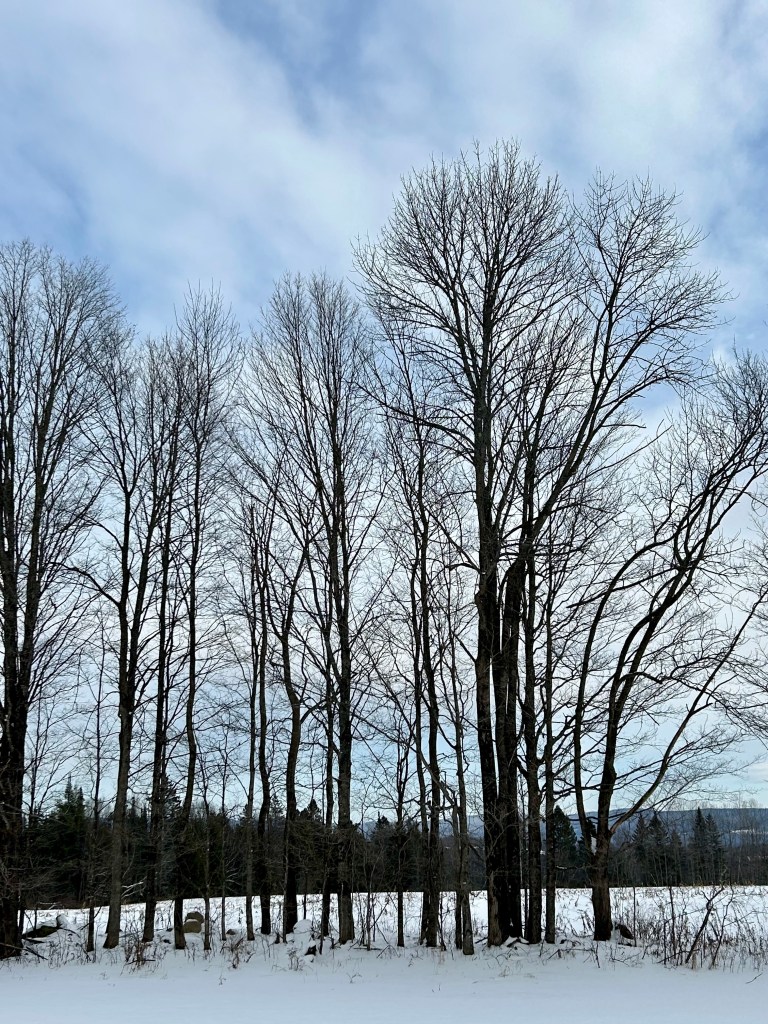
This May, a cold spring, snow yesterday all day in the New Hampshire White Mountains, I read through the mail. Make one phone call. A colleague stops by. My daughter makes grilled cheese, slices avocados, rims the edges of my plate with peanut butter cups. My brother texts, my sister calls, reminding me to eat, eat. In all this, I open the Grapes of Wrath, join hitchhiking Joad, and eventually sleep in the wood stove’s warmth. I dream of our lilacs who hold their buds closed against this cold, the Joad corn in the 1930’s, buried in feet of dust. Through my dream washes the rain against our windows, the purple and white violets studding our overgrown grass. Time and place and season sift like a jumbled dump cake.

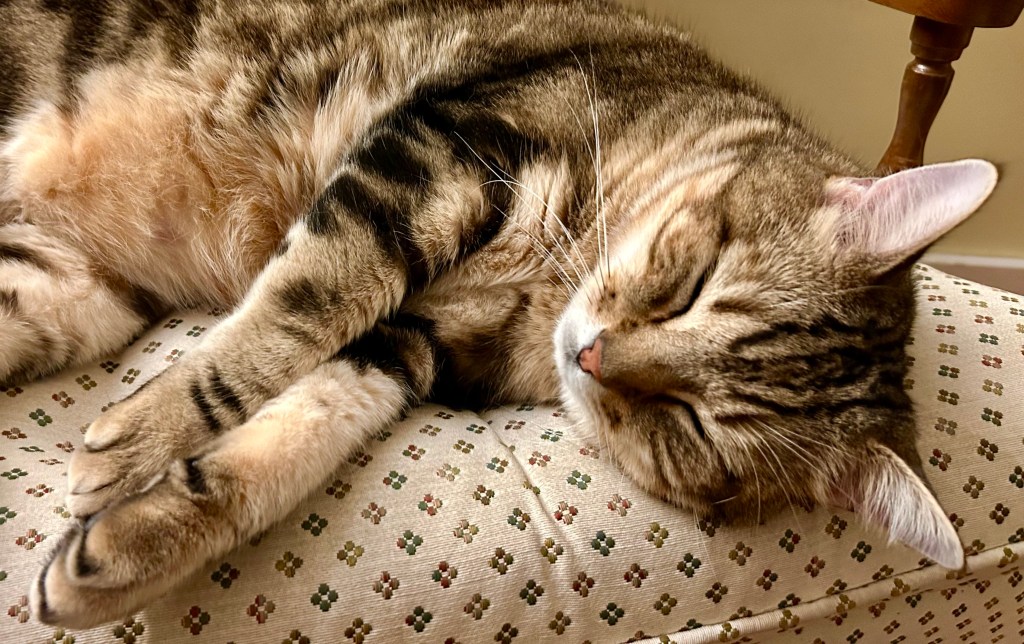
When I wake, my cat Acer lies purring against my foot, contentedly grooming a dainty paw, supremely confident of an imminent dinner and another toasty night before the beloved hearth.

Memorial Day weekend, when we always invite friends and neighbors for an outdoor dinner. Not so, this year. The pieces in my life, my family’s lives, shift, rearrange, mend. Slow healing, slow domesticity.

From Steinbeck: “You got a God. Don’t make no difference if you don’ know what he looks like.”

Mending…

After nearly two weeks away, I return home to the trees in full leaf, the lawn gone wild with violets and strawberry blossoms. Drizzly, cold, my brother starts the wood stove. The cats uncurl themselves before the blaze, satiated. A cold May, but verdant, lushly and satisfyingly so.

In these post-surgery days, I limp from room to room, venture outside to tug down a lilac branch and breathe in. The weeds run rampart, but whatever… the garden, too, will be sorted and tidied.

I’ve written repeatedly about the lilacs around my house, but again, I reiterate my joy in the soaring bushes. When I was five, we lived in a small green rented house, its yard surrounded by chainlink fence. A lilac bush leaned over the fence from the backyard neighbors. My second-grade sister was in school afternoons, my toddler brother sleeping, and so, after kindergarten and lunch, I lay on the long grass, staring up through the quaking leaves. These bushes, so New Englandy quaint with lavender, violet, and white blossoms, remind me of those unbounded childhood hours. One o’clock, two o’clock? Who knew? Who cared? I had just learned how to tie my shoes.

Like the walking wounded, I hobble from couch to chair, through the long grass, out of the workaday world and, yet, far from being a child. In glorious remission, in recovery from surgery, I keep thinking of this poem below, as I begin, day by day, to mend my body and life.

“Da Capo”

Take the used-up heart like a pebble
and throw it far out.

Soon there is nothing left.
Soon the last ripple exhausts itself
in the weeds.

Returning home, slice carrots, onions, celery.
Glaze them in oil before adding
the lentils, water, and herbs.

Then the roasted chestnuts, a little pepper, the salt.
Finish with goat cheese and parsley. Eat.

You may do this, I tell you, it is permitted.
Begin again the story of your life.

— Jane Hirshfield

The awful, the reprieve, Maurice Sendak’s chicken soup with rice.

Snow falls early on this Thanksgiving morning. The nurse wakes me for meds and vitals. I am eighty-four miles from home. My window looks out into a courtyard with a fan of three white birches. In a wind, their papery bark ripples in the breeze. Nearby, an office window glows where someone is already working.

I am here for a haul. My daughter brought me the striped blue and green quilt from my bed, the worn hand-me-down that reminds of home.

Monday, the pain and awfulness returned. My daughters drove me not to the local ER this time, but down the interstate, the two of them in front, me in the back with a pillow staring out the window, to Dartmouth-Hitchcock. At the ER, they took blood, asked my story. Someone in the waiting room, who must have been a frequent flier, had been waiting for four hours was threatening to leave to get something to eat. The nurse said she couldn’t go. I was sent out, waited less than four minutes, and was taken in for antibiotics and saline and pain meds, another CT scan.

An MD, a second. An oncologist who explains slowly that the lymphoma I have often responds well to treatment, so reassuring. This raging infection. I am taken upstairs. My daughters, folding with exhaustion — it is now late again — head back up the interstate. Shortly afterwards, the oncologist returns and bends down to look directly at me, eye level. I know this position means bad news again. In the three-week span of CT to CT, the cancer has grown and possibly eaten into my bowel. Surgeons will be in shortly to speak with me about emergency surgery to remove a section of bowel. My thoughts immediately surge from Thank god, I may be alive in May with my family and see blue squill bloom to Are you fucking kidding me? It’s the middle of the night.

Middle of the night or no, the surgery team comes in and out, talking, talking. The lymphoma renders the CT scan unclear. Because my mind works this way, I size up the head surgeon: she’s long experienced in trauma and general surgery. Her fellow tells me he’s been working with her for six years. She tells me so much, all the terrible — and these are devastating — things that could go wrong me for in the next few hours. In the end, I trust my life to her. It is the only course.

I call my brother. We call my daughters, who have not yet slept. My brother gets in his black Subaru. My youngest drives our red Subaru and drinks a quart of cold coffee, a more experienced driver than her sister after a cross-country trip this summer. Is the moon guiding them? I don’t know.

In the OR, a woman whose name I don’t know holds my hand as I instantly go under. When I wake, so confused, in an enormous dark room — it’s the still the pitch of night — I immediately lift my jonny and look at my abdomen, asking what happened? My flat abdomen has no huge bandage. The surgeon had gone in with a camera and decided what remains is sufficient, for now perhaps, forever perhaps, to change perhaps. My oldest showed me a photo she snapped of my family curled in the empty ICU waiting room, sweatshirt hoods over their heads. Let me write this: what a hard awful night, and how much worse it might have gone.

….. Then, that morning, in and out with the surgery team, with phlebotomists, nurses. The lymphoma oncology team arrives in a pack. The lead pulls out a chair, tells us to record, and begins talking. He’s brilliant and confident without cockiness in his ability to cure me. He outlines that complications of infection and my bowel will keep me here for the first chemo run, deep into dark December. I decide to do exactly he tells me.

My family again leaves. My daughters refuel with fast-food chicken and sandwiches for their drive. I sleep and wake in a drenching fever, which creates a flurry among the nursing staff. They come in and out. Somewhere in the miasma, I really wake up and decide to pull myself together. I’m going to be here for month, and I need to quit feeling sorry for myself. A nurse tells me to eat some chicken soup with rice — remember Maurice Sendak? The soup is delicious. The fever breaks. I survive a ten p.m. MRI — a blind descent into a cave where dwarfs bang around me while Freddie Mercury sings.

This is a long way of writing a fragment of how I arrived here, medical center land, not a Thanksgiving morning where the kitchen is savory with sage dressing, and I’m out in my boots, admiring the first downy snowfall in my garden. Living is a nonstop risk, the whole she-bang, but we don’t always tread such a thin pinnacle. By chance, as I packed my laptop and socks for the ER trip, I stuffed in the Vermont Almanac that had arrived in that day’s mail. Later, when I had decided to embrace where I am now, I opened the envelope. This volume, as the others, is exquisitely beautiful. A phlebotomist arrived to take blood. She admired the cover — especially the view of the mountains through the window — and she told me a little of her story from rural Vermont to Lebanon, New Hampshire.

In editor Dave Mance’s opening, he writes, now post-election, how we might return to embracing the complexity, rugged and elegant, of the natural world and our very lives. (Gracious, when I’m able to untangle myself from cords, I’ll update with his poetic words from the book just out of reach on the windowsill.:)

Complexity is precisely where I am, enmeshing in this crazy mixed-up jumble of the medical system’s turbo drugs and powerful machinery, the stories of the people who labor here, a nurse training for her first half-marathon and another with three young sons, welcome news of a friend’s first grandchild, my own energetic and loving family.

All of you, too, on this Thanksgiving or perhaps just a plain old weekday morning — in our lives, how much we’ve chosen and so much we haven’t — gratitude for being alive in this world. For chicken soup with rice.

Cutting grass at night…

I’m finishing mowing the front lawn when my neighbor opens her door and hollers, “Hey, there!” across her driveway. Save for a series of apartments in my twenties, I’ve never lived so close to another house and moved here, in fact, from a house that was surrounded by wilderness.

She’s a darn good neighbor. Twilight fattens to darkness as we talk about small things — a mutual friend who visited her, red roses blooming yet by her door. My pink cottage beauties have long since dried up.

I’ve lived long enough now in this town to have experienced the meanness of catty gossip and the kindness of strangers; nothing different from any other town or city, I suppose, simply the variety of human behavior, the tenor of thinking that makes me satisfied to be standing here in this dew-dampening grass, listening. A fallen pear that’s split by the mower blade bleeds its sweetness into the evening.

It’s a harvest full moon night, diminished by the eclipse and then returned. I sleep with the windows wide open, the moonlight on my curled cat who’s sleeping in his own cat way, more dream than rest, busy at his own cat magic. Here, too, I can hear the traffic on route 15, coming and going, going and coming. At 3:30 a.m., the traffic stills. The tree frogs sizzle on.

As a girl, we traveled summers in a green jeep and slept in tiny nylon tents. Waking in the night on those cross-country trips, I’d hear the interstate. So curious I was to know where everyone was headed. I repeated all that again in my hungry twenties. For a summer, we lived near the river in St. Johnsbury, Vermont. Every night, the train whistle bleated mournfully, passing through. Here I am now, in my fifties, lying awake, listening. The scent of the grass I cut that evening drifted into our house. In the moonlight, my cat lifts his head, questioning. “We’re here,” I counsel, “all’s well.” He tucks himself back into his curl. The moon and the frogs keep on. A milk truck rumbles by, pushing us towards day.

Complex People.

I was on a Claire Dederer reading jag, stepping into her island home, soaking up her kids and her questions and her fierce writing. Witty, smart, edgy. Which led to me to the father of those children and his books. 

Bruce Barcott writes in The Last Flight of the Scarlet Macaw:

 “… a good portion of my life I believed that a law of benevolent action held sway in the world. This law maintained that if you did the right thing and worked hard, eventually things would work out; that the world generally tended towards fairness, decency, and wisdom. But of course the world doesn’t work that way. The people who learn that lesson through crushing experience and still refuse to bow to it astound me. They go on fighting, again and again and again. These people aren’t perfect. They aren’t simple heroes. They are complex human beings. And we need them. Because without them the world would be lost.”

Making Things…

Mid-January, the earth is covered with ice and a crunchy snow a few inches deep. The meditative qualities of walking are swallowed up by fear of slipping or the grinding of hard snow beneath boots. People complain. Complaining is a normal winter’s activity, so are ice and snow, and yet — I’ll reiterate for what seems like the hundredth time again — we’ve slipped out of the cog of normalcy.

What I do:

I finish painting the bathroom (one Sunshine wall, the others Vanilla Ice Cream).

I’m diligent at my work.

My daughter and I go out for coffee, struggle through the CSS profile on financial forms, talk and talk and circle around.

I rise early every morning and rewrite my novel, snip, stitch, elaborate, with my imagination and my hands. In the night, I wake and lay more wood on the fire, pieces of my life arising in words: loons and dahlias and betrayal and desire.

On a Jane Alison bender (Meander, Spiral, Explode: Design and Pattern in Narrative), I inter-library-loan Alison’s memoir of how her parents switched partners with another couple, The Sisters Antipodes. Alison writes, “Making things helps make you.”

Sunlight on Sunday, a stiff breeze that jangles the wind chimes.