Birds, Black and White

When you drive down our dirt road hill, the woods give way suddenly to open farm fields along the river valley bottom where, before the rivers were polluted, must have made for amazing swimming. We never swim in the river, but the immense fields and the arching sky are beautiful, and all my many journeys along the brambly edge have yielded treasures – wildflowers I’d never seen or small running streams from the steep hillsides.

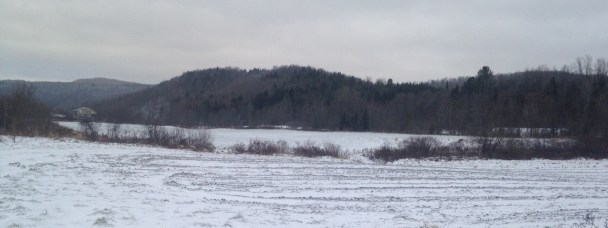
This afternoon, crows pecked  at the corn stubble. Something like white cloths fluttered in the light snow, and I realized those graceful swoops of white were seagulls. I’d never seen seagulls there.

If you’d been looking for an omen – and I had, indeed – that mixture of the black birds, with their beaks working where the open ground lay barren and brown, coupled with the downy white of seagulls who tilted upward in the breeze and drifting snow would have sufficed. It was just me and the birds, and the birds would have gone on quite happily without me, serene in a mysterious drama all their own.

…. you can
drip with despair all afternoon and still,
on a green branch, its wings just lightly touched

by the passing foil of the water, the thrush,
puffing out its spotted breast, will sing
of the perfect, stone-hard beauty of everything.

– Mary Oliver
fullsizerender

Hardwick, Vermont, snowing


The Value of One Word

My 11-year-old opened a box with a brand-new puzzle today and said happily, “This smells puzzle-y.”

What a world this is, where a kid can make up a word that’s indicative of so much – winter evenings around a table, cheerfully chatting – and spin together that treasured past with the tangible promise of future pleasure literally in her hands.

Our physical world is dictated by laws of equal and opposite action; the earth gives generously, but the earth taketh, too, and doesn’t skimp on the taking. Which is perhaps why that word puzzle-y shines so brilliantly. Like Noah’s olive branch, my daughter’s word treasures the past and beckons in the goodness of the future.

And it came to pass… the waters were dried up from off the earth: and Noah removed the covering of the ark, and looked, and, behold, the face of the ground was dry…. (The Lord said) bring forth with thee every living thing that is with thee, of all flesh, both of fowl, and of cattle, and of every creeping thing that creepeth upon the earth; that they may breed abundantly in the earth, and be fruitful, and multiply upon the earth… While the earth remaineth, seedtime and harvest, and cold and heat, and summer and winter, and day and night shall not cease.

Genesis 8:13-22, King James Version

fullsizerender

Stowe, Vermont

Dirty Shoes

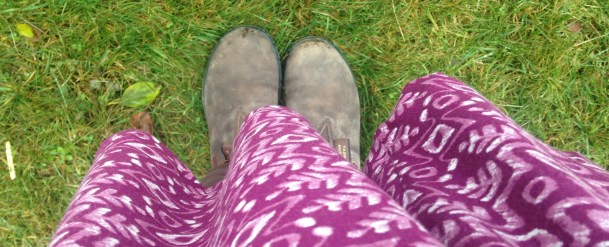
We’ve officially entered into the season of increasing darkness – not merely politically but because of the planet’s tilt. My teenager, home early from school, slouches at the kitchen table and moans about the gray. I advise her to head out for a run in the rain. She’ll return, pink-cheeked, and far more cheery, her running shoes smeared with greasy mud on their soles.

Post-election, all these words have surfaced again, the same ones Vermonters use over and over – community, persistence, hope – words that are distressingly meaningless without tangible action. How do our footprints mark our paths? For my daughter who will mature to adulthood under a new administration, I’m going to keep advising her to muddy your feet, girl. In my garden, the johnny-ups are yet blooming amongst the weeds.

I’ve been reading Scholastique Mukasonga’s Cockroaches, her memoir of growing up in Rwanda, and that’s all I’m going to write about this slim, powerful book.

The ultimate measure of a man is not where he stands in moments of comfort and convenience, but where he stands at times of challenge and controversy.

– Martin Luther King, Jr.

fullsizerender

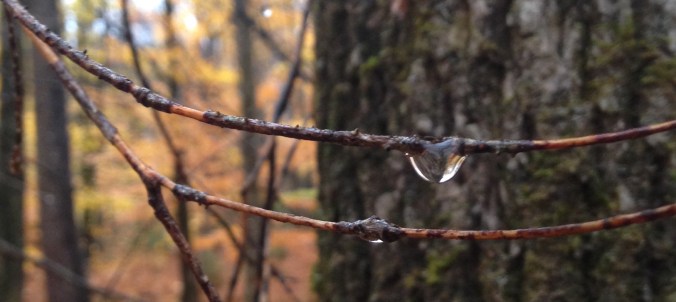
November color


How the Water Flows…. Or Doesn’t

A number of years ago, The New Yorker published a photograph of Marina Oswald the morning after Kennedy’s assassination. She was pinning diapers to dry on a clothesline. Last night, I was remembering this photo while solving my washing machine’s leaking cold water. While my mothering energy often heads toward the future – what will my older daughter do after high school graduation? will I make it to my younger daughter’s concert? – the nitty-gritty of daily life is really the grease in family wheels.

Case in point: my washing machine. Leaking hoses have now led to a clogged water filter (or so I believe….) Some days, family life seems one problem-solving exercise after another. This problem, in the scope of things, will crest and diminish. Via google, I’ll remedy the situation or find someone who will. More fodder for the creative grist mill; an aspect of modern family life I’ll master; one more piece of know-how my fingers have dirtied their nails upon.

The most common way people give up their power is by thinking they don’t have any.

– Alice Walker

img_2775


Family Life

One of the more revealing titles of my recent reading is Akhil Sharma’s Family Life,  a novel hardly of the slick parenting magazine fare I leaf through in that dentist office I so frequently visit these days. A slim, fierce, terrific book.

This morning, reading another book about family life – Margot Livesey’s Mercury  – this line jumps out at me: “The human brain often juxtaposes the sublime and the trivial.”

The line encapsulates the book, true, but also domestic life.

Parenting often seems an endless routine of gathering twisted toddler socks from beneath the kitchen table. When my girls were teeny-tiny, I often muttered to myself during unbroken days a line from Shirley Jackson: “All day long, I go around picking up things.” The tooth-brushing trivial.

And yet, embedded like gems in the midst of sandbox squabbling, there’s marvelous moments: braiding my daughter’s hair, inhaling the familiar, salty scent of her scalp, listening to her stories.

The blue vase on the sideboard was from the Song dynasty, eleventh or early twelfth century. How had it survived nearly eight hundred years when I could barely survive forty? I was in that state between waking and sleeping, neither fully inhabiting my body nor entirely absent, when I heard footsteps. The mattress dipped.

– Margot Livesey, Mercuryfullsizerender


Young Chimney Sweeps

Megan Mayhew Bergman begins her story “Housewifely Arts” with “I am my own housewife, my own breadwinner.” To that, add the line: “I am my own chimney sweep,” and why not? Sunday afternoon, in this balmy autumn, my teenage daughter props a ladder against the kitchen and asks her sister to hold it steady. I warn the kids this is a dirty job.

Our upper (and lower)  windows are desperately in need of paint; sections of the roof are down to tar paper; the cedar is cracked and splintery. In short, work needs to be done. But it is ours, free and clear, and the children love their house.

While our house breathes through its myriad cracks, its real lungs are the chimney. With a long pole, my teenager shoves down the wire brush, over and over, while I descend to the basement and shovel out fallen chips of creosote. It’s foul-smelling, black work. In the living room, I clean out the wood stove, scrub the pipe free of soot, vacuum the vents and ready the hearth for winter. While it’s the kind of work I find tedious and filthy, my teenager attacks with gusto; in her room, the younger girl tugs her bunk bed from one end of her bedroom to the other, rearranging.

My girls: not housewives – house women.

I am my own housewife, my own breadwinner. I make lunches and change lightbulbs. I kiss bruises and kill copperheads from the backyard creek with a steel hoe. I change sheets and the oil in my car. I can make a piecrust and exterminate humpback crickets in the crawl space with a homemade glue board, though not at the same time. I like to compliment myself on these things, because there’s no one else around to do it.

– Megan Mayhew Bergman, Birds of a Lesser Paradise

img_2540

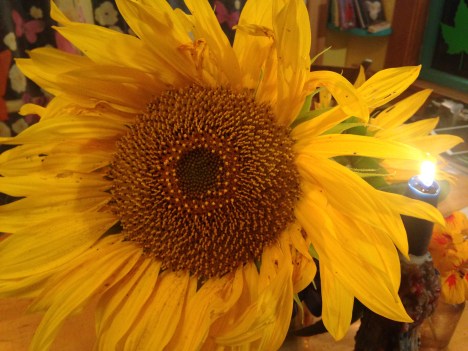
Dinner table, Woodbury, Vermont