We Are the Past

Remember the Turkish Delight in The Lion, The Witch, and the Wardrobe? The sweet that bribed Edmund to betray his siblings? My daughters were fascinated by this candy. Could it really be that good?

For years, I’ve been looking for this confection; yesterday, my daughter returned from a field trip with a small box. I found it, she said triumphantly.

Betrayal is far from my child’s intent – it’s not the Turkish Delight, of course, to be blamed for Edmund’s ill deed, but Edmund himself, and the story of his own particular unhappiness that carried him to that point.

I know people who insist the past is irrelevant, that what matters is only the here and now, the very present before our eyes, as if our unique stories could conveniently be swept into a dustbin and abandoned. As a writer, I think the most natural questions are of inquiry: what’s your story? How else can we understand ourselves and each other, without knowledge?

For good or too often for terrible ill, history is always with us. Standing Rock is clearly about the bitter present and an iniquitous past.

In Lewis’s novel, the Turkish Delight is not merely a square of candy in a child’s hand, but a child with a tangled past dragging behind him and a choice posed to him. Betray or refuse? I can’t help but think that’s a tantalizing element of this story: each reader can’t help but ask themselves, which way would I chose? Which way will I write my own story?

Does that story matter? Yes.

My Dear Lucy,
I wrote this story for you, but when I began it I had not realized that girls grow quicker than books. As a result you are already too old for fairy tales, and by the time it is printed and bound you will be older still. But some day you will be old enough to start reading fairy tales again.

C. S. Lewis, The Lion, The Witch, and The Wardrobe
 

Radiance and Rawness: Hallelujah and the Blues

Catching up with a friend yesterday, she mentioned she’s trying to figure out the parenting thing.

Let me know, I say, when you do. Pass your wisdom along.

I’m not expecting a parenting epiphany anytime soon. In my experience, epiphanies are few, and I was gifted one recently. My teenager and I were listening to a Leonard Cohen song while brushing our teeth one night when I realized the novel I’m writing reflects that song. In the same lightening flash, I saw my whole life was that song, the lyrics and Cohen’s voice imbued with the nearly unbearable beauty of living and the simultaneous godawful blues – that all of human existence, all the way back to the preliterate days of stick and stone warfare, of hunting and gathering, was about the holy and the broken hallelujah.

Hard at work in revision, my novel staggers upward, soaring, full-throated and lusty. The bitter blues I have in spades. What I need is bacon sizzling in a cast-iron skillet, fat crisping golden, succulent and salty, hot fat melting on my tongue. I make a mental note. Write in: more bacon.

…I did my best, it wasn’t much
I couldn’t feel, so I tried to touch
I’ve told the truth, I didn’t come to fool you
And even though it all went wrong
I’ll stand before the lord of song
With nothing on my tongue but hallelujah….

fullsizerender

Montpelier, Vermont

A Few Words

Ice has hammered down around us. The sky is gray. All the kids along our road stayed home from school today, sliding in their winter boots over the slick roads. Inside, the wood stove burns hot. The children’s mittens dry on the hot tiles beneath the stove.

The ice has physically shrunk our world. No longer the season of long days and endless bike rides, the kids swing in the hammock hung in our kitchen and wonder when they’ll grow too heavy for that particular set-up.

My daughters’ father is far, far away these days, building shelters at Standing Rock in North Dakota. Scant word comes over the internet. Fuller stories arrive from a friend who has returned. My teenager is hungry for what shadowy news she can find. Late, late, into the nights we talk.

What can I say to her? History is a brutal, bloody business: merciless.

And yet – whether in one’s one tiny family or in the great sprawl of humanity, hope always, indomitably, rises out of struggle. Those few simple and enormous words, ancient as humankind itself: and now abideth hope, faith, charity.

Meanwhile, the ice falls.

…all states can be parceled into four types: pluralist, in which the state is seen by its people as having moral legitimacy; populist, in which government is viewed as an expression of the people’s will; “great beast,” in which the rulers’ power depends on using force to keep the populace cowed; and “great fraud,” in which the elite uses smoke and mirrors to convince the people of its inherent authority.

– Charles C, Mann, 1491

fullsizerender

Postcards From the Past

Looking for baby pictures for her senior high school yearbook page, my teenager came across a postcard from long ago I’d stashed in a box. My father had mailed me the card when I was sophomore in college (about a 100 years ago), and it had been thumbtacked over my desk for years – once scribbled upon by the girl who’s now a teenager, when she was a toddler. On the back, my father had written that famous Hemingway quote, about the little new each of us has to give: fatherly advice, about the costliness of knowledge.

In my less confident mothering moments, I wonder if I’ve learned anything.

Last night, reading Mary Oliver, I found a line that reoccurs in her poetry, over and over, like a familiar stitch: take responsibility for your life. One of the very simplest things, and yet one of the hardest. The flip side is I force myself not to responsibility for all of my daughters’ lives, too. Put your hand through a window at 17? Odd and hard as it may seem, I believed it would be theft for me to take my daughter’s responsibility for that action.

I think of my toddler in her pink waffle-weave long underwear, going at this postcard with a gleam in her eye and my felt-tipped pen in her hand. At some point, I realized I had to let her grow up; at some point I realized I had to do the harder thing, and step back.

But there is, also, the summoning world, the admirable energies of the world, better than anger, better than bitterness… And there is the thing that one does, the needle one plies, the work, and within that work a chance to take thoughts that are hot and formless and to place them slowly and with meticulous effort into some shapely heat-retaining form, even as the gods, or nature, or the soundless wheels of time have made forms all across the soft, curved universe – that is to say, having chosen to claim my life, I have made for myself, out of work and love, a handsome life.

– Mary Oliver, Upstream

fullsizerender


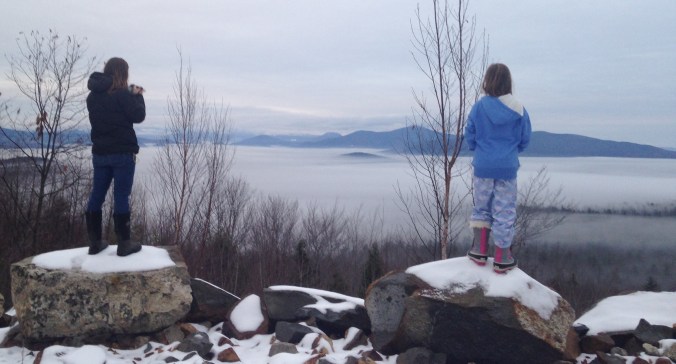
The Edge of the World

November light in Vermont is eerily dim, the daylight rapidly leaking away, and even what full sunlight we have is thin and scant. My older daughter complains, I don’t like this, to which I reply that no one does. Sometimes I wonder if an unspoken mainstay of my parenting might more concisely be: deal with it.

Yesterday, the girls and I took a short, unfamiliar hike in the White Mountains, switchbacking up an abandoned road. Below us, pine trees and mountains rose out of a sea of mist, and we never saw the valley floor. The girls were enchanted by this Lord of the Rings world. As we climbed higher, the view spread further, as if we peered down into an endless ocean with sacred islands rising majestically from its billows.

At the top, we found a blasted site where someone had once intended to build a house, and – likely through lack of money – abandoned that project and wandered off elsewhere. Fox prints tracked through the house now. The younger daughter remarked that the school bus wouldn’t come. She’d have to ski to school, she noted with real delight.

Stay honest whatever happens
says the bamboo bent under snow
over my window

– Buson

fullsizerender

Mt. Washington Valley, NH


This Brief Place

These few days, we’re staying in a house without a clock, which makes me realize just how much of my life is sewn together by those magic hands. When my daughters were tiny, and I was mostly home with them, our lives unfolded daily in the ways of very young children: the endless cycle of eating and play and napping. Now, I arrange complicated days, while stringing together long hours of work. But even when I have that time, I am always aware of that clock hammering down: work, work, while I have time.

Now, time-out-of-clock. With the shades pulled down, we slept late this morning. The sky is sleeting, the house warm, the children here and well. We may never return to our empty house.

Listen
with the night falling we are saying thank you
we are stopping on the bridges to bow from the railings…

M. S. Merwin, “Thanks”

fullsizerender