A Condensed Parenting Manual

There’s an odd line from Lee in Steinbeck’s East of Eden that’s always stuck with me, since I first read the book when I was sixteen or so: I will not put my finger in any human pie. What a strange metaphor (as if we’re baked goods?).

Tomorrow is Woodbury Pie Breakfast, the community-wide sit down to pie and coffee, live music and cabin fever conversation. This afternoon is pie baking in my house, as I suspect it will be in many Woodbury kitchens. The question around town is, What kind of pie are you baking? Or, wishfully muttered, I hope I get some of Skip’s chocolate with raspberry swirl this year.

Pie is easy – crust and filling – but human pie? Human creation? A family member this winter drove to North Dakota and joined the Standing Rock Protests, then disappeared underground, in a variation of Five Easy Pieces, with not a word to family he had left behind. He must have profoundly believed he was called to that Jihadist path, leaving behind a grief like earth crudely harrowed up but untended, uncultivated.

Steinbeck is likely at the heart of my own raw parenting philosophy. As one daughter steps into adulthood, and the other teeters on adolescence, my mantra repeats Socratic self-examination: What the heck are you doing – and why? What an annoyance it must be to have a mother more concerned with keeping the darkness of Nihilism at bay, rather than building a really stellar college application.

March is always the season of entropy, cabin fever, quarreling. We’re surrounded by depths of snow: Currier and Ives picturesque, and a real complication, too. And that’s another metaphor.

I believe that there is one story in the world, and only one. . . . Humans are caught—in their lives, in their thoughts, in their hungers and ambitions, in their avarice and cruelty, and in their kindness and generosity too—in a net of good and evil. . . . There is no other story. A man, after he has brushed off the dust and chips of his life, will have left only the hard, clean questions: Was it good or was it evil? Have I done well—or ill?

– John Steinbeck, East of Eden

FullSizeRender

Chipped Lives

It’s so darn cold here I woke up in the dark this morning with the cold scraping my cheeks. Leftover pork bubbles on the wood stove with red chili and beans: we need heat and bright color.

Despite the cold, the March light is sparklingly beautiful. My young neighbor and I slid around the ice surrounding the sugarhouse, covered with a few inches of sugary snow. I offer him salvaged doors and windows, piles of wood; he’s happy.

Less here; more down the road. This morning, while my wood stove slowly warmed our house, I remembered a Hemingway line about the surprise at the end of Ulysses. Finishing Finkel’s new book this morning, I discovered an incredible surprise in his ending. The line I snipped below is perhaps one of the few pieces of advice I could truly offer my 18-year-old daughter, this young woman who has already met the hole in her heart with burning rage.

The neighbor loads his Subaru. I’m relieved to have these potential pieces of home travel down the road. Build a greenhouse. Plant more seeds. Thrive.

I think that most of us feel like something is missing from our lives, and I wondered then if Knight’s (the hermit) journey was to seek it. But life isn’t about searching endlessly to find what’s missing; it’s about learning to live with the missing parts.

– Michael Finkel, The Stranger in the Woods: the Extraordinary Story of the Last True Hermit

FullSizeRender

Radius of This Afternoon

The cold hammers down around us again, returning with March’s powerful jaws, reminding me of all those years when my daughters were little, and we were housebound around the wood stove. Always, I bundled up the baby and walked out into the cold, even in the rawest of days, and the house’s warmth welcomed us on our return.

My friends would bring stacks of Sunday New York Times, and I would read months-old news before the wood stove, children playing with dolls or wooden frying pans, devouring the news aptly while eating popcorn. Such was the world of living with little children…. Today is merely a dip back in my mothering days, a memory when the girls couldn’t zip their coats or read a book.

I’m glad to welcome this reprise from the world-out-there of news I’d rather not hear but will make its way to our door, one way or another, eventually. For now, I’ll shake down the coals, lay on more wood, and brew tea.

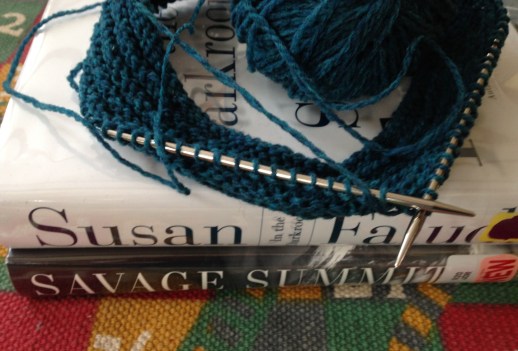
March is the in-between season, of library books, knitting, board games. End-of-winter pause.

The light stays longer in the sky, but it’s a cold light,
it brings no relief from winter.
My neighbor stares out the window,
talking to her dog. He’s sniffing the garden,
trying to reach a decision about the dead flowers.
It’s a little early for all this.
Everything’s still very bare—
nevertheless, something’s different today from yesterday.
We can see the mountain: the peak’s glittering where the ice catches the light…..

From Louise Gluck’s “March

fullsizerender

Last Week of February

Our days reflect this mixed-up weather: a jumble of crystalline perfect snow, excessive heat for February, and an unraveling disorientation. Where’s everyone going? Who’s coming and when?

Maybe it’s simply the place I am in my life, solidly in my forties, when long-term marriages of so many friends are cracking – some to fail, some certainly to mend and reknit, even more tightly – and that beastly presence of cancer rears in overlapping ripples of my intimate and not-so-near circles. The upshot, perhaps, is that we’re all in the same literal journey, living our lives in an infinitude of variations, all of us making some wise and some foolish decisions, chancing into ill-fortune or light-hearted luck.

This is midwinter, season of no greenery, no blossoms, no barefoot running over lake-dampened sand. No garden to gather a basket of greens for dinner. No sun-sweet Brandywines in my hand. No stash of cucumbers the kids have quartered and sprinkled with snipped dill and coarsely ground salt.

Midwinter is the season of the moon on the snow-buried garden, the stars icy against the night sky. Midwinter is the pondering season.

A reader essentially my whole life, I return to talismans of poetry, repeatedly. I read James Joyce first as a teenager, his Dubliners filled with rooms conversely both shadowy and light-filled. Over and over, I think of the ending of “The Dead,” with steadily falling snow, that image suffused with sadness and grief, yet also with an odd acceptance – even more, perhaps, a genuine comfort in the “generalness” of snow, the transience of all our lives, how each of us will rub up against hardship. A piece of this luck, certainly, and some of the outcome simple grace in how we navigate our lives.

He watched sleepily the flakes, silver and dark, falling obliquely against the lamplight. The time had come for him to set out on his journey westward. Yes, the newspapers were right: snow was general all over Ireland. It was falling on every part of the dark central plain, on the treeless hills, falling softly upon the Bog of Allen and, farther westward, softly falling into the dark mutinous Shannon waves. It was falling, too, upon every part of the lonely churchyard on the hill where Michael Furey lay buried. It lay thickly drifted on the crooked crosses and headstones, on the spears of the little gate, on the barren thorns. His soul swooned slowly as he heard the snow falling faintly through the universe and faintly falling, like the descent of their last end, upon all the living and the dead.

James Joyce, “The Dead”

FullSizeRender.jpg

Voting

Less than a hundred years ago, the 19th amendment to the US constitution was ratified on August 18, 1920.

Yesterday, my newly-turned 18-year-old daughter registered to vote for the first time. Not that long ago, on town meeting day, this girl played under long tables in the back of the town hall, burrowing beneath a giant pile of winter coats. This year, she’ll weigh in for herself on numerous votes that day, on town business ranging from electing select and school board members to setting the year’s tax rate.

Like her first day of kindergarten, I couldn’t resist snapping a photo. She politely acquiesced before heading off on her busy way.

The amendment reads simply:

The right of citizens of the United States to vote shall not be denied or abridged by the United States or by any state on account of sex.

Congress shall have power to enforce this article by appropriate legislation.

fullsizerender

Town Clerk’s Office, Woodbury, Vermont

Lying

I laughed at the utter aptness of the Oxford Dictionary word of the year for 2016 – post-truth – but the word (and this time) reminds me of Ernest Hemingway’s famous iceberg theory of writing, his “theory of omission.”

Years ago, when I began writing fiction, I also began reading differently, too, wondering what made terrific dialogue snap, but I also began listening in a very different way, too, and gradually realized our everyday speech often contains variations of lies, intentional or not. Lying by omission slides around in our speech, a somewhat slippery critter.

What’s the story? I sometimes ask my daughters. What’s happening under the surface of our language? Maybe there’s two, three, four stories winding together? Think complexly. Don’t assume.

Perhaps because our political world is so intensely polarized these days, the stories of greed and bigotry and outright desire for power push toward the surface. My suspicion is that this post-truth is apter than I realize, this nearly maniacal intent to create chaos and confusion, to obscure the real threads of the story beneath non sequiturs and outright blaring nonsense. History is one long story of the success of dominance, over and over. Why not chose confusion of speech as the weapon du jour?

Now I will tell you the answer to my question. It is this. The Party seeks power entirely for its own sake. We are not interested in the good of others; we are interested solely in power, pure power. What pure power means you will understand presently. We are different from the oligarchies of the past in that we know what we are doing. All the others, even those who resembled ourselves, were cowards and hypocrites. The German Nazis and the Russian Communists came very close to us in their methods, but they never had the courage to recognize their own motives. They pretended, perhaps they even believed, that they had seized power unwillingly and for a limited time, and that just around the corner there lay a paradise where human beings would be free and equal. We are not like that. We know that no one ever seizes power with the intention of relinquishing it. Power is not a means; it is an end. One does not establish a dictatorship in order to safeguard a revolution; one makes the revolution in order to establish the dictatorship. The object of persecution is persecution. The object of torture is torture. The object of power is power. Now you begin to understand me.

– George Orwell, 1984FullSizeRender.jpg