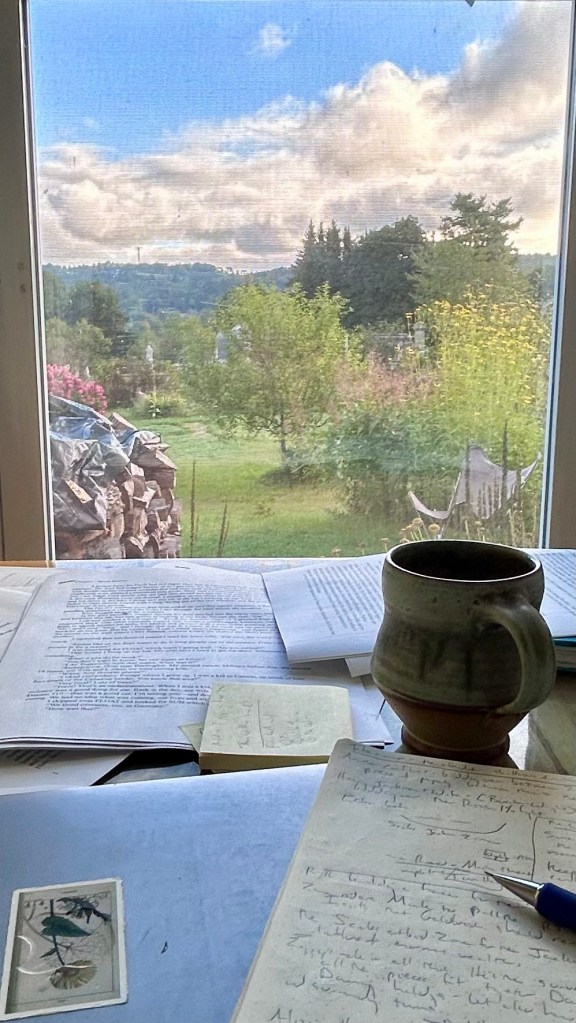
My ex and I were remarkably unsuited for each other in many ways; in particular was his ability to live without plans. I—in what’s surely irritating, too—lean into rhythms and patterns. This long holiday weekend, I wake hours before dawn, busily tearing apart a manuscript draft and rearranging, stitching, adding, cutting, cutting, cutting…
These early autumn days are sunny, with real heat yet. Afternoons, I park at the rail trail, stretch, and run. In the parking lot, there’s always that SUV with a youngster who’s on a different economic path, and an assortment of Subarus and Volvos with bike racks. These runs are short, a few miles perhaps. Sometimes, I make the four-mile loop. Ending, I often leave the path for the pasture along the river, the Joe Pye weed and purple asters and goldenrod dense. The pollinators eat hungrily.
An orderly life depends on a tenor of privilege, a gift I didn’t have in those years of in-the-thick mothering. Tillie Olsen in Tell Me a Riddle wrote about “living according to the rhythms of others”—a line I’ve considered for years. Nearly all my life I’ve lived in the sway of family, gleaning writing time where I could. Now, just a few years into the children-are-adults phase of my life, my companions are sweet fat housecats but also the unremitting remains of cancer and treatment: the mighty beast of fatigue. I lean into it and push; the fatigue pushes back. As in any family, you make your agreements. You learn to get on.
Late afternoon, we build a fire and linger. Long past dark, we huddle around the flames, the cold nipping in. I tilt my head back. Overhead, stars appear between patches of clouds. From the trees, apples have already fallen into the long grass, sweetly rotting from the day’s heat. I’ve left the kitchen light glowing over the table spread with pages and my scrawled notes. Tomorrow’s labor.
Blackberry Eating
I love to go out in late September
among the fat, overripe, icy, black blackberries
to eat blackberries for breakfast,
the stalks very prickly, a penalty
they earn for knowing the black art
of blackberry-making; and as I stand among them
lifting the stalks to my mouth, the ripest berries
fall almost unbidden to my tongue,
as words sometimes do, certain peculiar words
like strengths or squinched,
many-lettered, one-syllabled lumps,
which I squeeze, squinch open, and splurge well
in the silent, startled, icy, black language
of blackberry-eating in late September.— Galway Kinnell


