Inauguration Eve. Cold. And me, the mad mutterer.

On this Sunday inauguration eve, all day long, intermittently, as I go about the things I do, I’ve been thinking of a Mary Oliver poem. As I’ve written before, a friend has been sending me a poem each day that she reads aloud in her voice as clear as winter wind. Mid-January, Vermont, is the season both of winter settling in for the long haul and, conversely, as life often is, of lengthening days. We seek the merest brightening of the light as proof of spring’s promise. In her recording, my friend mentions seeing the division of seed packets in farm store, solid evidence of spring’s inevitability.

Later, just before twilight filters in, I walk out alone, tromping the short path through the woods and cemetery to the upper edge of the village. A few flakes of snow twirl. Otherwise, no one. My boots crunch over hard, packed snow. My mind is jammed with its usual monologue, when suddenly I realize my euphoria at walking along this wide road, flanked by white pines with broken branches, a single crow winging its way over the snowy Little League field. Yes, yes. I’ve forgotten my mittens, and my hands knotted in my coat pockets throb with cold, and yet I keep chortling like a mad woman, Yes and yes and yes.

Like any writer, I’m quite capable of running wildly with words, but as for the politics and national people, I’ll simply leave Mary Oliver’s words from her poem “Work, Sometimes.”

… What are we sure of?  Happiness isn’t a town on a map,
or an early arrival, or a job well done, but good work
ongoing.  Which is not likely to be the trifling around
with a poem.

Then it began raining hard, and the flowers in the yard
were full of lively fragrance.

You have had days like this, no doubt…. Ah, what a
moment!

As for myself, I swung the door open.  And there was
the wordless, singing world.  And I ran for my life.

This precise moment… Now.

My daughter and I drink coffee at the kitchen table and talk about the election. Sun pours in through the glass doors. A cat lies on the table between us, purring, utterly blissful.

At 19, it’s her first presidential ballot. At 19, I was a different kind of young woman, holed up in a far-off-the-path cabin with a boyfriend, determined to forge my future in “the smithy of my soul….” My daughter’s generation was shaped in the smithy of the pandemic. Last week, I tore off the New Yorker cover and clipped the illustration of Harris to our kitchen calendar, a white star gleaming on her earlobe. My daughter and I wonder, if Harris, then what? If not, then what? There’s no answers, yet, to any of this, the future yet to be revealed. We fry eggs, butter toast, brew more coffee.

Later, in the night, I’m out in my fat wool sweater and Danskos, holding a cup of hot honey tea, looking for the northern lights. The stars are crystalline, swirled through with white. The wind soughs through the white pines in the ravine behind my house, and a creamy half-moon, like a luscious unworldly melon slice — so tantalizing I’d like to hold it with both hands — hangs over my house.

I’m at the edge of my garden, that familiar place where, if I smoked cigarettes or drank scotch, I’d linger, contemplating the sunflower stalks and the village lights below. The night pretties up the village, wraps it up, so I can see how small this place really is. In the night, my heart opens toward the village; in the daylight, not so much.

The light from my house illuminates stray leaves sailing through the darkness, the great shift of autumn. Like so many of my friends, I’m at that place in life, kids growing and grown, where creative possibilities unfurl. I’m doing the things I’ve done nearly all my life: drinking tea, staring up at the wonder of the night firmament, contemplating which way I’ll jump. In the meantime, I’ve been housekeeping: edge away from that negative snarl, lean into what and who I know is true, the wind and the stars, the moving moon, this swallow of tea, this precise moment. Now.

“Problems that remain persistently insoluble should always be suspected as questions asked in the wrong way.”

— Alan Watts

Human chaos, the desert.

Galisteo, New Mexico

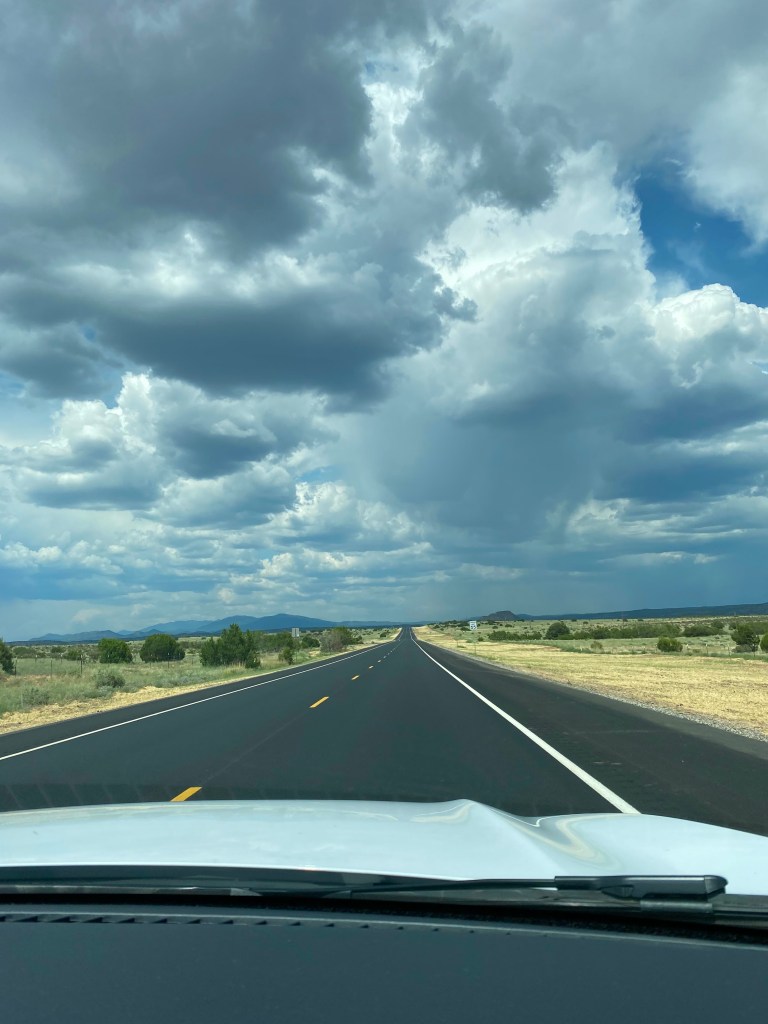
My daughter sends word of rain and more rain in our Vermont world. Meanwhile, on the other side of the continent, visiting my father in New Mexico, we’re amazed by the hues of green. The desert’s rainy this year, too. In the afternoon, I work outside while a storm blows in. In New Mexico’s wide skies, sooty clouds may lower and threaten and yield not a drop of water, blowing elsewhere, breaking or not.

In this quiet, edge-of-the-greenbelt place, news comes to us, the President now ill, an election teetering any which way. We do the everyday familiar things — drink coffee and eat dinner, play cards, talk about my mother’s recent death, about each one of us. After dark, the two girls and I stand outside in the dark in the cool rain, breathing in that ineffably sweet fragrance of the rain-damp desert. Wind shakes the junipers. Here, at fifty, I seem to be carrying a goblet of my life, the wind in the junipers one of the very first sounds I remember as a little girl, so many trips crisscross between Vermont and the desert, the enthusiasm of these young women with me who have seen so much of this world already, so eager they are for more, more of life. Later, when the girls are whispering and laughing in bed, the rain falling, the breeze blowing through the window, I feel that endless ancient desert around me, the calling coyotes, dwarfing for this moment even our human chaos.