After Midnight

Rain falls in the night. The cats press at the window screen, curious, wakeful in their quiet way.

In this post-midnight hour, I close my library book about Trump and deceit — how language is both truth and weapon. From the stack of books donated to my library, I pull a collection of essays.

While the rain continues to fall lightly — and I think of my thirsty garden drinking, drinking, the trees with their copious roots and the innumerable blades of grass — a domestic black-and-white-and-coffee-colored tiger curls at my feet while I read about a liver transplant.

We are made of the dust of old stars, our grade-school teacher told us; we are made of lives and sediment and the mulch of life. But I was also made of something rescued from the graveyard…. you can’t quite forget the how it felt to lie in the close darkness of that grave; you can’t forget the acrid smell of the earth or the stink of the moldering grave clothes, especially now that you know, as you never did before, that you’re headed back to the grave again, as is everyone, and you know this with a clarity you cherish and despise.

— Richard McCann, The Resurrectionist

IMG_2832.jpg


Antidote

A photograph of my daughter and her friend is on a Good Citizen poster.

What the heck does that mean, she asks? Who’s a good citizen?

I drag up my standard answers: that history matters, that good fortune doesn’t equate with good character, that our actions affect others, whether we see — or want to see — this or not.

Later, I realize I should add this in: read and write poetry.

Poems build our capacity for imaginative thinking, create a tolerance for ambiguity, and foster an appreciation for the role of the unknown in human life. From such compact structures of language, from so few poems, so much can be reinforced that is currently at risk in our culture.

— Tony Hoagland, Twenty Poems That Could Save America

IMG_2241


Constellations

11 at night, I’m at the high school, waiting for my daughter to return from a band/amusement park trip. The sun set hours ago, and I grab an extra sweater on the way out. It’s cold, cold enough I’m surprised I don’t see a ghostly cloud of my breath.

I get out of my car and hurry down the steep hill to the soccer field. Away from the lights in the school’s parking lot, the constellations appear, this silent beauty. I walk all the way around the field, to the far end where the woods begin. These fields, one of the most well-used places in Hardwick, are empty. On the rise of land above, I see moving car lights as parents pull in.

If the grass weren’t drenched with cold dew, I’d lie down. I remember being 19-years-old, the first year I lived in Vermont, and hiking in the middle of the night with a friend to a field. Rural Vermont, there were no human lights surrounding us at all. It was November and quite cold, but we were well-dressed and very young, and we lay down in the field and talked and talked.

I could feel the universe’s energy come up through the not-yet-frozen black earth, through the glacial pebble and tangled root, through my vertebrae and flesh, all the way up to the countless stars overhead.

IMG_8426.jpg

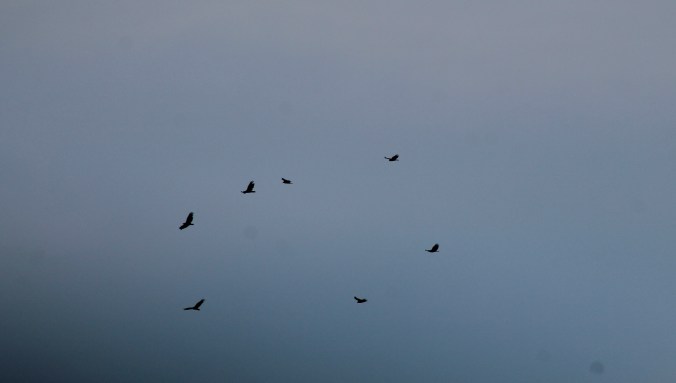
Vultures/by Molly S.

Journeys, More Journeys

Near the end of the last century — which really wasn’t all that long ago — my then-boyfriend and I spent a lot of time driving around the country. We were so young, and time seemed like an endless well we might draw from forever.

The other night, driving to the airport in the descending dusk, I remembered blood-red sunsets as we made our way across the midwest.

I think of the decades of my pre-children life as two-dimensional, although I know that’s not true. But when I became a mother, my own life grew, too, in ways I had never imagined.

In Burlington, I looked for a cup of coffee, but in that end of the city nothing was open but a Shell station where I saw a man bent over, mopping the floor. I stood in the new spring warmth and didn’t go in.

At the airport, two taxi drivers were laughing outside, talking in an accent I couldn’t recognize. Inside, it was just myself for a while, leaning against a wall and reading, and then slowly the airport filled up. Neighbors unexpectedly met each other, and I heard the update about a maple tree, blown over in a recent thunderstorm.

Then from that infinite night sky, my two daughters appeared, one tanned and one sunburnt, bursting with stories of their journey.

The only journey is the one within.

— Rilke

IMG_20180506_135507133.JPG

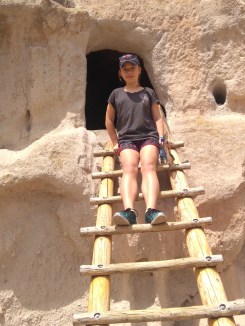
Frijoles Canyon, New Mexico

Metaphors

The front of our house has two small glassed-in porches, one on the first floor and one on the second. Since the windows are single-paned, we closed them off for the winter, leaving them as darn cold storage.

Our last house reminded me of a clipper ship, especially under the stars at night, with its tall and windowed cupola. This house, instead, on a hill, reminds me a lighthouse, its windows a beacon we can see all the way down into town.

The cats are happy to have the doors open to other rooms, coffee and laptop a portable office.

Aristotle, on the other hand, saw poetry as having a positive value: “It is a great thing, indeed, to make proper use of the poetic forms, . . . But the greatest thing by far is to be a master of metaphor” (Poetics 1459a); “ordinary words convey only what we know already; it is from metaphor that we can best get hold of something fresh.” (Rhetoric 1410b)

— George Lakoff, from Metaphors We Live By

IMG_1776

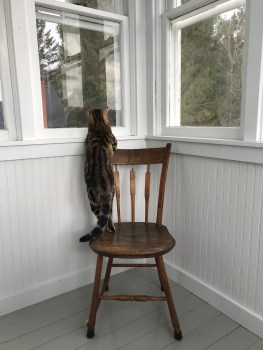
Acer on chair courtesy of Ben Hewitt

This Old Book

Walking with my friend through town, we find a cache of free, reeking-of-basement-mold books — a strange collection of Zen and psychoanalysis and car repair that might have come from my own  jammed shelves.

I pull out a skinny book with no title on its cover, only a black-and-white photograph of a long-haired girl in a white dress on a pile of rubble. An early edition of Brautigan’s The Pill versus The Springhill Mine Disaster.

For the rest of our walk, I hold the book loosely in one hand, past the the old granite cutting sheds, houses well-tended and houses abandoned, through the wet woods and blossoming bloodroot and a hillside of trout lilies just beginning to open. I keep thinking about my second book I’m finishing now, how I’m lacing together the connections within that story: a stolen jar of farmers market cash, a dead dog, a torn crimson scarf.

That night, reading the book, I discover a bookmark jammed in the book’s pages, from the Bedford, NH, bookstore of my childhood.

In a Cafe

I watched a man in a cafe fold a slice of bread
as if he were folding a birth certificate or looking
at the photograph of a dead lover.


— Richard Brautigan

IMG_1779.jpg