Soul’s Migration.

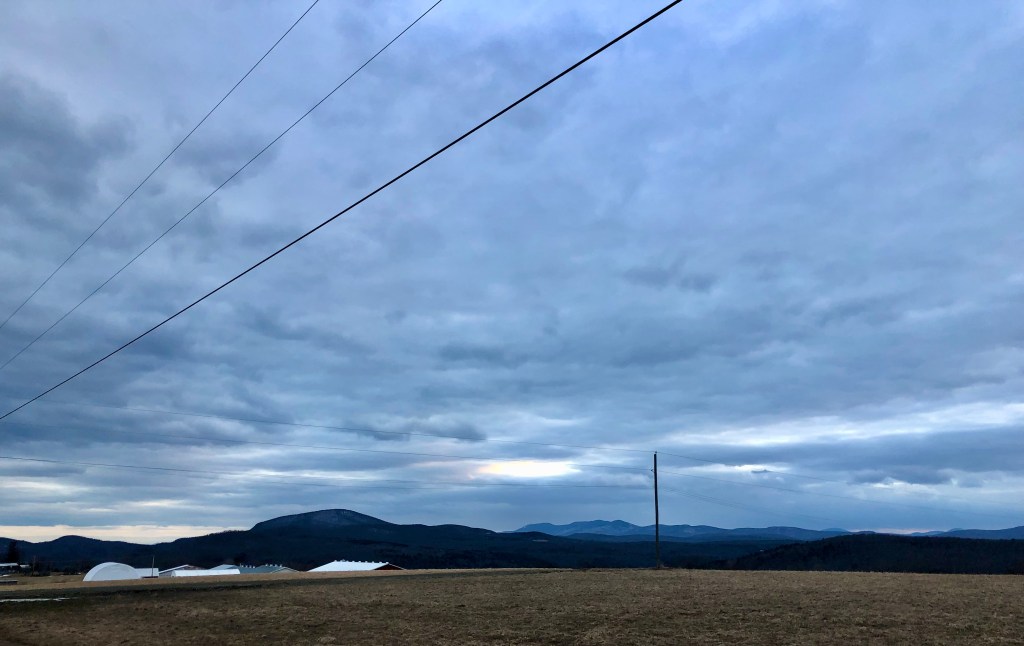
Lake Eligo, Vermont

At the end of the afternoon, I’m out with my skis, insufficiently dressed against the zero degree temps, hoping the movement will warm me even as I caution my youngest every day — bring enough clothes.

I warm.

I ski on the former railroad bed, behind a daycare. Earlier this winter, a new playground was built for the kids, of wood and ramps, and I wonder if some of the federal coronavirus money made its way here. The daycare itself is in the basement of an old building, and so the playground has a kind of bittersweetness, too, a bandaid of a much larger problem.

On the bridge over the river, I pause. Snowmobiles and a groomer have driven through here, and so the skiing is easy. Animal tracks mark the snow down the center of the frozen river. On the bank I ate wild grapes in the late fall. For now, it’s just me and the fresh snow and the sunlight while it lasts, the woodland creatures, the river flowing deep beneath that ice.

Birds migrate and caribou circle the cold top of the world. Perhaps we migrate between love and suffering, making our wounded-joyous cries: alone, then together, alone, then together. Oh praise the soul’s migration.

Mark Nepro

Eh, Winter.

18 below zero this morning.

The cold comes at my face like a knife when I take out the wood stove ashes. The early morning is perfectly still, full of sunlight. This is not the songbird season.

I’ve now lived through a few dozen Vermont Januaries, beginning as a young woman when I spent so many January nights walking around beneath the winter sky, amazed at all those stars in the deep country dark. Januaries of nursing babies, of a long driving commute, of sledding and baking bread, and enduring the beginnings of cabin fever’s madness.

Always, there’s the cold that reminds us immediately of our own fragile mortality and an inevitable thaw. By the end of the month, daylight returns in a rush. In these chopped-up days of uncertainty, I remind myself of these constants.

We forget about the spaciousness
above the clouds

but it’s up there. The sun’s up there too.

~Naomi Shihab Nye

‘Ask Me.’

Twilight drags out again — not a sign of spring by any means but a hopeful sign. The light’s returning to us. After work, I rush through my outside chores, then keep walking and walking. I’ve somehow slightly twinged my knee, and so I walk with the faintest of limps, which amuses my athletic daughter no end. Why wouldn’t your body hurt? she asks me.

We live in such a crazy, mixed-up time. Some of this is just us — a high school student, a grown daughter, four jobs between us, an EMT class, a recently published book and another I’m writing, an absent father, my single motherless — and then a world where the Expected Everydayness is suddenly flipped inside out. The rules have all changed, or at least it’s worth rethinking all the rules.

No phones, ever, at dinner. But then my youngest asks why? and we call my brother. He’s working at his brewery and steps into a quiet place. My daughter and I eat calzones and talk skiing and Covid. We talk bread making. And that is really darn nice.

“’Ask Me’

Some time when the river is ice ask me
mistakes I have made. Ask me whether
what I have done is my life. Others
have come in their slow way into
my thought, and some have tried to help
or to hurt: ask me what difference
their strongest love or hate has made.

I will listen to what you say.
You and I can turn and look
at the silent river and wait. We know
the current is there, hidden; and there
are comings and goings from miles away
that hold the stillness exactly before us.
What the river says, that is what I say.” 

— William Stafford

Onion Skins. Monday Morning.

In Vermont, winter has begun in earnest. My daughters ski in snow-and-freezing rain, then return home to sprawl around the wood stove with hot chocolate and homework. The red tulip bulbs I planted last autumn seem like a dream.

I carry the compost out, and a cold wind rushes over my potato patch.

My daughter makes toast this morning before heading to work in the bitter dark. I remember the winter she was four, and I baked a red velvet cake with her, to brighten our world. Little things, I remind her, are the stuff of our bigger lives. Day by day, towards spring ephemerals.

…. you who want to grasp the heart

Of things, hungry to know where meaning

Lies. Taste what you hold in your hands: onion-juice….

— Suji Kwock Kim, Monologue for an Onion

Stacked Deck.

In the evening, we play cards. For years, I had this inner narrative unspooling, about living on the edge of the wilderness, the cold a near constant companion for a good portion of the year. Now, returning from work to a chilly but not cold house, I remember keenly how that narrative began when I was a young woman, living in an uninsulated apartment, reading about polar expeditions.

The cold, indeed, makes us more alive. Too much cold, however, deadens us, too.

Our deck of cards has a few duplicates — additional sixes and eights and two Jacks of Diamonds. We have another, unpadded deck, but I have a particular fondness for this one that bends the rules and mixes our games in funny ways.

January. My inner narratives keep unwinding. Cold. Kids. Cats. Writing that nourishes my soul.

William Carlos Williams’ lines about this winter month:

Again I reply to the triple winds
running chromatic fifths of derision
outside my window:
                                  Play louder.
You will not succeed.

Math Matters.

Photo by Molly S.

My daughter gets her car inspected, but the mechanic has no inspection stickers. The stickers aren’t here yet, he explains. She texts me this, asking, What am I supposed to do?

Nothing, I answer. The stickers will come in when they come.

That sums up a strand of 2021 — there’s plenty more to this year, oh, boy, is there plenty more — but doing nada is definitely a 2021 strand. I’m not much for new year’s resolutions. I’m a compulsive list writer, and I tend to get a chunk of the stuff right before my eyes done. But there’s rain forecast for New Year’s Day when a deep freeze generally sets in. The world around us is unraveling.

This afternoon, I drove to the high school to pick up a rapid test for my daughter. The health department had taken over the parking lot with orange cones and bright vests. The tests were gone, of course. I talked with the health department employee for a few moments. He raised his hands, palms up, to the twilight settling in.

We commiserated about the strangeness of March weather in late December. Then I drove around him and headed home.

Small stuff. Big stuff. Proportion matters.