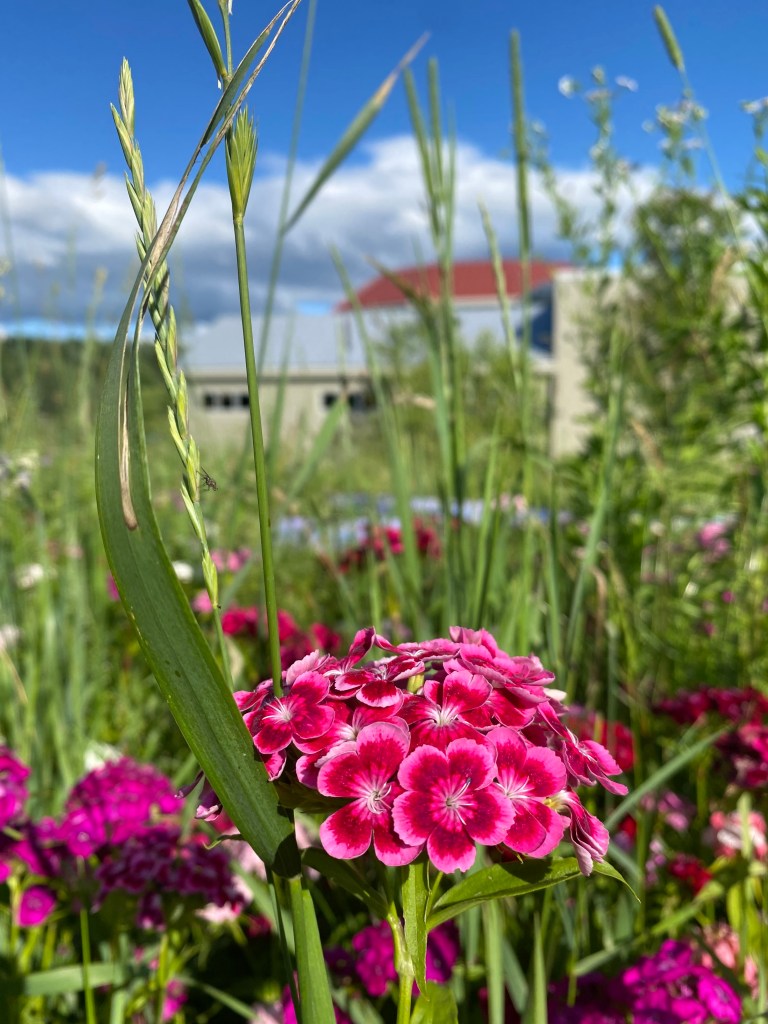
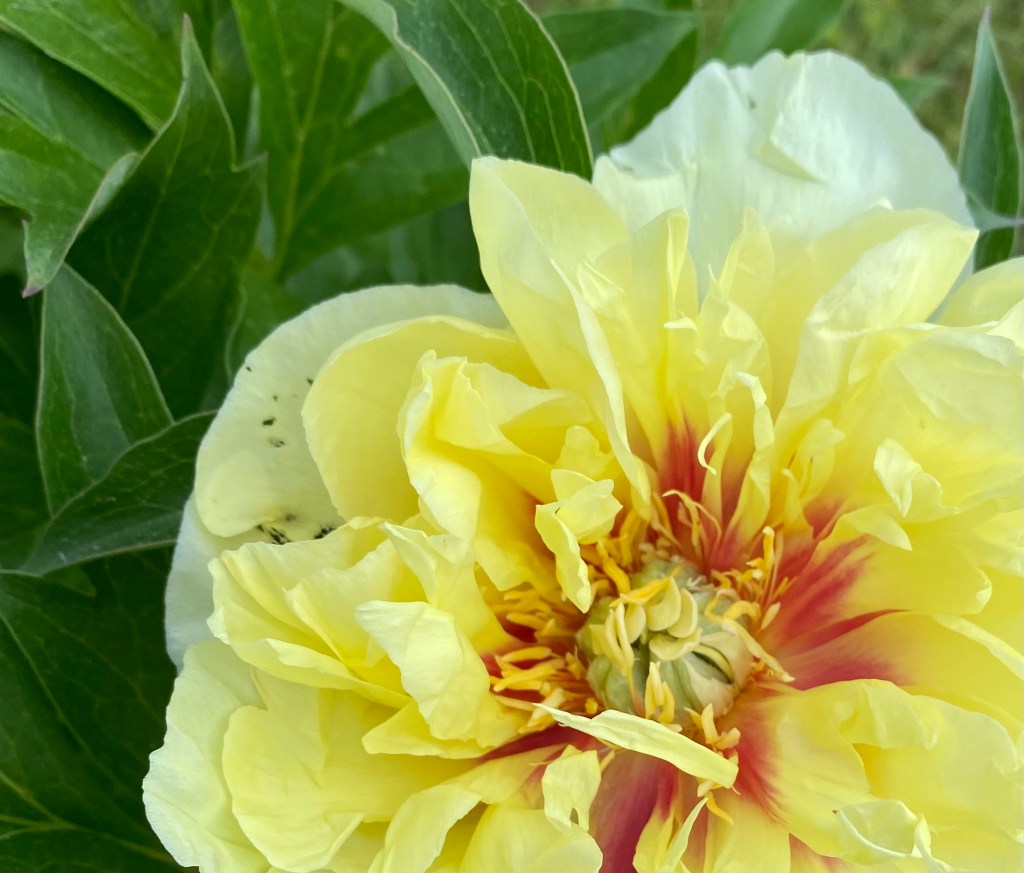
“Dear March—Come in—”

I stand outside eating a cheese sandwich stuffed with a handful of the lettuce I bought for my cat Acer. The trees across the road shake furiously in a wind as if outraged. What’s your complaint, I wonder.

Such a strange winter: a handful of skiing days, no ice skating, the hard cold a distant memory. The yuck of this winter has been the lack of sunlight, the sodden clouds that have lingered from last year’s rainy summer through January’s gloom. We kvetch. My own antidote is the early morning, my insistence that writing, that order and beauty, are a transformative might. There’s nothing new in that approach; it’s the ancient path of seeking luminosity, of Rumi’s words that the wound is where the light comes in.

In March, of course, sudden sunlight in your living room is apt to reveal the dirty cat hair clusters balled beneath your couch, the cobwebs trailing from the ceiling corner, drenched in dust. Make of it what you will.

Oh March, my long-time friend, giver of fine weather, betrayer with your miserable cold snowstorms. In the lengthening days, the sun returns like a long-ago lover. My friend the sun and I take long walks, my sunny friend whispering in my ear that brighter lovelier days are already here.

A few lines from Emily Dickinson:

Dear March—Come in—
How glad I am—
I hoped for you before—
Put down your Hat—
You must have walked—
How out of Breath you are—
Dear March, how are you, and the Rest—
Did you leave Nature well—
Oh March, Come right upstairs with me—
I have so much to tell—

Vermont’s fifth season: mud.

I carry my laptop out the backdoor of Hardwick’s coffee shop. A couple I know pulls up on their fat tire bikes and rave about the biking. There’s an adage in Vermont that the state’s fifth season is mud season. The first week of March is way early for the back roads to break up. Most towns post their roads around March 15, prohibiting heavy trucks, like log or delivery trucks, from destroying already soft roads. Now, towns have already posted these warnings, ribboned with orange survey tape, a sure sign that winter is on the wane.

I meet a friend at a former golf course now owned by the city of Montpelier where people let their dogs run. The course is last year’s brown grass, but when I squint I can see emerging green beginning shimmer, pushing back the dull amber. How much the world leans into living.

My oldest daughter calls from New Mexico, on her journey to visit the grandparents. Through our phones, her face glows with desert light. I think of her driving around Santa Fe, this old adobe city and the stunning landscape an infinitely complex story that stretches so far back. Within that human history, my own family story lodges in with its numerous plot points. Ah, family… never a straight line.

T. S. Eliot wrote of that April is the cruellest month, breeding/Lilacs out of the dead land, mixing/Memory and desire, stirring/Dull roots with spring rain. Winter kept us warm… Mud season may be the least loved. But in my mind, it’s the sweetest. Sap runs. The softening ground sucks our boots into its stickiness. Tender green unfurls, strengthens. We move, onward.

March 1: Cabin Fever, the Impossibility of Spring.

March: a day of singing chickadees, mushy ice, all the little paths running with thaw, twinkling in the sunlight with the promise of what I cheerily call early spring! The next morning, the temperature pegs itself solidly at 15 degrees and refuses to budge. I walk down to the post office, the wind scraping my cheeks. What grit of sandpaper is this? 80? 60?

Vermont late winter/spring is the season of vehement vacillating, of freeze and melt, sun, snow, rain. It’s the season of cold hands, flushed cheeks.

Late into the night I lie on the floor reading Leslie Jamison: “It’s what fairy tales have been trying to tell us for centuries. Don’t be afraid of never getting what you want. Be afraid of what you’ll do with it.”

March: the lurching season of cabin fever, of Where are those crocuses, anyway? Will flowers ever bloom again? I bake a cheesecake, fill bird feeders, have one, two, three essays picked up by little mags. The waning moon shines up the rutted mud, the dregs of snow. Early morning, the birds are at it, singing for dear life, tugging in spring.

Don’t let your cow get the upper hand, er, hoof…?

Ah, February, the month with the strange “U” that children stumble to spell. Two inches of a sugar snow this morning when I carried out the stove’s ashes, the cardinals whistling the day alive, a buttery full moon charming the evening sky. For the past few weeks, my life has overflowed with the challenges of faraway aging parents, with details mundane and immense, and all very very real. There’s that Tolstoy saying about families unhappy in their own way. Carrying in firewood, I remind myself: families endure the unspeakable in their own particular vernacular, swaddled in the way of all human life.

Sugaring season is hustling into Vermont now. The years I spent sugaring with a husband and two young daughters taught me to strip away the unnecessary, to bend into work when bending is required. It’s a habit I’ve carried to writing, and I’ve managed now to write three books against odds that even now seem not in my favor. But it was single parenting that honed my skills to grasp the nourishing in times of hardness, suck hard the marrow of the real. In a conversation with a young homesteader and poet today, she offers me a line of wisdom so pithy and wise I laugh out loud: Don’t let your milk cow get the upper hand on you. Yeah, think that one over.

Here’s a David Goodman interview with Elizabeth Price, mother of the young Palestinian man Hisham Awartani who was shot with two friends in Burlington, Vermont, last November. The family epitomizes courage, knowledge, and depth of heart — highly recommended.

Travel in Out-of-Everyday Places.

In the quietest hours of the night, driving by the twinkling line of Santa Fe’s lights in the immense desert, a crimson half moon cupped in the firmament like a bowl full of mystery, I have the strange sense of transmogrifying into a Russian novel. Maybe in part because of the Bulgakov novel from my sister crammed in my backpack with my laptop and half-written notebook, or maybe it’s my family story unfurling simultaneously at lightspeed and also breath by labored breath.

At the Albuquerque airport, the shuttle bus holds just me and the driver who says he’s from the Chicago suburbs. He remarks that I’m shivering and wonders how that can be, as I’ve told him I’m flying back to Vermont. I’m tell him I’m just tired. Perhaps. But the illuminated city and the airport floodlights and mundane directional signs for United and Alaska Air bedazzle my 3 a.m. eyes: there’s so much of the world, so many people and stories braiding and twisting, from the sweet simplicity of a child cradling a beloved doll to an old woman gasping her way to the end of her life.

The driver asks me about the church scene in Vermont. I rattle off about white steeples in every town. Driving incredibly slowly, he launches into his story of knowing that he wanted to be a better man but kept falling into sin, and then a page in the book of his life turned. I can see this is doubtlessly headed to a pamphlet he wants to hand me. Yet, as he speaks, I wonder what that really means: Knock, and Jesus will open the door.

Later, in the terminal, drinking coffee, I sit in a space crowded with strangers, all on their meaningful journeys. My heart swells full with so many things: the robins singing in my parents’ aspen, last night’s dream of wandering through a sugarbush, forest floor sprinkled with spring beauties, the luminous crimson bowl of the moon in the infinite darkness. Nature never builds a door. Maybe those doors and windows we’re forever using as metaphors are illusions.

The driver had forgotten his bag, so the pamphlet was a no go. I take his words and tuck the sliver of his story into my writer’s mind with the hard-boiled egg I’d split down the middle and shared with a young woman yesterday morning. While we ate, she told me about her son’s heart surgery, and the surgeons who saved the boy’s life. With my fingers, I sweep the eggshells into a pile on the plate we’ve shared.

Complex People.

I was on a Claire Dederer reading jag, stepping into her island home, soaking up her kids and her questions and her fierce writing. Witty, smart, edgy. Which led to me to the father of those children and his books. 

Bruce Barcott writes in The Last Flight of the Scarlet Macaw:

 “… a good portion of my life I believed that a law of benevolent action held sway in the world. This law maintained that if you did the right thing and worked hard, eventually things would work out; that the world generally tended towards fairness, decency, and wisdom. But of course the world doesn’t work that way. The people who learn that lesson through crushing experience and still refuse to bow to it astound me. They go on fighting, again and again and again. These people aren’t perfect. They aren’t simple heroes. They are complex human beings. And we need them. Because without them the world would be lost.”