Bone Marrow.

The co-op cashier confides to me as she rings up my tomato and a loaf of bread that she loves this weather — brilliant sun interspersed with downpours. “Must be the Irish in me.”

The past few weeks have been a kind of July bonus: great growth in early June. My apple trees brushed out. I’ve placed an old desk and weathered chair on my covered porch. Recently, carrying out my laptop, I saw the desk sprinkled with gold pollen as if magic had swept through in the night. What luck, I thought, sat down and sneezed, worked.

I am of the wary bent, not to crow, don’t reveal a royal flush, a full house, for god’s sake don’t invite in bad fortune. At the little farmstand around Woodbury Lake, I park and walk behind the dilapidated barn towards the greenhouses, in search of a few more flowers for my garden, to fatten out the echinacea the groundhogs ate last year. In the tiny house, a dog barks. The farmer steps out and calls to me, my former library patron. He sings, “I’m saying it! I’m loving this.”

His words, not mine. Mine are this: in this northern realm, take in the sun and the green, store these gems in your marrow.

Don’t confuse hunger with greed.

At breakfast, I mention to my daughter that June 6, today, is D-Day. I’ll write what perhaps she would not want me to write: that she’s standing at the counter making avocado toast and drinking yesterday’s cold coffee. She pours sriracha over the cut avocado. She’s 19, and, lord, a sheer miracle of youth, this gorgeous young woman.

I say, The soldiers were your age. Younger.

We stand staring at each other in our small kitchen of June sunlight. On our table lies a pile of unopened mail, our tabby cat Acer grooming his whiskers, car keys and lip balm, a hunting knife that could extract a man’s heart.

In the evening, I’m at the local arts center to see Nora Jacobson‘s documentary about poet Ruth Stone. The evening is still light when I drive home. I take the long way and pull over beside a field to admire the ragged robin, its pink spreading where the dandelions have gone to seed and green. In my Subaru, it’s me and that box of my mother’s ashes. I once knew a woman who kept her stepfather’s ashes for three years in a Datsun. Impossible, I thought. Now, I think, Sure, possible.

A day of such historical might, such profound sorrow. Yet, our own domestic dramas, the kitchen table stories: how real and meaningful these are, too. As a woman, as a writer, I’ve been thinking for weeks about Ruth Stone’s admonition: “Don’t confuse hunger with greed;/And don’t wait until you are dead.” In my garden, I grab a branch of lilac – the goregous white double blossoms, withering with rot – and breathe in the sweet fragrance.

There is only the wearing away,

The changing of means.

From Ruth Stone’s “Speculation”

Unfathomable fortune.

In the late afternoon, I listen to public radio and move firewood from the outside stacks into the barn, where it will dry again all summer until the autumn nights when I gather my kindling and birchbark. On Monday, the wood delivery guy will come again, with a load of green wood to dry all summer in the open air. Lord, I think as I stack, let the sun shine this summer.

When my daughter appears, I pull off my leather gloves, and we sit on the steps, talking about the Trump verdict. A hummingbird darts between us, onyx and ruby. Later, I’m driving north in the narrow Black River valley to hear GennaRose Nethercott read in the gorgeous old East Craftsbury church. In the parking lot, I join a few friends, talking talking about the verdict, another of these moments with a historic tinge. Crows peck in the farm field behind the church freshly harrowed up. The end-of-May evening is rich with a mixture of cow manure and lilac. Vermont loveliness.

19 years ago, my youngest was born. She fit perfectly in my arm, snuggled from my elbow to fingertips. I kept thinking, How is this possible?

A few days after she was born, the season’s first nubs of corn emerged through farm fields. To bring this child into the world, I had been cut and sewn by strangers. Here we were, our tiny family, a few days later, passing these fields on our way home from the hospital, me marveling at the season already passing from spring into summer, this six-pound baby miraculously given to us. 19 years later, when I return home in the dusky evening, we drink tea and eat almonds, talking talking, this great big world crammed full with so many things…. Enough said. For this day, our immense unfathomable luck.

Garden, fence, lilacs, vultures.

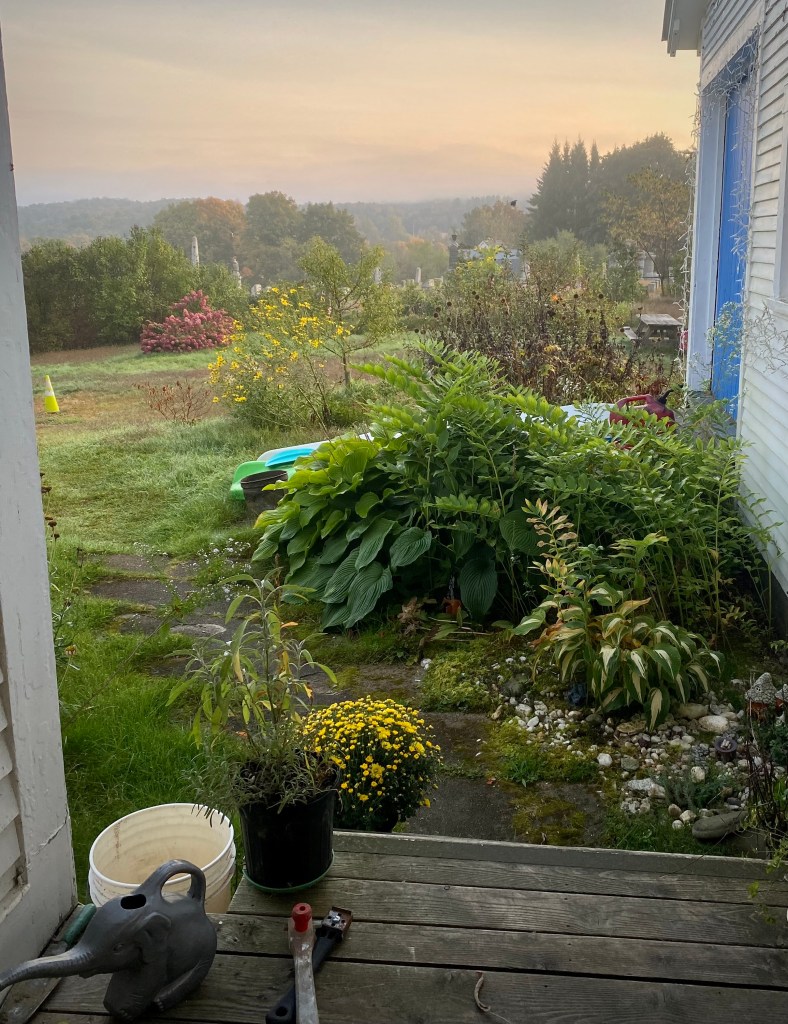
Last spring, a late frost ate the lilacs, death-knelled a young apple tree. Not so, this year. All morning, I work on the back porch, the pollen sifting over my keyboard and laptop screen, the scent of lilacs surrounding our house. May is the brand-new season of pea shoots and asparagus, of peony buds and bleeding hearts.

In the late afternoon, my daughter finds me in garden and salvages the fence from bedstraw and witchgrass. Our garden abuts a town cemetery, fenced by metal and lilacs. On this holiday weekend, the cemetery is busy. As we work, talking, we spy folks wandering through, some tending graves, others gathering handfuls of lilacs or wandering about some other business.

I’m at the early summer gardening place of great good cheer: so much is possible this year. My daughter — a grownup now, but a young grownup — works easily and happily. We’ll share dinner soon, feed our two tabbies, and my daughter will disappear with friends and her swimming suit. I’ll walk into the cemetery and, lured by the scent of lilacs, keep on for a bit. The turkey vultures, maybe a few dozen, will circle low over my head. Then eventually I’ll head down to the village, and the birds and I will part ways.

In these early summer days, I think about my mother all the time. I live in a house that she visited only once. I live a life she did not understand at all. And yet, as I scissor bouquets of lilacs to bring to a friend, as I stand barefoot in my garden deciding to sow sunflowers here, plant basil there, I know these are things my mother loved keenly: the lushness of blossoms, the vim to create a garden.

Heart Runneth Over…

The Gihon River runs through the Vermont Studio Center campus, turning as a river does just out my studio window. All day long, the mallards do their duck thing, swimming up and downstream. In the wild honeysuckle’s tiny bits of green leaves, cardinals perch.

In this week I’ve spent at the Vermont Studio Center, I’ve leaned with a ferocity and joy into writing. A week to write, unfettered by the everydayness of commerce and cooking, of checking the car oil, adhering to those endless lists of can the house insurance get a lower premium, and am I ever going to paint the back side of my house? A thousand things comprise a life — some stupidly trivial like repairing a kitchen cabinet knob, some sacredly profound, like mourning a parent’s passing. 

Does writing, does sculpture, printmaking, poetry, make the world a finer place? The jury’s out perhaps, but art certainly unites the finer parts of who we are as humans, and makes this life more bearable.

Thank you again for reading.

The Bardo.

A few years ago, I bought a stick of a forsythia plant. The plant had withered in a nursery which hadn’t cared much for this plant, one of the three or four remaining perennials at the season’s end. For years, I had wanted to plant a forsythia with its cheery early-spring blooms, but I stood there and considered. The plant was about ten dollars. I eventually opened my wallet and took the admittedly meager risk.

The plant thrived. A few years later, I sold that house, dug up the forsythia, and carried the pot in the back of a friend’s pickup to my new house. The plant grew but never thrived, more stick and leaf than bloom.

This year, however, seven years into our life here, the blooms are abundant. I am not a Buddhist, not trained or schooled in any formal education at all, but here’s a thing. For a period of time after each of my daughters was born, I lived in a rarefied space, not of the common everyday world, but exposed and tender, as if the sky had opened up. I had labored to carry a six-pound baby into this mortal world. I had a foot in this world, and a foot still lingering in a gauzy undefined realm. But each day of nursing and crying, of meals of roast chicken and buttered toast, bricked up that entrance, planted me securely in this world again.

So, on the other end of mortality, I see my mother lingering yet with us, in profound and complicated manifestations, in the four of us — her husband and three children — and her four grandchildren as she drifts into her new realm.

In the house where I grew up, my mother and her neighbor bickered over ownership of an enormous forsythia that straddled their property line. As I walk around, planting and watering a lilac tree, stacking firewood, raking, I’m tugged to these delicate gold petals, so brief, such a long struggle, so miraculously splendid.

Darkness overtakes us on our way 

in my lodging the roof leaks 

weeping cherries in flower 

— Buson