Finding Jesus with the star sunglasses…

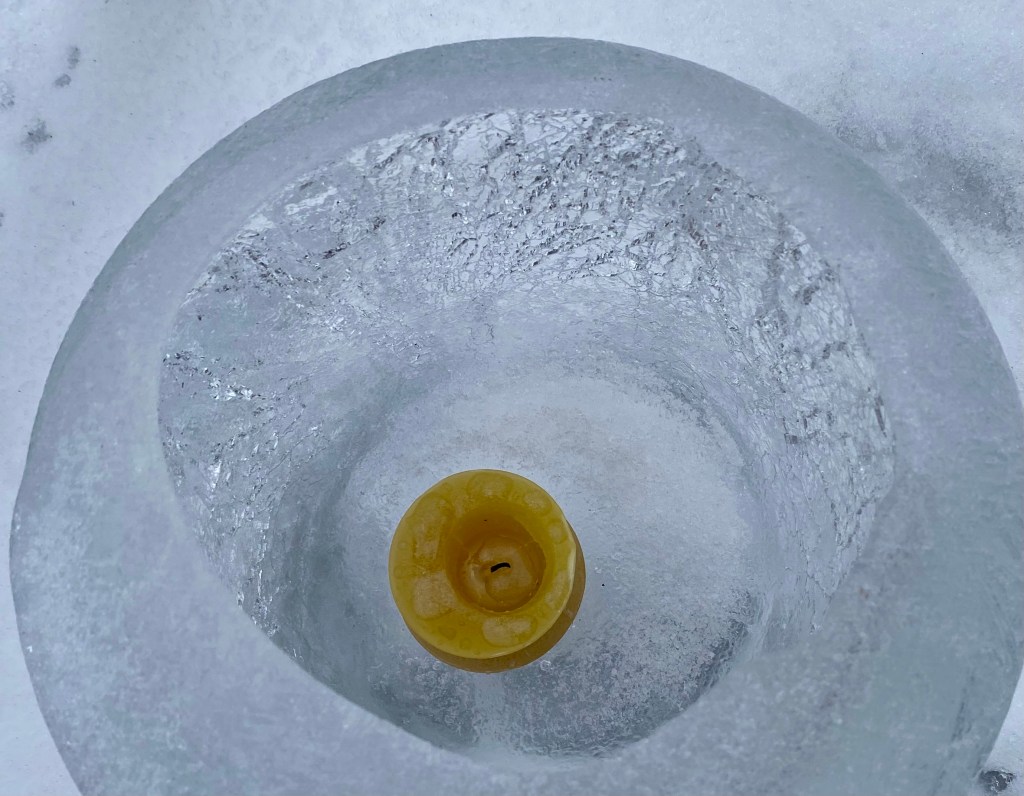
Home again and somewhat shocked to see an ice floe leering off my back roof, not exactly the size of A23a Iceberg, but approximating it….

I’m under strict orders to drink broth, eat saltines, lie on the couch and read — the last two I’ve been perfecting for months now. As for the rest of the order (this is the only thing you should be doing, Brett), I’ve been quietly breaking rules for years. Now, intimate with cancer and my mortality, I push myself to obey the orders, stick with the plan, follow the course precisely.

The winter thaws. The iceberg chips, shifts. I step outside and lean against my house in my down jacket that is now limp and beaten down, a sad thing that, this quarantined winter, I’ve used so little. How will my thousand words a day fit into these orders? A grant deadline looms. When will I put on my clean shoes and that linen sweater I knitted and return to work? A cardinal perches on the railing.

In those 48 hours I spent in the Dartmouth ER, in a beige isolation room, an upbeat nurse with amazing eyelashes occasionally stopped in to cheer me and whoever of my daughters was there. On the TV, which we never turned on, she pointed out a tiny orange plastic duck, and told us someone had placed small figurines all over the hospital. “I found Jesus,” she said. “I know that’s weird, to go around a hospital saying I’ve found the Man, but really…” She reached in her pocket and pulled out an inch-high plastic Jesus in a long robe, black curls, gold star sunglasses. He smiled so widely his teeth gleamed.

In that same room, I spied a second duck, brought the ducks home with me and lined them up on the bathroom mirror beside the wooden blue elephant from the Metropolitan Museum my daughter gave me. Two tiny things that arrived in my pocket, after a week of manifold things, after months of many manifold more. All day, it will rain, the warmth softening that iceberg on my roof, falling on the deck and breaking the wood, or not. If it’s broken, we’ll repair it this summer. If not, we’ll move on to the next thing.

And utterly seasonally inappropriate, here’s a Galway Kinnell poem I’ve been loving:

Blackberry Eating

I love to go out in late September
among the fat, overripe, icy, black blackberries
to eat blackberries for breakfast,
the stalks very prickly, a penalty
they earn for knowing the black art
of blackberry-making; and as I stand among them
lifting the stalks to my mouth, the ripest berries
fall almost unbidden to my tongue,
as words sometimes do, certain peculiar words
like strengths or squinched,
many-lettered, one-syllabled lumps,
which I squeeze, squinch open, and splurge well
in the silent, startled, icy, black language
of blackberry-eating in late September.
“You ask the sea, what can you promise me…”

About 17 years ago – in what doesn’t at all seem like another lifetime but part of these continuous decades I’m living, I walked in the dark from our sugarhouse to our house with my two children. Having worked all day, I’d received a reprieve from sugaring and carried up the dinner chili pot and dirty bowls and spoons. March, the nights are always cold, although sometimes a balmy breeze stirs up as a teasing promise of spring.

I threw the kids’ soaked snowsuits in the washing machine (in those days, the washing machine was always churning) and banked the wood stove. I was knitting something from yellow yarn. What this was – a child’s cap, a gift pair of mittens – I can no longer remember. But I remember reading Maurice Sendak’s Chicken Noodle Soup with Rice to my five-year-old, who slept beside me, profoundly as a child sleeps, her cheeks flushed rosy from a day outdoors. In these hours of making syrup, the children had brought in the mail from the driveway box.

The house was warm after hours in the unheated sugarhouse and also cold, since no one had fed the fire all day. I opened The New Yorker and read “March” by Louise Glück, a poem I probably quote every March in this blog. 17 years later, I’m still reading this poem, even as that kindergartener is now a college sophomore. There’s that cliché, in like a lamb, out like a lion, but March is often lion and lamb, all the time. Now, 17 years later, less impatient with spring’s maddening dawdle, I no longer read Maurice Sendak. Yet, unlike the triteness that when the children are grown, they’re flown, our family delves into my disease, digs hard at the stuff of what family means.

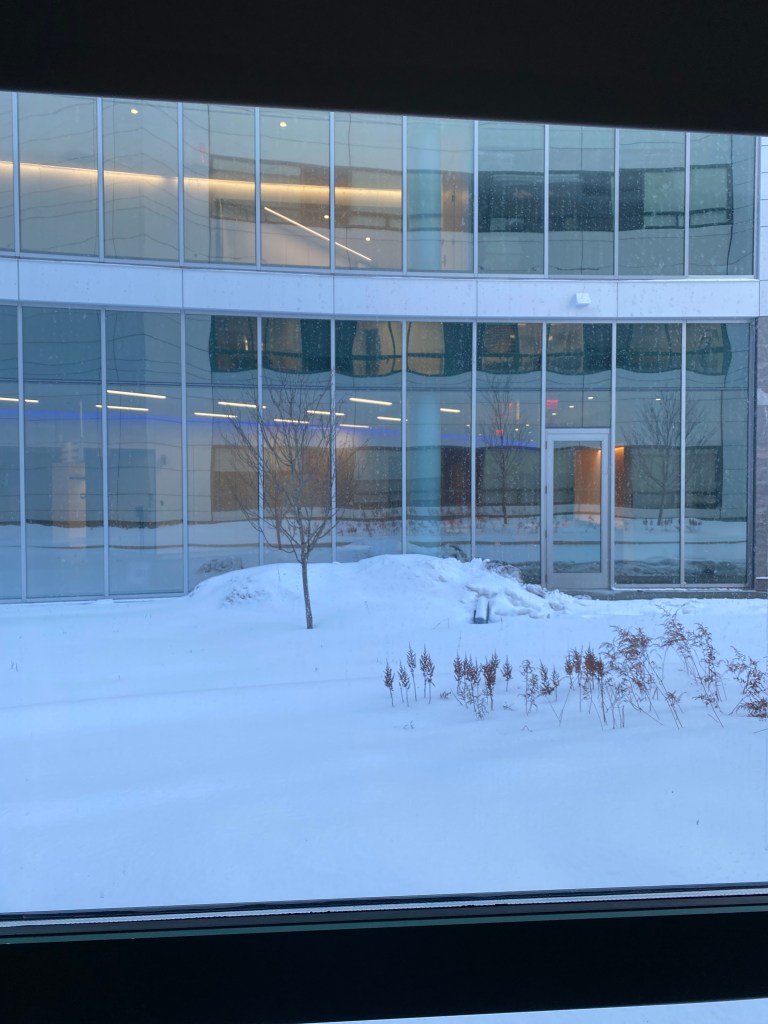
Still at Dartmouth, the nurse muses this morning about nine degree temperatures. March is a brutal tease and may leave more sharply than she arrives. But it’s March. The earth will thaw. The universe ambles along, dragging us, too.

You ask the sea, what can you promise me
and it speaks the truth; it says erasure….


The earth is like a drug now, like a voice from far away,
a lover or master. In the end, you do what the voice tells you.

Survivors.

Friends appear at my kitchen door with a rose and gossip. Midwinter, and I’m happy to keep my cats sprawled belly up before the glowing wood stove. The creatures sleep on the hot metal floor guard, their fur gathering ashes and birch bark curls. The snow bends down my thorny rose bushes. My daughter texts with news of a robin sighting. We talk about the usual — town meeting day approaching, the strangeness of an administration determined to chop apart the country. In Vermont, we do our usual thing: heads together, we strategize how to endure, how to keep our hearts open.

The snow is no fresh news. The unbroken cold (and hardly that awful — I’ve seen 40 below, albeit just once and that was enough 40 below for this lifetime) is no news, either. The sun begins to return, the days spreading out at either end, although the icicles remain icy, dripless daggers.

For me, this winter is the most profound of my life, surely the most sacred. I’ve had my own lovely share of winters with my newborns nestled against my chest, of small children delighted with swirling snowflakes, of long skis through woods. On the night before the Presidential election, an ER doctor gently told me I had cancer. Months later, I’ve immersed myself in the mundaneness of insurance and how to navigate the multi-levered medical system. Beyond that, my life slowed, often to simply enduring an afternoon, a night….

I’m adding to my draft of this post, a day later, now hospitalized again. Let there be no mistaking one of the world’s realities: infection is a mighty (and frequently fatal) force. Now, my daughter and I have this down: fluids and pain meds, with the curve now of puzzling out with the oncologist why I’m back. I contracted Giardia last summer from swimming in unclean water. Although I’ve been treated, the question lingers… has this bizarrely lingered?

But I wanted to return to the beginning of this short piece, about the kindness of friends and strangers. Lymphoma is my disease to bear, my bone marrow and veins and intestines and organs. But now, I — who so long saw myself as a lone running wolf — have been humbled to realize I’ve never been apart from the world, all this time. All around me, strangers and loved ones alike hold me together.

From my friend Jo, who sends me an audio poem every night:

“Survivor”
Adele Kenny

A jay on the fence preaches to a
squirrel. I watch the squirrel quiver,
the way squirrels do – its whole
body flickers. I’m not sure why this
reminds me of when I was five and

something died in our drain spout.
Feather or fur, I watched my father
dig it out, knowing (as a child knows)
how much life matters. I have seen how
easily autumn shakes the yellow leaves,

how winter razes the shoals of heaven.
I have felt love’s thunder and moan, and
had my night on the wild river. I have
heard the cancer diagnosis with my name
in it. I know what mercy is and isn’t.

Morning breaks from sparrows’ wings
(life’s breezy business), and I’m still here,
still in love with the sorrows, the joys –
days like this, measured by memory, the
ticking crickets, the pulse in my wrist.

Picking at the salty remains of roast beef…

Shortly before the November election, I’d heard word of a friend’s illness, and I determined to fly West and see this couple. At that time, I thought I was poisoned by mold and struggling myself, but I really wanted to visit. I decided to hold off buying the ticket for a few days until just after the election, because, well, what if? What if the grid crashed or something? I’ve lost money on airline tickets before.

What happened, instead, is I ended up in the ER the night before the election and discovered the mold was a red herring. I had cancer — although I hold, yet, that the mold was an element of a complicated equation that may, or may not, have added to turning on that cancer gene. By then, flying was impossible for me. Now, news comes to me of her final passage from this life. My friend has lived a long, loving — a good, very good — life, and yet…

All afternoon, another friend and I text back and forth. Remember the nights we ate in their dining room where the walls were painted light blue above a cream headboard? On the wall thermometer, we watched the January temps dip to 20, 21, 25 below zero, laughing at what would be a cold drive home. We never wanted to leave early. Instead, we kept drinking wine, eating chocolate cake, picking at the salty remains of roast beef.

Sorrowful, indeed. We are all now far enough along in life to know that no one dodges the Reaper, that the cut of illness or injury might fall swiftly at any moment. That, in the end, we leave as we entered. While my daughter drove me home the other twilight, I watched the stars ignite in the burnished blue along the horizon, one by one, these ancient untouchable illuminations. She followed the highway home; my eyes fastened on those seed pearls, the slender thread that thickened just the merest width as the night flushed in.

Here’s a line from Niall Williams that, by stroke of coincidence, I read today.

“… you could stop at, not all, but most of the moments of your life, stop for one heartbeat and, no matter what the state of your head or heart, say This is happiness, because of the simple truth that you were alive to say it.”

What the living do.

I’ve written about the strange and often terrifying world of cancer here over the past few months. In the past week, my eyelashes have thinned. At first, my eyelashes looked as though I had walked through a rainstorm. I’m not at all adverse to rain and lousy about remembering a jacket, so I often end up in a deluge. Last July, I explored trails on a friend’s property. Over the past years, she’d designed and cut narrow trails. I walked through what seemed like enchanting forests of moss, stands of cedar so dense the light darkened, around a former beaver pond filled in as swamp, and finally discovered great white pines. She had unearthed pieces of white quartz and marked the edges of the trail. Walking back, rain fell, hard. By the time I reached my Subaru, I was drenched. I wiped my face on a sweater I’d left on the passenger seat. In the rearview mirror, my eyelashes held crystals of raindrops, diminutive pieces of that forest’s quartz.

January, temperature hovering around ten degrees, rainfall is in no immediate forecast.

As an andidote to the national clamor, here’s a few lines poet Marie Howe wrote for her brother from “What the Living Do.”

Johnny, the kitchen sink has been clogged for days, some utensil probably fell down there.
And the Drano won’t work but smells dangerous, and the crusty dishes have piled up

waiting for the plumber I still haven’t called. This is the everyday we spoke of.
It’s winter again: the sky’s a deep, headstrong blue, and the sunlight pours through

the open living-room windows because the heat’s on too high in here and I can’t turn it off.
For weeks now, driving, or dropping a bag of groceries in the street, the bag breaking,

I’ve been thinking: This is what the living do….

Inauguration Eve. Cold. And me, the mad mutterer.

On this Sunday inauguration eve, all day long, intermittently, as I go about the things I do, I’ve been thinking of a Mary Oliver poem. As I’ve written before, a friend has been sending me a poem each day that she reads aloud in her voice as clear as winter wind. Mid-January, Vermont, is the season both of winter settling in for the long haul and, conversely, as life often is, of lengthening days. We seek the merest brightening of the light as proof of spring’s promise. In her recording, my friend mentions seeing the division of seed packets in farm store, solid evidence of spring’s inevitability.

Later, just before twilight filters in, I walk out alone, tromping the short path through the woods and cemetery to the upper edge of the village. A few flakes of snow twirl. Otherwise, no one. My boots crunch over hard, packed snow. My mind is jammed with its usual monologue, when suddenly I realize my euphoria at walking along this wide road, flanked by white pines with broken branches, a single crow winging its way over the snowy Little League field. Yes, yes. I’ve forgotten my mittens, and my hands knotted in my coat pockets throb with cold, and yet I keep chortling like a mad woman, Yes and yes and yes.

Like any writer, I’m quite capable of running wildly with words, but as for the politics and national people, I’ll simply leave Mary Oliver’s words from her poem “Work, Sometimes.”

… What are we sure of?  Happiness isn’t a town on a map,
or an early arrival, or a job well done, but good work
ongoing.  Which is not likely to be the trifling around
with a poem.

Then it began raining hard, and the flowers in the yard
were full of lively fragrance.

You have had days like this, no doubt…. Ah, what a
moment!

As for myself, I swung the door open.  And there was
the wordless, singing world.  And I ran for my life.