Crushed Leaves

A colleague tells me her brother contracted Covid in January. A professional chef, he opened an oven and wondered what was wrong with the meatloaf — it had no smell. He survived after an intense illness.

So this week, I know I’m alive as Vermont autumn is all scent. The after school kids ask me to step into their fort. I lean over the wall built of leaf and vine and breathe in, and I’m eight-years-old again, with my siblings and the neighbor kids, building houses of fallen leaves.

Wood smoke and skunk and the soil I’ve turned over in the garden.

As the daylight shrinks noticeably and we turn more and more indoors, inevitably I look for sources of strength — geese flying low over our back porch, their wings rushing, the rising cream-colored moon, our neighbors’ laughing boys — and my youngest daughter on the cusp of young adulthood, sharing bits of her world in snippets, puzzling over this great big world.

Oh, good gigantic smile o’ the brown old earth,

      This autumn morning!

— Robert Browning

Calais, Vermont

Friday Poem

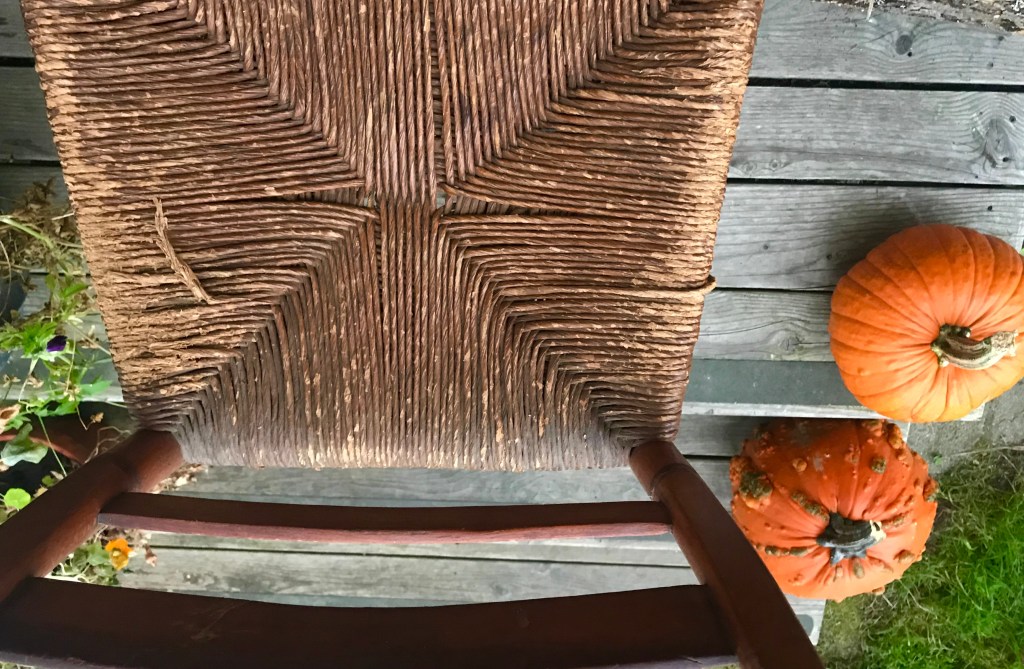
I picked up two chairs in a free pile along a backroad yesterday.

No! my daughters said.

In the evening, playing Yahtzee, our cat Acer begins to gnaw on the chair’s loose strands, which makes the girls laugh hysterically.

Something for everyone in the free pile. That’s where we are in the pandemic world.

I pull out the gray hairs,

And under my pillow,

There is a cricket.

— Basho

Butterflies and Crickets

On a balmy afternoon, I’m on Nature Conservancy Property in Greensboro, Vermont — Barr Hill — the first place my daughters hiked. Nearby lies the glassy blue gem of Lake Caspian.

On my short drive there, I’d been listening to the governor’s twice weekly press conference. By now, like so many people in the state, I’m familiar with Scott’s voice, his cabinet members, and the press. Scott allows the press to ask question after question; these sessions have an interesting kind of intimacy, a we’re going to get through this kind of attitude.

On my way along Barr Hill, I pass rusting old farm equipment in fields where cows are grazing. Here, the past is both near and hidden.

In a field, I paused and admired the view of the mountains and the line of lake. The sky these days is slightly overcast with smoke from the west coast wildfires. Around me, butterflies flew over the blooming goldenrod, and crickets leaped in the dusty path around my feet.

I had such a sense of living in an historic time — the Covid pandemic — and yet I just soaked up that all that sunlight, those tiny flickering wings.

Season Change

My daughter and her friend were been hired for the afternoon to harvest pumpkins.

That afternoon, picking up the girls at the farm, I stood talking for awhile with the couple, whom I’ve known since my oldest daughter was a toddler. They showed me the sunflowers they had managed to save from the frost by covering. The flowers, I could see, were not long for living.

Bundled in sweaters and sweatshirts, we stood talking in the late afternoon sunlight. The couple was appreciative of my daughter and her friend — how the girls’ hard work boosted the boys’ output. I laughed, watching the girls walk towards me, out of the field, holding gloves in their hands, talking with each other.

I remembered those long-ago summer and fall days, when I had worn this child on my back while I sold maple syrup and homemade ice cream. Her little fingers reached over my shoulder, looking for snacks.

The couple’s son drove up on a tractor, a father now himself. As I drove back to our warm house, baking lasagne and apple crisp, I kept thinking of how that couple would give my youngest a tiny pumpkin every year at the farmers’ market. She would carry that orange squash in her two hands, like treasure.

Mid-September?

Three years ago, I sold our house on a back road and moved into the village, for a few reasons, for mostly so my daughter could walk to school. By then, I was a single parent, hustling a livelihood, and I needed my youngest to be able to get herself around. Rural Vermont, for those not in our world, depends on the car or pickup to get yourself around.

In the pandemic world, where I often find myself ticking off what I’m grateful for, as an antidote to the long list of what I’m decidedly not grateful for, that 15-minute walk ranks pretty high up my list.

These days, I’m wondering how this pandemic will shape my daughter’s generation.

A year ago, she was a freshman in high school, with a regular slate of classes and fall soccer games. As a sophomore, she’s more like a college student, grabbing in-person classes instead of online classes, insisting I’m not to interfere; she’s worked out her own schedule.

Study hall on Monday afternoon? I’ve given her permission to walk home with her friends.

So, while she’s hoping her year will be filled with chemistry, anatomy and physiology, trigonometry, Spanish, and French, I see a different kind of education this year. When her father and I divorced, her childhood had a hard line — a Before and an After. Now, across her whole generation, I see a Before and an After.

I’m incredibly curious to see how that unfolds.

The Uses of Sorrow | Mary Oliver

(In my sleep I dreamed this poem)

Someone I loved once gave me
a box full of darkness.

It took me years to understand
that this, too, was a gift.

Hardwick, Vermont

Empty House

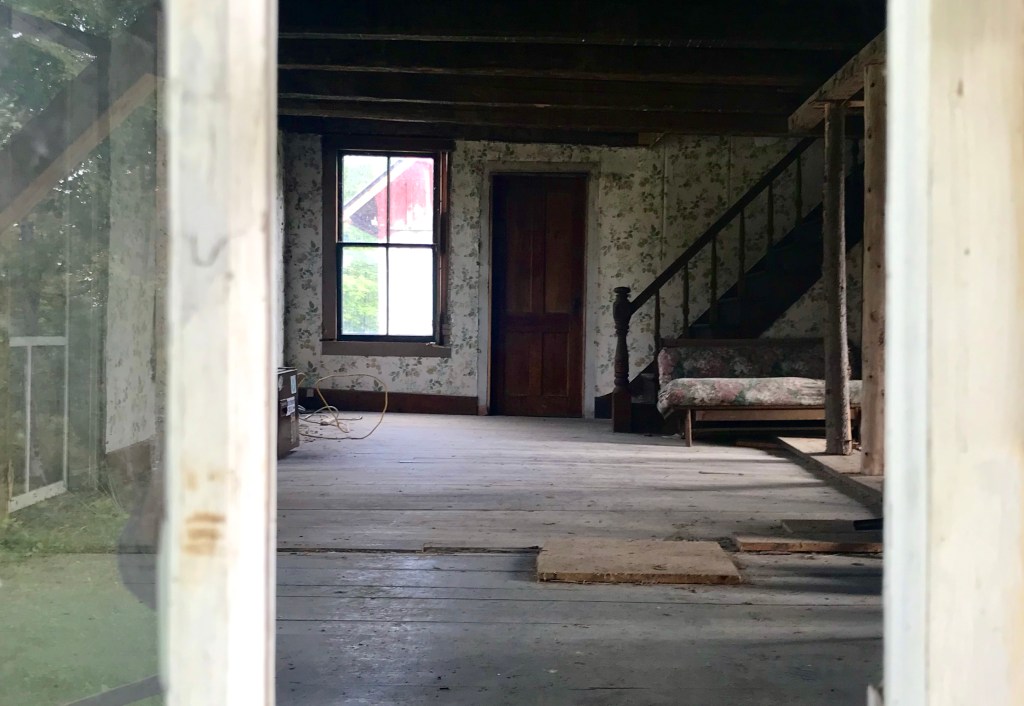
The afternoon’s end finds me on a remote road, looking at an abandoned house. No one’s lived here in a long time, save for intermittent squatters.

It’s the first day of school for my high school sophomore. Although I’m at this property for work, I keep thinking of my daughter.

Behind this house are two immense white pines. I stand there, listening to the breeze rising off Lake Eligo, imagining what it was like a hundred years ago to farm here. What will it be like a hundred years from now? The question looms impossibly.

I bend down and peer through a missing pane of glass in the door.

In Yaa Gyasi’s Transcendent Kingdom, I read a line from Thoreau: “Not till we are lost, in other words not till we have lost the world, do we begin to find ourselves, and realize where we are and the infinite extent of our relations.”

In so many ways, that sums up my experience. But that lostness I know now, is hardly a brief experience. The thing about the pandemic is that it’s exposed all the weaknesses in our society, and in ourselves, too. In my own world, I see acutely how pandemic has highlighted the near impossibility of single parenting, as I find myself these days unmoored, the thinness of my life exposed.

These days, in my work, I’m able to listen to people’s stories about how they’re experiencing the pandemic. These stories are often so much about loss — particularly about families separated — and worry about an uncertain future. Surely, I think, if there’s a time stories connect us, it’s now.

So on this first day of school, with the sweet scent of Vermont’s fall, with so much uncertain, I walk around this abandoned house, thinking of how time flows on. Near the step, I find a tiny plastic pig. Using the hem of my shirt, I rub dirt from the creature, then leave the toy on the broken step, hoping a child will chance upon it.