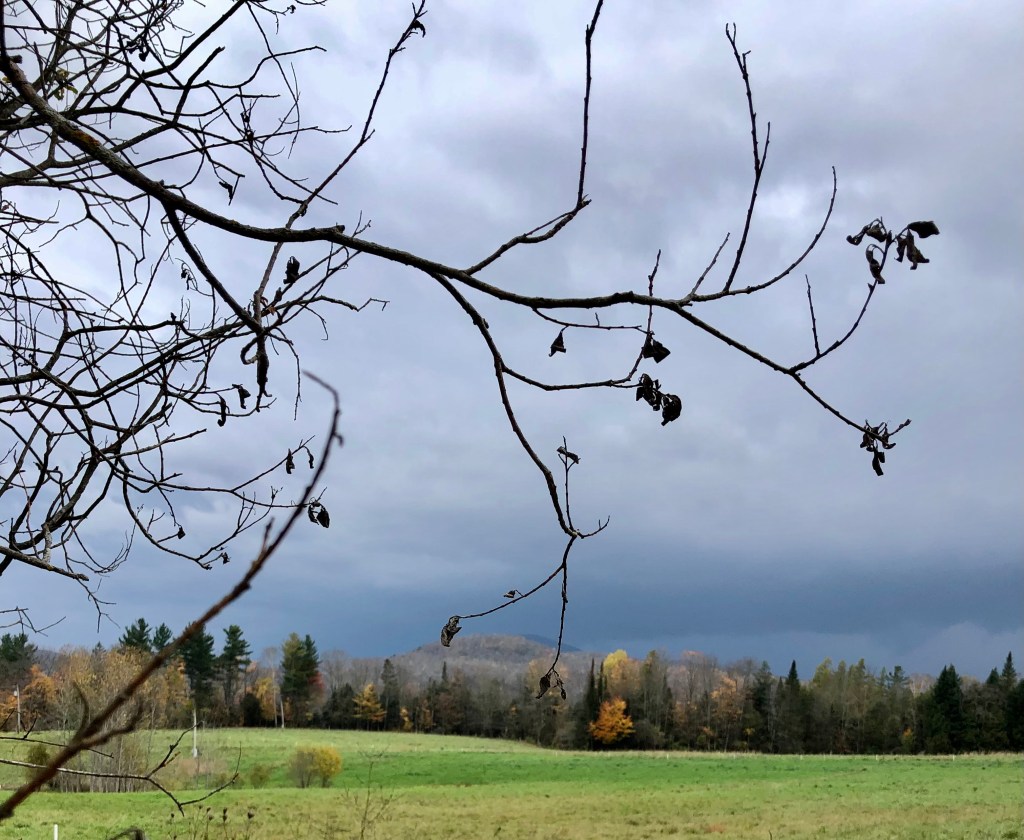
This photo sums up November — little remainders of green, intermittent mud, and a long road ahead. It’s not all bad news, for sure. November twilights are the loveliest — pale blue and blood red.
On Anne Sexton’s birthday, a line from this poet: “Put your ear down close to your soul and listen hard.”
In the dark, we walk downtown and leave letters in the mailbox. Through the valley’s mist, house and streetlights glow. November looms. Poet Thomas Hood described November: “No dawn — no dusk — no proper time of day.”
The news around us is of two, unrelated homicides, neither far from our house, in our rural state with scant violent crime. In the dark, I bring in an armful of wood and pause for a moment. Across the valley, I see a pair of headlights crest a dark hillside and begin a descent, slow to my eyes through the mist.
Through the house windows, I see my daughters before the wood stove, our walls painted butter-yellow. The crickets are gone. Late fall pushes in. Every year, the darkness enfolds us again, inescapable and mysterious.
Late afternoon finds me running along the former railroad bed in a rare kind of October sunlight — a gift of warmth and honeyed autumn light. I stop where I always do, where the transformation from railroad bed to trail hasn’t happened yet. The rusting iron bridge is covered with boards, and I’m careful there.
Where a giant hole gapes with a view of the Lamoille River below, someone has spray painted You Die Here and an arrow pointing down, as if the passerby couldn’t put that hole and a potential demise together. I stand there and affirm, Sure, that would be a bad fall.
An otter runs along the riverbank, slips beneath the water, and surfaces again. Two ducks glide slowly. I crouch at that edge for a good long while, in no particular rush to head back on that trail.
In the end, of course, there’s nothing else to do but tighten my laces. My feet crunch through the fallen leaves that are piling high, releasing that inimitable scent of broken leaf and moist soil — the smell of a New England childhood.
We’re at the point in Vermont’s fall where our world makes me ask, What’s happening? but in the loveliest, most wonderful way. The fall colors are stunningly gorgeous — so much vibrant red, so many shades of gold — the trees silently going about their business. Our hillsides are amazing, but so is each tree an individual marvel.
We’d had rainy day upon rainy day, but the weather looks to be clearing, at least for a short stretch. In New England, heading into later fall, sunlight can be sparse. These handful of days are the time to soak up color and light.
When I stopped on Hardwick’s Main Street to snap this photo yesterday, a man walking by said, “Winter’s not far.”
True, but at the moment, autumn in all her radiance.
I’m so glad I live in a world where there are Octobers.”
Pulling up dead cucumber vines in my September garden, I realize my main crop this year is a forest of sunflowers. In years past, I’ve verged at times into the maniacal side of gardening. This year, however…. this year, as we all know, has simply been this year.
My oldest wanders out to the garden, her head bent to one side, braiding her hair. She’s begun training on the local volunteer ambulance crew, and tonight is her first overnight shift. She tells me she’s going to stay up all night. Why would I sleep?
My garden soil is dry, hot from the sun beneath my bare feet. The fall greens — kale and Brussels sprouts — are interspersed with brown stalks of dill, seeds drying.
Hidden in my forest of flowers, I remember when I was eighteen and left home. One of the first things I did was stay up all night, wandering around outside in the dark with a friend until the sun came up. It was the first time I realized how long a single night can stretch.
She straightens, and I admire her braids. She’s all grown up, heading out into the world to do her own thing and make her own way. Still, I remember her at four in her pink overalls, determined not to sleep then, either. She hurries away, and I stand there, with my dirty hands, watching.
We need enormous pockets, pockets big enough for our families and our friends, and even the people who aren’t on our lists, people we’ve never met but still want to protect. We need pockets for boroughs and for cities, a pocket that could hold the universe.”
A young AmeriCorps worker stops by looking for information about how small town Vermont government works and brings a crabapple pie he baked.
The pie is deep-dish, about the size of a dinner plate. He’s tall and cheerful and tells me about his dog named Mindy. Eventually, I give him a paper map and tell him to drive around town. I highlight one section of the map in yellow. Here, I tell him, is one especially beautiful stretch of dirt road, high above a lake. He’s driving his grandmother’s hand-me-down Toyota Corolla.
Good luck, I say as he leaves.
When he’s gone, a friend stops in, looking for town info, too. The sunlight comes through the windows. I offer her a piece of pie. We talk and talk. She finally says, I feel like I haven’t seen anyone in so long.
The strange thing is, I feel that way, too. We keep eating pie. The young baker has peeled the crabapples, one by one, to sweeten the pie. We eat the whole thing, and then I wash up the plates and forks.



 Stony Soil Vermont