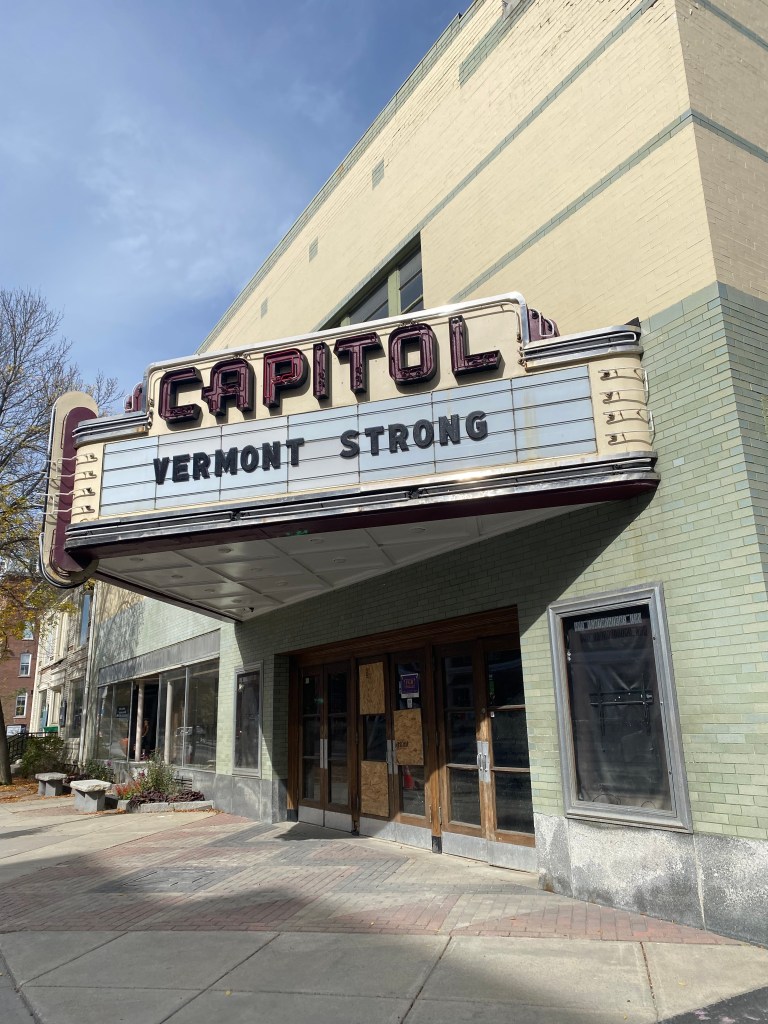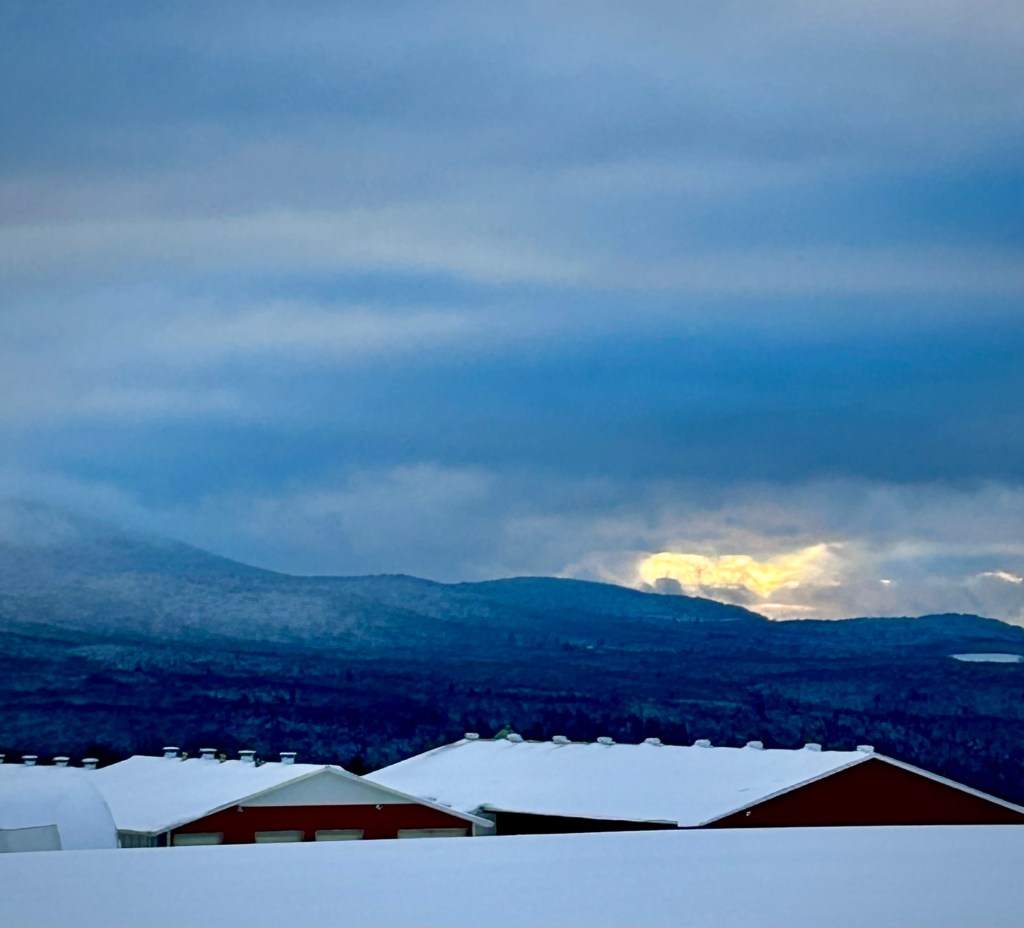
Post-Flood, Montpelier.

As if overnight, the fall foliage has vanished, swept into gray. The secret of Vermont’s autumn is the long lingering twilights, languorous and violet. Branch by branch, the trees are emerging from their summer splendor. Before frost yet, my garden rages on, orange tithonia, candy-colored cosmos, the morning glories that intrepidly vine through sunflowers and tomatoes and borage.

This weekend, I walked through Montpelier. So much of Vermont’s capital remains boarded up after the July flood, in need of money or labor. Other folks have shuttered up and headed elsewhere. It’s impossible to pretend that the world around us isn’t swirling in chaos. Nonetheless, when I come in with my fingers and toes cold, I build a fire. The neighbors string up gold lights. Quickly, quickly, and immensely slowly, the season settles in.

“You must try,
the voice said, to become colder.
I understood at once.
It’s like the bodies of gods: cast in bronze,
braced in stone. Only something heartless
could bear the full weight.” 

— Jane Hirshfield

Stealing Flowers Gone Wild.

Bear Pond Books in Montpelier reopened yesterday, nearly two months after the July flood, beloved bookstore in Vermont’s capital city. “The flood” sounds Biblical, and I’ll note that the Old Testament has never been known as a Hallmark read.

Last fall, I often parked my car behind the town garage so I could run on the rail-trail. On a heap of gravelly slag, a variety of yellow asters blossomed. At the fall’s end, shortly before frost, I brought a bucket and shovel and dug up a clump of stalks. I buried that clump in my garden. The leaves emerged this spring. By then, I had forgotten that re-homing of the yellow aster. Now, the green buds are on the verge of opening.

There’s a submerged theme between the three things in this post that I imagine only I can see— the bookstore and the flood, my stolen flowers, Mary Ruefle’s lines about clouds: the unstoppable force of our planet, immense, immense. Meanwhile, our toiling: the bookstore folks carrying out mud bucket by bucket, me with my shovel and a small handful of what might appears to be merely weeds.

Mary Ruefle:

All that summer there were so many clouds we

didn’t know what to do with them. They overflowed the

sky – they were on our streets, in our homes, in our draw-

ers, and in our cabinets. They were in our cars and on our

buses, I even saw them in taxis. No one had ever seen so

many clouds, to the extent that, as often happens with a

glut, no one could remember a time without them…

From My Private Property

August Gloaming.

The foxes that denned behind our house did not return this year. A neighbor who lives around our hillside shares that she saw a kit earlier this summer, and we speculate that the fox family set up summer quarters nearer her. It’s all speculation, neither here nor there.

Who has returned are the turkey vultures, roosting in the pines between our houses, reliable as the rain this summer.

Mid-August, and the kids are trickling back to school. A friend texts me that her son is headed into his senior college year. I remember when this kid was born. He used to come to our house and stand on a kitchen chair and bake cookies. In this soggiest of summers, still time unspools inexorably. In the evenings, we sit outside and watch the sunset sprawl crimson, the mosquitoes drawing drops of our blood.

The pollinators suck at my small garden’s calendula, gold and orange. A few years back, I sowed a few seeds. Gone wild, the calendula reseeded rampantly, nestling against tomatoes, among cucumber vines. I haven’t the heart or will to pluck a single flower.

It rained for three days straight, a relentless steady rain that kept up its monotonous rhythm day and night, there being no periods of waxing and waning or moments of imperceptible brightening…

— Mary Hays, Learning to Drive

Field of Sunflowers.

In a former garden I tended, I planted elecampane whose yellow blossoms bloomed over my head. The plant spread along the garden’s back edge, a natural fence between the bed where I planted greens and tomatoes and the field where I sowed potatoes. We had reclaimed that stretch of field from the forest, and the sparse soil was hungry for manure and the cover crops we rotated.

Now, in search of elecampane to transplant, I find this flower, the long ragged-edge leaves already fading from this year’s growth, the greenery not particularly lovely. I plant this strange flower before our house.

Flowers have the undeserved rap of girlyness, of flimsy decoration, of false medicine. Not so, not so.

how quiet
the light-blue morning glory —
such good manners

— Issa

“Distrust everything, if you have to…”

As a firm believer in clotheslines and keeping my bills low, we don’t have a clothes dryer.

In past rainy summers, with children in cloth diapers, I spent time in laundromats on Sunday mornings before selling maple syrup at a farmers market.

After a span of rainy days, I eventually break down (again, this no-dryer commitment might be simply stubbornness or gratuitous ego, pushed far beyond rationality) and load two dryers in the Hardwick laundromat. I bring a book and read on the porch of the Inn across the street. Behind the Inn, the Lamoille curves through town. On the river’s other side, a house burned earlier this summer. Now, what remains slides down the bank, piers of a narrow porch first, the back clapboard wall soon to follow.

Unintentionally, I’ve chosen busy Friday afternoon, and the intersection is jammed with traffic and pedestrians. I’m reading about schizophrenia and crime, about madness and civilization, and I keep looking over my shoulder at that empty house and its unanswered question of what’s happening here?

Eventually, I close the book, walk across the street, and fold our clothes warm with the dryer’s heat. Beside me, a little girl and her father study the line of dryers. She’s wearing a dress with bunnies. Seeing me, she pulls out her skirt. “Pink,” she offers.

I nod and answer, “Great-looking rabbit,” and then I head home.

Wait, for now.
Distrust everything, if you have to.
But trust the hours. Haven’t they
carried you everywhere, up to now?

— Galway Kinnell

Four Feet of Mud.

Friday afternoon, when the Fed Ex man drops off a package, I ask what he’s seen on his route, his perception of flood damage and how folks are faring. In places, he says, nearly nothing. In others, houses perch over streams.

This stranger keeps going — and I keep asking questions — about his experience in the national guard, a tour in Iraq, and then a month in New Orleans after Katrina.

We’re back in blistering July, and I’m sweaty and dirty from weeding in the garden. On our sandy hillside, this summer the grass flourishes, a benefit of months of rain. I’ve finally mowed the grass (hardly a top priority these days in our house), and that ineffable and sweetly delicious summer scent of cut grass washes around us.

Our conversation bends back to Vermont and our washed-out valleys, how Hardwick’s Walgreens had four feet of mud. He looks at me and ask how tall I am. It’s true; I’m not that much taller than four feet. For a moment, we stand there, two strangers, contemplating four feet of mud. Then he heads to his truck.

Which pieces of our world will go back together, and which won’t? It’s a metaphor for many of us, perhaps.

All the way I have come

all the way I am going

here in the summer field

— Buson